3M Adhesive Snap Fasteners Explained: How No-Drill Window Shades Actually Hold

Key Takeaways
- EZ-Snap® shades hold with two parts working together: a patented no-drill Cap & Pin snap (U.S. Patent 8,032,994) and 3M VHB structural adhesive tape — the snap is the removable joint, the tape is the foundation.
- 3M VHB reaches initial grab in about 60 seconds per stud and full strength in roughly 72 hours, and applies best around 60°F on clean, dry siding.
- No-drill installation avoids permanent holes, making it ideal for renters, stucco and fiber-cement walls, and RVs where wall penetrations risk leaks.
- The U.S. Department of Energy notes exterior shades are the most effective way to reduce solar heat gain because they block sunlight before it reaches the glass; exterior solar screens can block up to about 90% of solar heat gain.
- EZ-Snap's black Optical Grade Thermo-Weave™ mesh blocks up to 90% of solar heat, cuts to any window shape with scissors, and installs in an afternoon; kits start at $66.95.
There is a small, quiet miracle happening on the back of every EZ-Snap shade panel, and almost nobody thinks about it: a fastener no bigger than a coin is holding back wind, sun, and gravity on the outside of your home without a single hole drilled into the wall. That is the whole trick, and it is worth understanding before you trust it with your siding.
Most people shopping for exterior shade arrive asking a reasonable, slightly nervous question: if there are no screws, what is actually holding this thing up? The honest answer is two technologies working as a pair — a patented mechanical snap and an industrial adhesive from 3M — and once you see how they divide the labor, the "no-drill" promise stops sounding like marketing and starts sounding like engineering.
How do 3M adhesive snap fasteners hold window shades without drilling?
3M adhesive snap fasteners hold no-drill window shades with two parts working together: a patented Cap & Pin snap that mechanically locks the panel on and off, and 3M VHB tape — an industrial double-sided acrylic foam adhesive — that bonds the pins to your wall. No screws, no holes, no drilling required.
What "3M adhesive snap fasteners" actually means
The phrase bundles two parts that do very different jobs. The snap is the mechanical connector — the click that lets you take a panel down for winter and put it back in spring. The 3M adhesive is what marries that snap to your wall. EZ-Snap uses a patented no-drill Cap & Pin fastener, covered by U.S. Patent 8,032,994, a ratchet-style system where a female cap removably locks onto a male pin to secure covers without drilling.5 The pin half is mounted to the building; the cap half is set into the shade fabric. Separate the two and the panel comes off in seconds, leaving the studs in place for next time.
This is the distinction worth internalizing when you read about How EZ-Snap Works: the snap is the joinery, the tape is the foundation. Confuse the two and the system sounds flimsy. Understand them and it sounds, correctly, like a fastener designed to be installed and re-installed for years.
The 3M VHB tape doing the heavy lifting
The reason these no drill snap fasteners work is 3M VHB — Very High Bond — a double-sided acrylic foam tape engineered to replace rivets and screws in structural assembly. It is not the stuff on the back of a poster. VHB conforms to surface texture and then, over time, the bond chemically builds until the tape behaves less like an adhesive and more like a weld you can't see.
Three numbers matter for a clean install, and all three are about patience:
- ~60 seconds per stud. Press a pin firmly for about a minute and the tape achieves its initial grab — enough to hold position while you work down the window.
- ~72 hours to full strength. The bond keeps curing for roughly three days. Hang the panels, but don't go stress-testing them on day one.
- ~60°F to apply. Acrylic adhesives wet out properly in warm conditions. Below that, the tape is sluggish, so a mild-weather afternoon is your friend — and if you have no choice but to mount in the cold, it's worth understanding the 60°F / 72-hour cure window before you start.
Surface prep is the part people skip and later regret when a snap walks loose. Clean, dry, oil-free siding is non-negotiable; the tape bonds to what's there, so if what's there is a film of dust or old wax, that's your real bond line. If you're unsure whether your conditions are right, an honest read on when the VHB will and won't hold is worth a few minutes. Done right, these 3M VHB snap studs hold the same panels through summer sun and the first cold snaps without a fastener walking loose.
No screws, no holes, no patching in the spring — the wall you started with is the wall you end with.
Why no-drill is the point, not a compromise
It would be easy to assume drilling is "stronger" and adhesive is the budget shortcut. For exterior shade, the opposite logic applies. Every screw hole is a future leak path and a permanent commitment; adhesive snap fasteners for fabric shade systems give you the strength without the scars. That matters most for renters, for stucco and fiber-cement owners who dread patching, and for anyone running shades on an RV, where you absolutely do not want new penetrations in a skin built to keep water out.
It's the same no-drill philosophy behind EZ-Snap's RV skirting, which uses the Diamond Weave™ fabric and the same fastener family to wrap a rig for winter without touching the body panels. One snap system, two seasons, no holes either way.
How strong does a coin-sized snap need to be?
Strong enough to handle wind load on a taut mesh panel, and no stronger than that — which is exactly what the Cap & Pin geometry delivers. The mesh itself is open weave, so wind passes through rather than ballooning against a solid sheet, and the load on any single snap stays modest. Distribute a row of pins around a window and no individual fastener is carrying much. The stick on snaps for shades approach works precisely because the fabric isn't fighting the wind; it's filtering it.
For any specific wind-speed or pull-force figure, I'd want a tested number rather than a confident guess. What I can say plainly is that the snap is a removable mechanical lock and the VHB is a structural adhesive, and the two together are rated by 3M's own engineering for load-bearing, screw-replacing assembly.
What the shade is actually doing once it's up
The fastener is the means; heat control is the end. EZ-Snap's Optical Grade Thermo-Weave™ mesh is the shade analog of the skirting fabric, and the physics behind it is the strongest argument for exterior shade at all. The U.S. Department of Energy is blunt about it: exterior shutters and shades are the most effective option for reducing solar heat gain, because they intercept sunlight before it reaches the glass.1 Interior blinds can only react to heat that has already entered the room.2
The leverage is real. Windows are responsible for roughly 25–30% of residential heating and cooling energy use,4 and depending on the material, exterior solar screens can block up to around 90% of solar heat gain before it ever reaches the window.3 EZ-Snap's black mesh blocks up to 90% of solar heat; the white mesh trades some of that blocking for brighter, more open light. That is the whole payoff the little snap exists to deliver.
Putting it on the wall
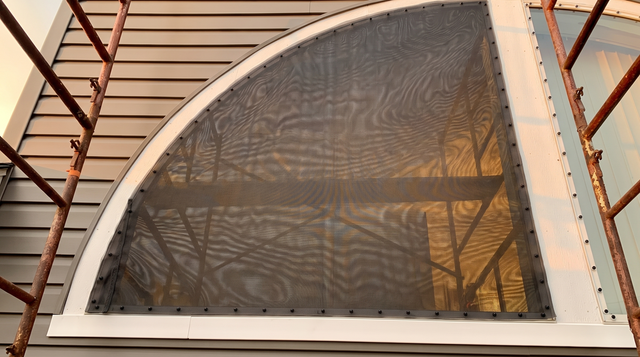
The install lives up to the name. You cut the non-fray mesh to any window shape with ordinary scissors, set the pins, press for a minute each, and let the bond cure — most homeowners finish in an afternoon. Kits start at $66.95, shipping is free over $225, and the materials carry a Limited Lifetime warranty from a company that's been doing this since 2006 for more than 38,000 customers.
If you want to see the snap system stretched across a full window line, the exterior shades collection is the place to start, and the EZ-Snap Sun Screen kit shows exactly what arrives in the box. The fastener is small. What it lets you skip — the drill, the holes, the spring patching — is the whole reason it's worth understanding.
Sources
- "Exterior shutters and shades... are most effective at reducing solar heat gain." The page also states window awnings can reduce solar heat gain by up to 65% on south-facing windows and 77% on west-facing windows. U.S. Department of Energy (Energy Saver), 2024 ↗
- "Exterior window attachments block solar heat before it reaches the window." Interior attachments "can be less effective at reducing heat gain than comparable exterior shading systems because they do not block direct sunlight until after it has already passed through the window." DOE Building America Solution Center (Pacific Northwest National Laboratory), 2023 ↗
- "Depending on the material used, solar screens have the potential to block up to 90% of solar heat gain before it even reaches the window." U.S. Department of Energy, Office of Energy Efficiency & Renewable Energy (EERE), 2023 ↗
- "Heat gain and heat loss through windows are responsible for 25%-30% of residential heating and cooling energy use." U.S. Department of Energy — Energy Saver, 2024 ↗
- U.S. Patent 8,032,994 B2, "Marking and fastening device and method of using same" (inventors Raymond J. Waddell & Dean A. Myrfield; originally assigned to EZ-Snap Products Inc), describes a male member with a projection plus a female member with an aperture forming a ratchet system that removably secures the female onto the male member to fasten covers without drilling. United States Patent and Trademark Office (via Google Patents), 2011 ↗
Common questions
How do no-drill window shades stay up without screws?
They rely on two parts working together: a patented Cap and Pin snap that mechanically locks the panel on and off, and 3M VHB tape, an industrial double-sided acrylic foam adhesive that bonds the pins to the wall. No screws, holes, or drilling are required. The snap is the removable joint and the tape is the foundation.
What is 3M VHB tape and how strong is it?
3M VHB, short for Very High Bond, is a double-sided acrylic foam tape engineered to replace rivets and screws in structural assembly. It conforms to the surface texture and keeps curing until the bond behaves less like an adhesive and more like an invisible weld. 3M rates it for load-bearing, screw-replacing assembly.
How long does the 3M VHB adhesive take to cure?
The tape reaches its initial grab in about 60 seconds of firm pressure per stud, enough to hold position while you work down the window. It then keeps curing to full strength over roughly 72 hours, so panels can hang but should not be stress-tested on day one. It bonds best applied around 60 degrees Fahrenheit.
Will adhesive snaps hold on stucco, fiber cement, or an RV?
Yes, and no-drill is the point rather than a compromise. Because every screw hole is a future leak path, adhesive snaps deliver the strength without permanent penetrations, which matters most for renters, stucco and fiber-cement walls, and RVs where new holes risk leaks. Clean, dry, oil-free surfaces are essential for the bond to last.
How do I get the adhesive snaps to hold reliably?
Prep the surface first. The tape bonds only to what is on the wall, so it must be clean, dry, and free of dust, oil, or wax. Apply around 60 degrees Fahrenheit, press each stud firmly for about a minute, and let the bond cure for roughly 72 hours before putting it under load.
How much do the exterior shade kits cost and how hard are they to install?
Kits start at $66.95, with free shipping over $225. The install lives up to the no-drill name: you cut the mesh to any window shape with ordinary scissors, set the pins, press each for a minute, and let the bond cure, with most homeowners finishing in an afternoon. The black mesh blocks up to 90% of solar heat.