How to Measure Windows for Exterior Shades (Free Template Walkthrough)

Key Takeaways
- Always measure width first, then height, take each dimension at three points, and order to the largest reading to avoid a short kit.
- EZ-Snap® mesh cuts to any shape with scissors and does not fray, so it is safer to round up and trim than to measure tight.
- For arched, round, or odd-shaped windows, ignore the curve and measure the smallest rectangle the whole window fits inside (the bounding box).
- Exterior shading is the most effective window attachment for reducing solar heat gain because it blocks sunlight before it reaches the glass.
- Include enough flat mounting surface around the window for the no-drill Cap & Pin snaps, which anchor to the frame, not the glass.
There is a particular kind of regret that arrives in a flat-rate shipping box: the shade kit you ordered, unrolled across the kitchen table, that is two inches short of the window it was meant to cover. Almost every one of those moments traces back to a tape measure held wrong for thirty seconds, and almost every one of them is preventable.
How do you measure a window for exterior shades?
Measure the full opening you want to cover, not just the glass. Use a steel tape: take the width at the top, middle, and bottom and keep the largest number, then do the same for height. Add overlap onto the surrounding frame, round up, and write width before height every time.
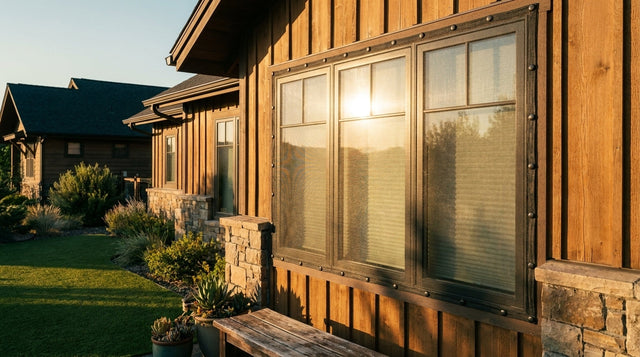
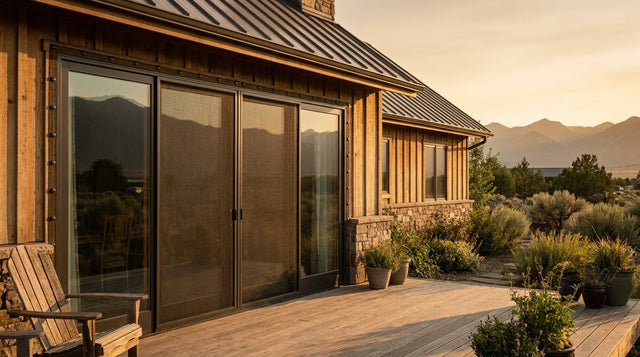
Measuring a window for an exterior shade is not hard, but it is unforgiving in a way that interior decorating never is. Outside the glass, you are working against sun, wind, and the geometry of your own siding. The good news is that the EZ-Snap Sun Screen system is built to be merciful here — the mesh cuts to any shape with household scissors and the edges do not fray — so your measurement does not have to be surgical. It just has to be honest, written down, and taken the same way twice.
Why measuring the outside matters more than you think
Before the tape comes out, it helps to know why you are putting the screen on the outside of the glass in the first place. The U.S. Department of Energy is blunt about it: exterior shutters and shades are the most effective window attachment for reducing solar heat gain.1 The physics is intuitive once you hear it. Interior blinds only get a vote after sunlight has already passed through the glass and become heat trapped in your room; exterior attachments block solar heat before it ever reaches the window.2 If you want the full walkthrough of shading windows from the outside, the mounting logic is the same on every shape.
That distinction is not small. Heat gain and heat loss through windows account for 25 to 30 percent of residential heating and cooling energy use.4 Depending on the material, exterior solar screens can block up to 90 percent of solar heat gain before it reaches the window.3 The black Optical Grade Thermo-Weave™ mesh in an EZ-Snap kit blocks up to 90% of that solar heat; the white mesh trades some of that blocking for more daylight. Either way, the screen is doing its real work in the half-inch of air outside your glass — which is exactly why getting its footprint right matters.
Measure the opening you actually want to cover, not the window you remember.
The tools, and the one rule that prevents most mistakes
You need shockingly little: a steel tape measure (cloth ones stretch and lie), a pencil, and a single sheet of paper per window. If you want to be tidy about it, a printable window measuring guide with a box for each dimension keeps you from transposing numbers — and yes, you should confirm whether a downloadable template is offered before you rely on one.
The rule that saves more orders than any other: measure twice, in the same units, and write it down immediately. Width first, then height — always in that order, every window, so you never have to wonder later which number was which. Mixing inches and centimeters across a single project is the single most common way a kit ends up the wrong size.
How to measure a standard square or rectangular window
This is the case that covers most homes, and it takes under a minute once you know where the edges are.
- Find your shading footprint. Decide what you want the screen to overlap. For the cleanest sun block, you want the mesh to extend beyond the glass and onto the surrounding frame or trim — covering the whole opening, not just the see-through pane.
- Measure the width. Run the tape horizontally across the area you intend to cover, from the outer edge of trim on the left to the outer edge on the right. Take it at the top, middle, and bottom; older homes are rarely perfectly square, and you want the largest of the three.
- Measure the height. Do the same vertically — left side, center, right side — and again record the largest.
- Add your overlap. Because the EZ-Snap mesh is non-fray and trims with scissors, it is far safer to order slightly generous and cut down than to come up short. Round up.
One detail people miss: the patented no-drill Cap & Pin snaps anchor to the frame or siding around the window, not the glass, using 3M VHB tape (about 60 seconds per stud, full strength in roughly 72 hours above 60°F). So your measurement needs to include enough flat mounting surface for those snaps to land on. Glance at the perimeter and make sure there is somewhere solid for them to grip before you commit your numbers.
How to measure arched, round, and oddly shaped windows
This is where most shade systems quit and EZ-Snap keeps going. Because the mesh is cut to fit on site, you do not need a manufacturer to bend a rigid frame to your arch — you need a bounding box.
The bounding-box method
For any non-rectangular window — an arch, a half-round, an octagon, a trapezoid over a stairwell — stop trying to measure the curve. Instead, imagine the smallest rectangle that the entire window would fit inside. Measure the full width at its widest point and the full height at its tallest point. That rectangle is what you order to; the curve gets traced and trimmed during installation. The same bounding box is all you need to cover a triangle window from outside, where there is no curve at all — just two angled sides meeting a base.
For a classic arched window, that means measuring the width across the springline (where the straight sides meet the curve) and the total height from the sill up to the very top of the arch. When in doubt, hold a straightedge across the top of the arch and measure to it. Getting a true custom fit on shades for arched and curved windows is really just this one trick applied with a little patience.
Skylights and tilted glass follow the same logic, and they are worth shading: because the sun strikes them nearly head-on, they are some of the hardest-working surfaces in the house. The bounding box still rules — measure the widest and tallest extents of the opening and let the scissors handle the rest.
Turning measurements into the right kit
With width and height in hand for every window, you can size your order. EZ-Snap kits start at $66.95, ship free over $225, and are sold by coverage area, so total up the rectangles you measured rather than guessing window-by-window. If you are sizing a whole sun-beaten side of the house, it is genuinely cheaper per square foot to order the larger coverage and divide it across openings.
Take a last look at your list before you check out. The whole point of stopping the sun at the glass is that windows are the thermal weak link of a building — though they are only a sliver of the wall area, they can drive a wildly outsized share of the heat moving through it.5 The windows that bake in the afternoon are the ones worth measuring most carefully.
When your numbers are written, doubled, and rounded up, you are ready to choose a kit. Browse the full lineup of EZ-Snap Sun Screen Kits to match your coverage, or compare mesh colors and mounting options across the exterior shade collection. Measure once, honestly — and the box that arrives will fit the first time.
Sources
- "Exterior shutters and shades... are most effective at reducing solar heat gain." The page also states window awnings can reduce solar heat gain by up to 65% on south-facing windows and 77% on west-facing windows. U.S. Department of Energy (Energy Saver), 2024 ↗
- "Exterior window attachments block solar heat before it reaches the window." Interior attachments "can be less effective at reducing heat gain than comparable exterior shading systems because they do not block direct sunlight until after it has already passed through the window." DOE Building America Solution Center (Pacific Northwest National Laboratory), 2023 ↗
- "Depending on the material used, solar screens have the potential to block up to 90% of solar heat gain before it even reaches the window." U.S. Department of Energy, Office of Energy Efficiency & Renewable Energy (EERE), 2023 ↗
- "Heat gain and heat loss through windows are responsible for 25%-30% of residential heating and cooling energy use." U.S. Department of Energy — Energy Saver, 2024 ↗
- Windows "are known as the weakest link in the thermal envelopes" and are "attributable for approximately 10% of building energy use"; though only ~8% of envelope area, they can contribute "up to 45% of the envelope heat loss" in climate zones 4 and 5. Lawrence Berkeley National Laboratory — Windows & Daylighting, 2023 ↗
Common questions
How do you measure a window for exterior shades?
Measure the full opening you want to cover, not just the glass. Use a steel tape and take the width at the top, middle, and bottom, keeping the largest number, then do the same for the height. Add overlap onto the surrounding frame, round up, and always write width before height.
How do you measure an arched, round, or odd-shaped window?
Use the bounding-box method: ignore the curve and measure the smallest rectangle the whole window fits inside. Record the full width at its widest point and the full height at its tallest point, then order to that rectangle. The mesh is cut to fit on site, so the curve gets traced and trimmed during installation.
Should you measure the glass or the whole window frame?
Measure the whole opening, extending the mesh beyond the glass and onto the surrounding frame or trim for the cleanest sun block. You also need to include enough flat mounting surface for the no-drill Cap and Pin snaps, which anchor to the frame or siding, not the glass.
What happens if my measurement is slightly off?
A slightly generous measurement is easy to fix because the mesh cuts to any shape with household scissors and does not fray. It is far safer to order a little large and trim down than to come up short, so round up rather than measuring tight.
Why are exterior shades better than interior blinds for blocking heat?
Exterior shades block sunlight before it reaches the glass, which the U.S. Department of Energy calls the most effective window attachment for reducing solar heat gain. Interior blinds only act after sunlight has already passed through the glass and become trapped heat. Depending on the material, exterior solar screens can block up to 90 percent of solar heat gain.