How to Cover a Triangle Window: A Simple Exterior Fix for Heat and Glare

Key Takeaways
- To cover a triangle window, work from the outside of the glass: the U.S. Department of Energy identifies exterior shutters and shades as the most effective option for reducing solar heat gain.
- Exterior solar screens can block up to 90% of solar heat gain before it reaches the window, while interior treatments only act after sunlight has already passed through the glass and become indoor heat.
- EZ-Snap®'s Optical Grade Thermo-Weave™ mesh cuts to any window shape with scissors and is non-fray, so an angled triangle edge is no harder to cover than a rectangle.
- The patented no-drill Cap & Pin snap (U.S. Patent 8,032,994) plus 3M VHB adhesive installs without screwing into the frame, and most windows go up in an afternoon.
- Windows account for 25–30% of a home's heating and cooling energy, so stopping the sun at a high triangle window meaningfully cuts cooling load.
There is a particular window that defeats people: the tall triangle perched above a stairwell or crowning a great room, throwing a blade of afternoon sun across the floor and baking the room beneath it. You can't reach it, custom blinds for it cost a small fortune, and the angled top edge laughs at every off-the-shelf shade you bring home. The good news is that the fix is simpler than the problem looks — and it lives on the outside of the glass.
How do you cover a triangle window from outside?
Cut an exterior screen mesh to the triangle's shape with scissors and snap it onto the window frame with no-drill fasteners. Because the screen sits outside the glass, it blocks up to 90% of solar heat before it enters the room — far more effective than any interior blind cut to fit the angled top.
Most people start indoors. They go looking for interior blinds cut to a 45-degree rake, get quoted a custom-order price, and quietly give up. But the indoor approach is fighting physics. By the time sunlight hits an interior shade, it has already passed through the glass and become heat trapped in your room. The smarter move is to stop the sun before it ever reaches the pane — the same case for going outside that applies to any approach that shades windows from the outside.
Why the triangle window is so hard to cover
A triangle (or gable, or "eyebrow") window breaks every assumption that mass-market window coverings are built on. There is no level top rail to mount a roller. The geometry changes along its entire length, so a rectangular shade either gaps at the corners or has to be trimmed by someone who measures in fractions of an inch. And these windows are usually high — twelve, sixteen, twenty feet up — which means anything operable indoors needs a wand, a motor, or a ladder you don't want to climb twice a year.
So the real question behind how to cover a triangle window isn't "what blind fits an odd shape?" It's "how do I kill the heat and glare from this thing without ordering a custom unit I'll be afraid to ever take down?" Once you frame it that way, the answer points outward — the same logic behind the no-drill way to cover angled glass.
Why the outside of the glass is the right place to fight
This isn't a stylistic preference — it's building science. The U.S. Department of Energy is blunt about it: exterior shutters and shades are the most effective option for reducing solar heat gain.1 The reason is mechanical. Exterior attachments block solar heat before it reaches the window, while interior treatments don't intercept direct sunlight until after it has already passed through the glass.2
That distinction matters more than people expect, because windows are the thermal weak link of any house. Heat gain and loss through glass account for 25 to 30 percent of residential heating and cooling energy use.4 An exterior solar screen, depending on its material, can block up to 90 percent of solar heat gain before it even reaches the window.3 Move that same screen behind the glass and you've already lost the fight — the energy is inside, and now your AC has to carry it back out.
Stop the sun at the glass, not after it has already become heat in your living room.
The simple exterior fix: a screen that cuts to the shape
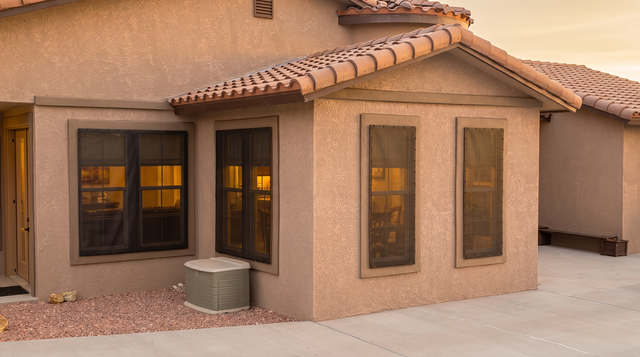
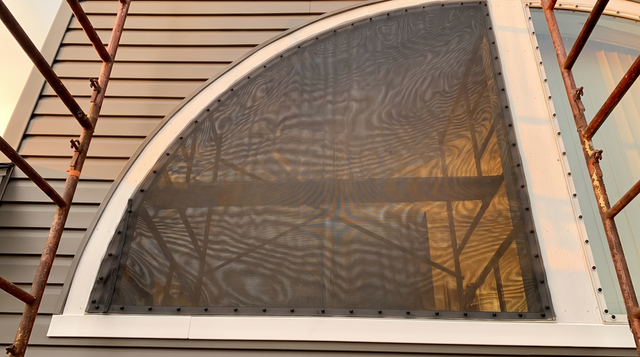
This is where the awkward geometry stops being a curse. An EZ-Snap Exterior Shades kit is built around a screen mesh — Optical Grade Thermo-Weave™ — that you cut to fit with ordinary scissors. There's no custom factory order keyed to your exact angle. You lay the mesh over the opening, trace the triangle, and trim. The material is non-fray, so a raw-cut hypotenuse stays clean. A shape that wrecks every rigid blind becomes, for a screen you cut yourself, a complete non-issue. The arched and triangle window shade kits are built for exactly these angled openings.
The black mesh is the triangle window heat blocker most people want — it blocks up to 90% of the sun's heat while you still see out through it. If you'd rather keep more daylight and give up some of the heat rejection, the white mesh trades the other way: more light in, less heat blocked. Either way, the screen does its work on the outside of the glass, which is exactly where the DOE says the work should happen.1
How it actually attaches — no drilling into the frame
The part that makes this work on a high, hard-to-reach window is the fastening system. EZ-Snap uses a patented no-drill Cap & Pin snap (U.S. Patent 8,032,994) paired with 3M VHB adhesive.6 You stick the pins to the window frame — no screws, no holes in the trim — snap the screen onto them, and trim the cap. The adhesive needs roughly 60°F to cure, sets in about 60 seconds per stud, and reaches full strength in around 72 hours. Most people get a window done in an afternoon.
What that means for a tall window
Because the screen is light and the snaps are permanent-but-removable, you're not engineering a motorized interior system twenty feet up. You handle it once during install, and the screen stays put through the season. If you ever want it off, it un-snaps. This is the same logic behind the broader exterior shade collection, and it's why the approach scales from a single gable window to a whole wall of west-facing glass.
What to expect once it's up
Two things change immediately. The glare — that hard diagonal of light crossing the floor at 4 p.m. — softens to a manageable, even daylight. And the room stops gaining heat through that triangle, which is the whole point: a low solar-heat-gain setup is more effective at cutting cooling load in summer because it blocks the sun's energy before it's released as heat inside.5
For privacy, the black mesh gives you a one-way effect in daylight — you see out, passersby don't see in clearly — which solves covering a triangle window for privacy without the dead, blacked-out look of a solid shutter. (At night with interior lights on, the effect reverses, the same as any screen.)
- Heat and glare: black Thermo-Weave™ mesh, blocking up to 90% of solar heat from outside the glass.
- Daylight first: white mesh for rooms where you'd rather keep the brightness.
- Any shape: cut the triangle (or arch, or trapezoid) with scissors; the mesh won't fray.
- No drilling: Cap & Pin snaps on 3M VHB — frame stays intact, screen stays removable.
Among the tall triangle window covering ideas floating around — interior cellular shades cut on the rake, stick-on film, custom plantation shutters — the exterior screen is the one that respects both the geometry and the physics. It treats the odd shape as easy (because you cut it) and the heat as serious (because it's outside the glass). The same cut-to-fit method handles the trickiest curves too, which is how you get a true custom fit on arched and curved windows with no drilling. Kits start at $66.95, and if you're shading a whole bank of windows, the same system covers all of them. When the hardest window in the house turns out to be one of the easiest to solve, that's usually a sign you were attacking it from the wrong side of the glass.
Sources
- "Exterior shutters and shades... are most effective at reducing solar heat gain." The page also states window awnings can reduce solar heat gain by up to 65% on south-facing windows and 77% on west-facing windows. U.S. Department of Energy (Energy Saver), 2024 ↗
- "Exterior window attachments block solar heat before it reaches the window." Interior attachments "can be less effective at reducing heat gain than comparable exterior shading systems because they do not block direct sunlight until after it has already passed through the window." DOE Building America Solution Center (Pacific Northwest National Laboratory), 2023 ↗
- "Depending on the material used, solar screens have the potential to block up to 90% of solar heat gain before it even reaches the window." U.S. Department of Energy, Office of Energy Efficiency & Renewable Energy (EERE), 2023 ↗
- "Heat gain and heat loss through windows are responsible for 25%-30% of residential heating and cooling energy use." U.S. Department of Energy — Energy Saver, 2024 ↗
- SHGC is "the fraction of solar radiation admitted through a window, door, or skylight — either transmitted directly and/or absorbed, and subsequently released as heat inside a home"; a low-SHGC product "is more effective at reducing cooling loads during the summer by blocking heat gain from the sun." U.S. Department of Energy — Energy Saver, 2024 ↗
- U.S. Patent 8,032,994 B2, "Marking and fastening device and method of using same" (inventors Raymond J. Waddell & Dean A. Myrfield; originally assigned to EZ-Snap Products Inc), describes a male member with a projection plus a female member with an aperture forming a ratchet system that removably secures the female onto the male member to fasten covers without drilling. United States Patent and Trademark Office (via Google Patents), 2011 ↗