Shades for Arched & Curved Windows: Getting a True Custom Fit With No Drilling

Key Takeaways
- Arched, half-round, and eyebrow windows can be shaded with a true custom fit by templating the curve and trimming flexible exterior mesh to the radius — no special-order rigid inserts required.
- Exterior shading is the most effective way to cut solar heat gain because it blocks sunlight before it reaches the glass, unlike interior treatments that only act after heat is already inside.
- The EZ-Snap® Sun Screen's Optical Grade Thermo-Weave mesh cuts to any window shape without fraying; black mesh blocks up to 90% of solar heat, while white mesh trades heat rejection for more daylight.
- The patented no-drill Cap & Pin snap (U.S. Patent 8,032,994) on 3M VHB tape lets the shade mount along a curve with no holes drilled in the window frame.
- Windows account for 25%-30% of residential heating and cooling energy use, so shading an unshaded arch on a sunny wall removes an outsized cooling load.
Walk any older neighborhood and you can read its ambition in the windows: a half-round crowning a front door, an eyebrow curve over a gable, a Palladian arch holding the morning light. They are the most beautiful glass in the house, and the most stubborn to shade, because the very radius that makes them lovely is the thing rigid blinds cannot follow. So the curve usually goes bare, and by July it becomes a heat funnel.
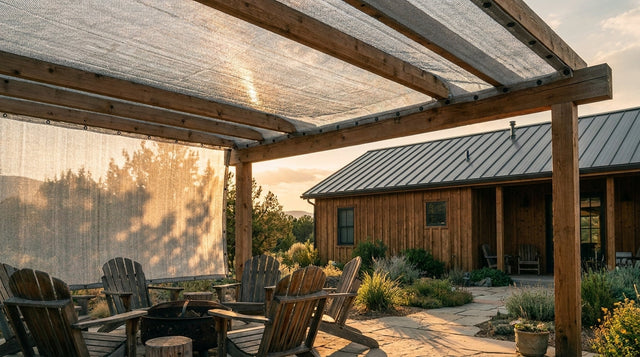
The standard answer is to special-order a rigid arch insert, wait six weeks, and pay for a piece that still only sits behind the glass. There is a quieter, faster path: template the curve yourself and trim a flexible exterior mesh to follow it. That is the whole method, and it is why a true custom fit on an Exterior Shades system stops being a special-order ordeal and becomes an afternoon project.
Why the curve is where ordinary blinds give up
Interior cellular shades and rigid arch inserts are built to one fixed geometry. A half round, an eyebrow, a quarter-arch, a true ellipse — each is a different specification, and most are sold as one-shot custom orders you cannot adjust once they arrive. That is half the problem. The other half is location: they sit behind the glass, which means the sun has already entered the room before anything tries to stop it.
That sequencing is the real failure. The U.S. Department of Energy is blunt about it: exterior shutters and shades are the most effective option for reducing solar heat gain, precisely because they intercept sunlight before it reaches the glass.1 Interior attachments are inherently more limited, since they cannot block direct sunlight until after it has already passed through the window and turned into heat inside the room.2 A handsome rigid arch insert on the inside is fighting the battle after it has already been lost — and on a curve, it rarely seals against the trim anyway.
A curved window doesn't need a special-order part. It needs a material that bends to the radius instead of fighting it.
The mesh that follows the line
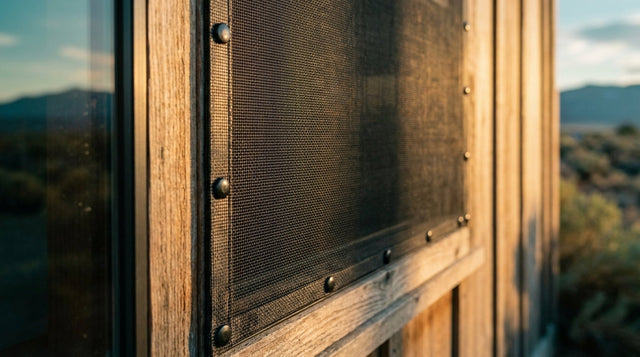
The reason this works at all is the material. The EZ-Snap Sun Screen uses an Optical Grade Thermo-Weave™ mesh — the shade-side cousin of the Diamond Weave™ fabric on the skirting line — and it is engineered to cut cleanly to any shape without fraying. There is no hem to unravel, no rigid frame to mitre, no minimum straight edge. You can run scissors along a drawn arc and the cut line holds. The same non-fray trait is what makes EZ-Snap a no-drill way to cover angled glass — once the material follows any line you draw, the difference between an arch and a triangle is only the shape of the cut.
In black, that mesh blocks up to 90% of solar heat before it ever touches the glass, which lines up with the DOE's own figure that exterior solar screens can stop up to roughly 90% of solar heat gain at the surface.3 Choose white instead and you trade some of that heat rejection for brighter, softer daylight — a fair swap on a north-facing eyebrow window where glare, not heat, is the enemy. Either way, the curve is no longer a structural exception. It is just another line to cut to. See the full set of shades for arched and curved windows.
How to template an arched or curved window
Here is the part people overpay to avoid, and it takes about twenty minutes. The goal of a template is simple: capture the exact radius once, in a material you can trace. The principle is the same one behind measuring any window for exterior shades — get the opening onto something you can hold against the glass before you ever touch the mesh.
- Tape a paper or builder's-felt sheet over the opening. Press it flat against the glass and trim and crease it firmly into the inside edge of the frame so the curve prints onto the paper.
- Trace the crease line. Run a pencil along the impression. For a true half round, find the center of the straight base, measure the rise, and you can confirm the arc with a string compass — but the crease method captures eyebrow and irregular curves a compass never will.
- Cut the template and dry-fit it. Hold the paper arc back against the opening. If it kisses the frame all the way around, it is your pattern. If it gaps, re-crease and re-trace; paper is cheaper than mesh.
- Transfer to the mesh and cut. Lay the template on the Thermo-Weave™, trace, and cut the curve with sharp scissors. Because the weave is non-fray, the edge you cut is the edge you keep. With your curve captured, size your exterior shade kit to the radius you measured.
This is the difference between "how to fit a shade to an arched window" as a search and as a Saturday. The radius lives on a sheet of paper, not in a six-week back-order queue.
Mounting on a curve with no drilling
Cutting the curve is only useful if you can hold it there without a straight mounting bar. That is where the patented no-drill Cap & Pin fastener comes in — a male-and-female snap system, covered by U.S. Patent No. 8,032,994, that secures the cover without putting a single hole in your frame.5 The pins ride on 3M VHB tape, so they bond to the existing trim instead of biting into it.
On a curved opening, you simply place the snap bases at intervals around the arc, following the radius as closely or loosely as the curve demands — tighter spacing on a sharp eyebrow, wider on a gentle half round. The mesh snaps over the pins and is held in tension along the curve, not across a straight span. A few notes that matter for a clean result:
- The VHB needs about 60°F to cure and reaches full strength in roughly 72 hours, so pick a mild, dry day for install.
- Each stud presses on in about 60 seconds; the slow part is the templating, not the mounting.
- The whole job — half round, eyebrow, or quarter-arch — installs in an afternoon with scissors, with no power tools and nothing permanent done to the house.
What the curve is actually costing you
It is easy to treat one arched window as a decorative detail and ignore the heat. But windows are the thermal weak link of the whole house: the DOE attributes 25%–30% of residential heating and cooling energy use to heat moving through glass.4 An unshaded arch on a south or west wall is a small piece of that envelope doing outsized damage, pouring in solar gain your air conditioner then has to claw back out.
Stopping that gain at the surface is the move with the most leverage, and it is exactly what an exterior screen is built to do. The same logic that makes a black mesh worth installing over a picture window applies to the curve above it — the only thing that ever changed was the shape, and the shape is now solved. If you want the full method on the flat openings too, the how it works walkthrough covers the snap system end to end, and our step-by-step guide to shading windows from outside carries the same Thermo-Weave™ mesh into every window in the house.
EZ-Snap has been making no-drill exterior shading since 2006, kits start at $66.95, and the curve you have been told needs a special order is, it turns out, just a line you can draw and cut to.
Sources
- "Exterior shutters and shades... are most effective at reducing solar heat gain." The page also states window awnings can reduce solar heat gain by up to 65% on south-facing windows and 77% on west-facing windows. U.S. Department of Energy (Energy Saver), 2024 ↗
- "Exterior window attachments block solar heat before it reaches the window." Interior attachments "can be less effective at reducing heat gain than comparable exterior shading systems because they do not block direct sunlight until after it has already passed through the window." DOE Building America Solution Center (Pacific Northwest National Laboratory), 2023 ↗
- "Depending on the material used, solar screens have the potential to block up to 90% of solar heat gain before it even reaches the window." U.S. Department of Energy, Office of Energy Efficiency & Renewable Energy (EERE), 2023 ↗
- "Heat gain and heat loss through windows are responsible for 25%-30% of residential heating and cooling energy use." U.S. Department of Energy — Energy Saver, 2024 ↗
- U.S. Patent 8,032,994 B2, "Marking and fastening device and method of using same" (inventors Raymond J. Waddell & Dean A. Myrfield; originally assigned to EZ-Snap Products Inc), describes a male member with a projection plus a female member with an aperture forming a ratchet system that removably secures the female onto the male member to fasten covers without drilling. United States Patent and Trademark Office (via Google Patents), 2011 ↗
Common questions
Can you put shades on an arched or curved window without special-ordering a rigid insert?
Yes. You template the curve yourself and trim flexible exterior mesh to follow the exact radius, so no special-order rigid arch insert is required. The mesh cuts cleanly to any shape without fraying, which turns what is usually a six-week back-order into an afternoon project.
How do you template an arched window for a shade?
Tape a paper or builder's-felt sheet over the opening and crease it firmly into the inside edge of the frame so the curve prints onto the paper. Trace the crease, cut the template, and dry-fit it; once it kisses the frame all the way around, transfer it to the mesh and cut. The step takes about twenty minutes.
Do exterior shades block more heat than interior blinds on a curved window?
Yes. Exterior shades stop sunlight before it reaches the glass, which the U.S. Department of Energy calls the most effective way to reduce solar heat gain. Interior treatments can only act after heat has already passed through the window and turned into heat inside the room.
How much heat does the mesh block, and what is the difference between black and white?
Black mesh blocks up to 90% of solar heat before it touches the glass. White mesh trades some heat rejection for brighter, softer daylight, which is a fair swap on a north-facing eyebrow window where glare rather than heat is the real problem.
How does the shade mount on a curve without drilling?
It mounts with a patented no-drill Cap and Pin snap system that rides on 3M VHB tape, so the bases bond to the existing trim with no holes in the frame. You place the snap bases at intervals around the arc, and the mesh snaps over the pins to hold tension along the curve. Each stud presses on in about 60 seconds.
How long does an arched-window install take?
The job installs in an afternoon with household scissors, no power tools, and nothing permanent done to the house. Pick a mild, dry day around 60 degrees so the VHB tape can cure; it reaches full strength in roughly 72 hours. Most of the time goes to templating the curve, not mounting.