Skylight Screens and Mesh Covers: Block Heat, Keep the View

Key Takeaways
- A roof surface can absorb three to four times more solar radiation in midsummer than a wall, making an overhead skylight the hottest glass in a typical home.
- Exterior shading stops the sun before it reaches the glass, which the U.S. Department of Energy calls the most effective way to reduce solar heat gain.
- For skylights specifically, the DOE states exterior shades reduce summer heat gain more effectively than interior shades.
- Depending on the material, exterior solar screens can block up to 90% of solar heat gain before it even reaches the window.
- A breathable mesh skylight screen blocks heat while keeping daylight and the view, and EZ-Snap® installs it with a patented no-drill snap and no holes in the roof.
A skylight is a hole you cut in your roof on purpose, and on a July afternoon it behaves exactly like one. The same opening that fills a stairwell with morning light turns into a heat funnel by two o'clock, and the usual fixes ask you to give back the daylight to get the comfort. There is a third option that gives back neither.
That option is a breathable mesh stretched across the outside of the glass: a skylight screen. Not a blackout shade, not a roller blind buried in the well, but a taut panel of fabric that intercepts the sun before it touches the pane. To understand why an exterior skylight mesh cover beats almost everything you can hang on the inside, it helps to know why overhead glass is the worst-behaved glazing in the house.
Why your skylight runs hotter than any window
Orientation is everything in solar heat gain, and a skylight has the worst orientation there is: straight up. A roof surface can receive roughly three to four times as much solar radiation on a midsummer day as a north- or south-facing wall.1 Your vertical windows catch the sun at a glancing angle for part of the day; the skylight stares at it from dawn to dusk. The Department of Energy is blunt about the consequence: because skylights sit on the roof, they can create unwanted additional heat in summer.2
The number that captures this is SHGC, the solar heat gain coefficient, which is simply the fraction of solar radiation a window or skylight lets through. The lower the SHGC, the less solar heat it transmits and the greater its shading ability.3 You can't change the SHGC of glass already in your roof. But you can put something in front of it that drops the effective number dramatically — which is the heart of any honest approach to choosing a skylight cover that reduces heat.
Inside shade vs. outside screen: where you stop the heat matters
Here is the part most people get backwards. An interior blind feels like the obvious fix because you can reach it. But by the time sunlight hits an inside shade, it has already passed through the glass and become heat trapped in your room. Exterior window attachments block solar heat before it reaches the window, while interior ones are less effective precisely because they don't intercept direct sunlight until after it has already passed through.5 For skylights specifically, the DOE states exterior shades will be more effective than interior shades at reducing heat gain in summer.2 If you're still weighing the two, the full case for interior skylight blinds versus exterior shades comes down to exactly this geometry.
Stop the sun at the glass, not at the ceiling. Once heat is in the room, a shade only decides where it lands.
This is why exterior shading is, in the DOE's own framing, the most effective way to reduce solar heat gain.4 A mesh on the outside is the cheapest, lightest way to put a barrier where the barrier actually works.
How a mesh screen blocks heat and keeps the view
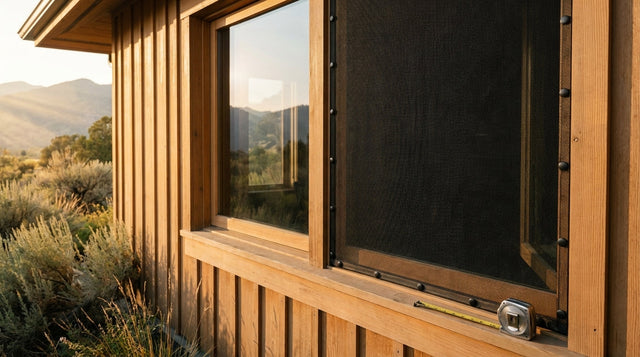
The trick of a good mesh skylight shade is that it isn't solid. It's a tight weave with thousands of tiny openings, so it absorbs and reflects the sun's energy on the roof side while your eye still reads straight through the gaps to the sky beyond. Depending on the material, exterior solar screens can block up to 90% of solar heat gain before it even reaches the window.6
EZ-Snap builds its screens from Optical Grade Thermo-Weave™, a mesh engineered so the weave geometry does the shading without turning the opening into a wall. The black version blocks up to 90% of solar heat while you keep looking out; the white version is the choice when daylight matters more than maximum heat rejection, trading some heat control for a brighter, softer light. Either way the material is non-fray and cuts to any shape with ordinary scissors, which matters when your skylight is a pyramid, a tube, or some trapezoid the builder improvised.
A screen for the view, not a bug screen
If you searched for a screen for skylight hoping to keep insects out of an opening vent, know that a solar mesh is a different tool aimed at a different problem. It's the skylight bug screen alternative people actually want once they realize the heat, not the bugs, is what's making the room unusable in August. The view is the point: you bought a skylight for the sky, and a heat shade shouldn't take it back from you.
Installing without drilling into your roof
The fear with anything on the outside of a skylight is obvious: you do not want new holes in your roof. EZ-Snap's system avoids them entirely with a patented no-drill Cap & Pin snap mounted on 3M VHB adhesive tape — no screws, no sealant, no penetrations through flashing or glass. The same logic guides any sound method of covering a skylight from the outside without drilling.
- Cut the Thermo-Weave mesh to your skylight's shape with scissors; the weave won't fray at the edges.
- Stick the snap caps with the 3M VHB tape onto clean glass or frame, ideally around 60°F so the adhesive cures right. Each stud presses on in about 60 seconds.
- Snap the mesh onto the pins, tensioning as you go for a flat, taut panel.
- Wait — the VHB reaches full strength in roughly 72 hours, so plan the install a few days ahead of a heat wave, not during one.
The whole job is an afternoon with scissors, and it's reversible: the same snap-and-mesh approach is what EZ-Snap uses across its exterior shade line, so a skylight is just one more surface it cuts to fit. Kits start at $66.95, with free shipping over $225. When you're ready, build your skylight shade kit to fit your opening.
What a screened skylight actually changes
The honest pitch isn't a magic number; it's a behavior change in the room. The space under a screened skylight stops spiking in the afternoon, the air conditioning stops fighting a fixed heat source overhead, and the glare that washed out the TV or the kitchen island goes soft. Because the screen lives outside on a no-drill mount, you can pull it for winter when you want every photon of low-angle sun, then snap it back in spring.
EZ-Snap has been doing exterior, view-preserving shade this way since 2006, with more than 38,000 customers and a Limited Lifetime materials warranty behind the mesh. If your skylight is the hottest glass in the house — and physics says it probably is — the fix that respects the view is a screen on the outside, not a blind on the inside. Start with the Shop Skylight Shades collection, or read how the snap system works before you measure.
Sources
- One square foot of roof area can receive approximately three to four times as much solar radiation on a midsummer day as one square foot of north- or south-facing wall. Pacific Northwest National Laboratory (Building America Solution Center, U.S. DOE), 2024 ↗
- Because skylights are located on the roof, they can result in unwanted additional heat in summer... Exterior shades will be more effective than interior shades at reducing heat gain in summer. U.S. Department of Energy, Office of Energy Saver, 2024 ↗
- Solar heat gain coefficient (SHGC) is the fraction of solar radiation admitted through a window, door, or skylight... The lower the SHGC, the less solar heat it transmits, and the greater its shading ability. U.S. Department of Energy, Office of Energy Saver, 2024 ↗
- "Exterior shutters and shades... are most effective at reducing solar heat gain." The page also states window awnings can reduce solar heat gain by up to 65% on south-facing windows and 77% on west-facing windows. U.S. Department of Energy (Energy Saver), 2024 ↗
- "Exterior window attachments block solar heat before it reaches the window." Interior attachments "can be less effective at reducing heat gain than comparable exterior shading systems because they do not block direct sunlight until after it has already passed through the window." DOE Building America Solution Center (Pacific Northwest National Laboratory), 2023 ↗
- "Depending on the material used, solar screens have the potential to block up to 90% of solar heat gain before it even reaches the window." U.S. Department of Energy, Office of Energy Efficiency & Renewable Energy (EERE), 2023 ↗
Common questions
Do skylight screens block heat while keeping the view?
Yes. A breathable mesh skylight screen intercepts the sun on the outside of the glass while your eye still reads through the weave to the sky. Depending on the material, exterior solar screens can block up to 90% of solar heat gain before it reaches the window, so you keep the daylight and lose the afternoon heat spike.
Why does a skylight get so much hotter than a regular window?
A skylight faces straight up, the worst possible orientation for solar heat gain. A roof surface can receive roughly three to four times as much solar radiation on a midsummer day as a north- or south-facing wall, so overhead glass is usually the hottest glass in the house.
Are exterior skylight shades better than interior blinds?
Yes. The U.S. Department of Energy states exterior shades reduce summer heat gain more effectively than interior shades for skylights. An inside blind only acts after sunlight has passed through the glass and become trapped heat, while an exterior screen stops the sun before it reaches the pane.
Can you install a skylight screen without drilling into the roof?
Yes. EZ-Snap uses a patented no-drill Cap and Pin snap mounted on 3M VHB adhesive tape, with no screws, sealant, or holes through flashing or glass. You cut the mesh to shape with scissors, press each stud on in about 60 seconds, then snap the panel into place. The adhesive reaches full strength in roughly 72 hours.
What is the difference between black and white skylight mesh?
Black mesh blocks up to 90% of solar heat while you keep looking out, making it the choice for maximum heat rejection. White mesh trades some heat control for brighter, softer daylight, so it suits rooms where light matters more than cooling.
How much do skylight shade kits cost?
Kits start at $66.95, with free shipping on orders over $225. The mesh cuts to any skylight shape with household scissors and won't fray at the edges, so pyramids, tubes, and odd builder trapezoids are all covered by the same snap system.