Skylight Covers to Reduce Heat: A Complete Buyer's Guide

- A square foot of roof can receive roughly three to four times the solar radiation of a north- or south-facing wall on a midsummer day, so skylights run hot.
- Exterior shading reduces a skylight's summer heat gain more effectively than interior shading, because it blocks the sun before the energy reaches the glass.
- Depending on the material, exterior solar screens can block up to 90% of solar heat gain before it reaches the window.
- Interior films and blinds act only after sunlight has already passed through the glass, making them less effective at stopping heat than comparable exterior screens.
- An exterior mesh skylight screen mounted with a patented no-drill snap and 3M VHB tape punctures neither the roof nor the skylight curb, and most installs finish in an afternoon.
Key Takeaways
- A square foot of roof can receive roughly three to four times the solar radiation of a square foot of wall on a midsummer day, which is why skylights run hotter than ordinary windows.
- The U.S. Department of Energy states exterior shading is more effective than interior shading at reducing a skylight's summer heat gain, because it blocks the sun before it reaches the glass.
- Depending on the material, exterior solar screens can block up to 90% of solar heat gain before it reaches the window.
- Interior films and blinds act only after sunlight has already passed through the glass, making them less effective at stopping heat than comparable exterior screens.
- The EZ-Snap® Sun Screen uses Optical Grade Thermo-Weave mesh and a patented no-drill snap mount, with black mesh that blocks up to 90% of solar heat and kits starting at $66.95.
Stand under a skylight at two in the afternoon in July and you can feel the physics without a single instrument: the air below the glass is warmer, the light has weight, and the room your home cools hardest is the one with a hole in the roof. A skylight is a window turned skyward, and that geometry is exactly why it runs hot. One square foot of roof can receive roughly three to four times as much solar radiation on a midsummer day as a square foot of north- or south-facing wall.1
That is the whole problem in one sentence. Below, we rank every real way to cool a skylight, from the films people reach for first to the exterior cover that actually stops the heat outside the glass.
Why a skylight runs hotter than any other window
Roof-mounted glass takes the sun at the worst possible angle. There is no eave, no overhang, no neighboring wall to throw shade across it at noon. Because skylights sit on the roof, they admit unwanted additional heat in summer, and the Department of Energy is blunt about the fix: exterior shading is more effective than interior shading at reducing that gain.2 The number that governs all of this is the solar heat gain coefficient, or SHGC, the fraction of solar radiation a window admits. The lower the SHGC, the less solar heat it transmits and the greater its shading ability.3 Every option below is really just a different strategy for dragging that one number down.
The contenders, ranked by where they stop the sun
Here is the organizing principle the marketing copy usually buries: the heat you stop before the glass never becomes a cooling problem. The heat you stop after it has already passed through is heat you are now fighting indoors. Sort the options by that line and the ranking writes itself.
Low-E and tinting films (interior, applied to glass)
A retrofit low-E or tint film is cheap, permanent, and genuinely lowers SHGC. It also lives on the inside face of the glass, which means it works on radiation that has already entered the cavity. Interior attachments can be less effective at reducing heat gain than comparable exterior systems precisely because they do not block sunlight until after it has passed through the window.5 Films are a fine baseline. They are not a heat blocker in the strong sense.
Interior blinds, cellular shades, and blackout panels
These improve comfort and glare and look tidy on a remote pole. But a blind hangs in already-heated air; the sun crossed the glass before the fabric ever saw it. Useful for light control, modest for heat — a trade-off we pull apart in detail in our breakdown of skylight blinds versus exterior skylight shades.
Reflective exterior films and specialty glazing
Better, because they act at the surface. The catch is cost and commitment: re-glazing a skylight is a roof job, and exterior films degrade under exactly the UV load you bought them to fight.
Exterior solar screens and shades
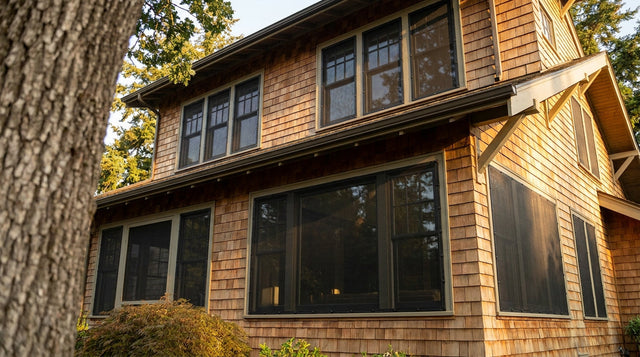
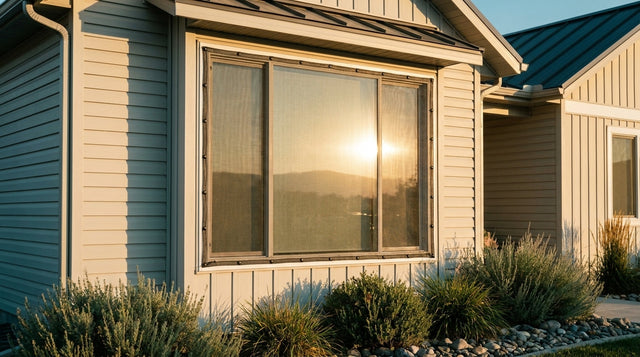
This is the category DOE keeps pointing at. Exterior shutters and shades are most effective at reducing solar heat gain, because they intercept the sun before it reaches the glass.4 A solar screen does its work in open air, on the outside of the assembly, where the heat it rejects simply radiates back to the sky instead of into your kitchen — and unlike a fixed panel, a good exterior mesh screen blocks heat while keeping the view.
Stop the sun on the roof, and the room never has to argue with it.
Why "outside the glass" wins the energy math
The mechanism is not subtle. Exterior window attachments block solar heat before it reaches the window, while interior ones only intervene after the energy is already inside.5 Once sunlight clears the glass, most of its energy is in the room to stay — it re-radiates as long-wave heat the glass won't let back out. An exterior screen breaks that chain at the only point where breaking it is free.
The ceiling on the approach is high. Depending on the material, solar screens have the potential to block up to 90% of solar heat gain before it even reaches the window.6 That is the difference between a skylight that defines your cooling bill and one you forget is there. If you want the full framing of where overhead glass fits in a home's heat picture, our Shop Skylight Shades guide lays out the room-by-room case.
How EZ-Snap turns the best option into the easy one
The honest objection to exterior shading has always been installation. Skylights are on the roof; nobody wants to drill into flashing. The EZ-Snap Sun Screen is built specifically to remove that objection. Its mesh is Optical Grade Thermo-Weave™, and the black mesh blocks up to 90% of solar heat — squarely in the range DOE describes for exterior solar screens.6 Prefer to keep more daylight? White mesh trades some heat rejection for a brighter room.
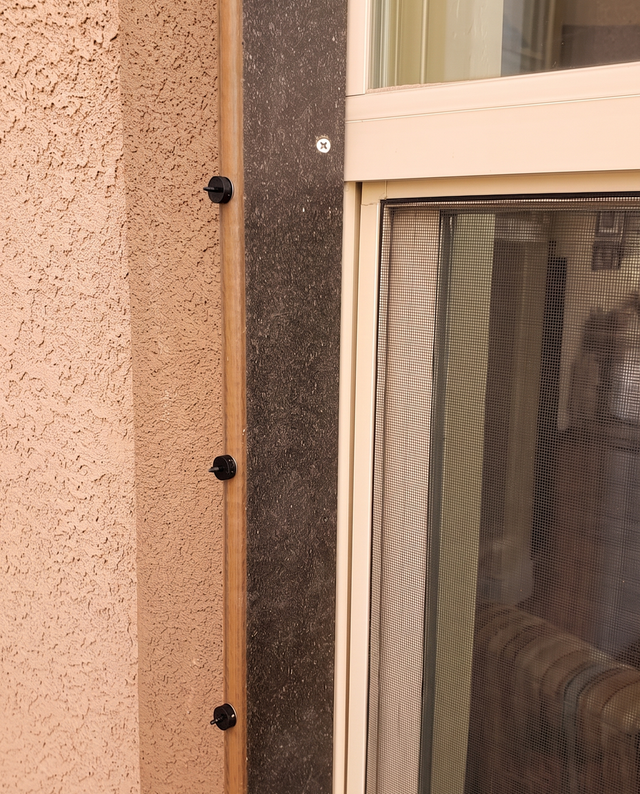
The mounting is the real trick: a patented no-drill Cap & Pin snap paired with 3M VHB tape, so nothing punctures the roof or the skylight curb. The mesh cuts to any skylight shape with scissors, won't fray, and most installs finish in an afternoon — our step-by-step on how to cover a skylight from the outside walks through the no-drill method curb by curb. A few specifics worth planning around:
- The 3M VHB cures best above roughly 60°F and reaches full strength in about 72 hours — so pick a mild, dry day.
- Each stud seats in about 60 seconds once the surface is clean.
- Kits start at $66.95, with free shipping over $225.
- Backed by a Limited Lifetime materials warranty from a company that has shaded glass since 2006 and served 38,000+ customers.
Ready to size one for your own roof? You can build your no-drill skylight shade kit to fit any skylight shape.
The same system handles vertical glass, patios, and RVs — see how the approach generalizes on our exterior shades overview, or read the full no-drill install method before you commit.
Choosing your skylight heat blocker
If you want the cheapest possible nudge to SHGC and you accept that it acts late, a low-E film earns its keep. If you want light control more than heat control, an interior cellular shade is pleasant. But if the actual goal is skylight heat reduction — measurably cooler air under the glass, a lighter cooling load, a room that stops being the one you avoid at noon — the building science is settled and one-directional. Block the sun outside the glass. An exterior screen is the only common option that does, and a no-drill one is the only version that doesn't require a contractor and a ladder against your roof.
The skylight didn't get hotter because the design was wrong. It got hotter because it's pointed at the sun. Put the shade on the right side of the glass, and that stops being a problem you live with and becomes one you solved in an afternoon.
Sources
- One square foot of roof area can receive approximately three to four times as much solar radiation on a midsummer day as one square foot of north- or south-facing wall. Pacific Northwest National Laboratory (Building America Solution Center, U.S. DOE), 2024 ↗
- Because skylights are located on the roof, they can result in unwanted additional heat in summer... Exterior shades will be more effective than interior shades at reducing heat gain in summer. U.S. Department of Energy, Office of Energy Saver, 2024 ↗
- Solar heat gain coefficient (SHGC) is the fraction of solar radiation admitted through a window, door, or skylight... The lower the SHGC, the less solar heat it transmits, and the greater its shading ability. U.S. Department of Energy, Office of Energy Saver, 2024 ↗
- "Exterior shutters and shades... are most effective at reducing solar heat gain." The page also states window awnings can reduce solar heat gain by up to 65% on south-facing windows and 77% on west-facing windows. U.S. Department of Energy (Energy Saver), 2024 ↗
- "Exterior window attachments block solar heat before it reaches the window." Interior attachments "can be less effective at reducing heat gain than comparable exterior shading systems because they do not block direct sunlight until after it has already passed through the window." DOE Building America Solution Center (Pacific Northwest National Laboratory), 2023 ↗
- "Depending on the material used, solar screens have the potential to block up to 90% of solar heat gain before it even reaches the window." U.S. Department of Energy, Office of Energy Efficiency & Renewable Energy (EERE), 2023 ↗
Common questions
Why do skylights get hotter than regular windows?
Skylights run hotter because roof-mounted glass takes the sun at the worst possible angle, with no eave, overhang, or neighboring wall to shade it at noon. One square foot of roof can receive roughly three to four times as much solar radiation on a midsummer day as a square foot of wall. That geometry is why the room with a skylight is often the hardest one to cool.
What is the best way to reduce heat from a skylight?
Exterior shading is the most effective way, because it blocks the sun before it reaches the glass rather than after. The Department of Energy states exterior shades reduce a skylight's summer heat gain better than interior shades, and depending on the material an exterior solar screen can block up to 90% of solar heat gain. Heat you stop outside the glass never becomes a cooling problem indoors.
Do interior films and blinds cool a skylight as well as exterior screens?
No, interior films and blinds are less effective because they act only after sunlight has already passed through the glass. A low-E film lowers solar heat gain and makes a fine baseline, and interior blinds help with light and glare, but both work on heat that is already in the room. An exterior screen intercepts the sun outside, where the rejected heat radiates back to the sky.
How much solar heat can a skylight cover block?
Depending on the material, an exterior solar screen can block up to 90% of solar heat gain before it reaches the glass. EZ-Snap's black Optical Grade Thermo-Weave mesh is built to that range, blocking up to 90% of the sun's heat, while white mesh trades some heat rejection for a brighter room.
How do you cover a skylight from the outside without drilling the roof?
EZ-Snap uses a patented no-drill Cap and Pin snap paired with 3M VHB tape, so nothing punctures the roof or the skylight curb. The mesh cuts to any skylight shape with scissors and won't fray, and most installs finish in an afternoon. Plan for a mild, dry day: the VHB cures best above about 60°F and reaches full strength in roughly 72 hours, seating each stud in about 60 seconds.
How much does an exterior skylight sun screen cost?
EZ-Snap Sun Screen kits start at $66.95, with free shipping on orders over $225. Each kit is backed by a Limited Lifetime materials warranty from a company that has shaded glass since 2006 and served more than 38,000 customers.