Garage and Shop Window Sun Shades: Keep Your Workspace Cool All Summer

Key Takeaways
- Exterior shading is the most effective way to reduce solar heat gain because it blocks sunlight before it reaches the glass, while interior blinds only act after the heat is already inside.
- Exterior solar screens can block up to 90% of solar heat gain before it reaches the window, depending on the mesh material.
- Heat moving through windows accounts for 25-30% of residential heating and cooling energy use, and uninsulated garages and shops feel it most because they have no AC to compensate.
- The EZ-Snap® Sun Screen installs with no drilling using a patented Cap & Pin snap and 3M VHB adhesive, cuts to any window shape with scissors, and starts at $66.95.
- Black Optical Grade Thermo-Weave mesh maximizes heat rejection while keeping a see-through view; white mesh lets in more task light at the cost of some heat blocking.
There is a particular kind of misery that lives in a west-facing garage at four in the afternoon — the air goes thick, the metal of your tools turns hot to the touch, and the whole room feels like it is holding its breath against the glass. The fix most people reach for lives on the wrong side of the window, which is exactly why it never quite works.
Garages and shops are a different animal from living rooms. Nobody runs central air to a detached workshop, the windows are often single-pane and west-facing, and the heat that pours in has nowhere to go. So the room bakes. If you have been hunting for exterior shades on a garage or shop use that actually move the needle on a workspace — not a tinted film, not an interior blind — the physics are squarely on your side. You just have to put the shade where the sun is.
Why the garage cooks while the house stays bearable
Windows are the thermal weak link of almost any building. They make up a small fraction of the wall area but leak heat far out of proportion to their size — research from Lawrence Berkeley National Laboratory describes them as "the weakest link in the thermal envelopes," contributing a disproportionate share of a building's heat loss and gain.6 In a conditioned house, your AC quietly fights that battle for you. In a garage or shop, there is no AC. The heat just accumulates.
That heat arrives as solar radiation, passes through the glass, and gets re-released indoors as warmth — the quantity engineers measure as Solar Heat Gain Coefficient.5 Across all residential buildings, the Department of Energy attributes 25–30% of heating and cooling energy use to heat moving through windows.4 Your uninsulated shop doesn't get that statistic softened by a thermostat. What comes through the glass is what you breathe.
Inside the glass is already too late
Here is the part most people get backwards. An interior blind or a roller shade can only act on sunlight that has already crossed the glass and entered the room. By then the energy is inside, and the blind mostly just absorbs it and re-radiates it back at you. The DOE is blunt about this: interior attachments "can be less effective at reducing heat gain than comparable exterior shading systems because they do not block direct sunlight until after it has already passed through the window."2 It is the same reason an outdoor blind tends to lose to an exterior shade mesh over the long run on a hot exposure.
Exterior shading flips the equation. It intercepts the sun before it ever touches the glass — and the DOE names exterior shutters and shades as the option "most effective at reducing solar heat gain."1 That is the whole game for a workshop window.
Stop the sun at the glass, and the heat never becomes your problem to remove.
What an exterior solar screen actually does to the heat
An exterior solar screen is a fine mesh that sits a hair off the outside of your window and stops sunlight as a screen, not as a film. Depending on the material, solar screens "have the potential to block up to 90% of solar heat gain before it even reaches the window," per the DOE.3 That is the difference between a shop you can work in and one you abandon by noon. If you want the full mechanics, it's worth understanding how shade screens work and how much heat they really block before you pick a mesh.
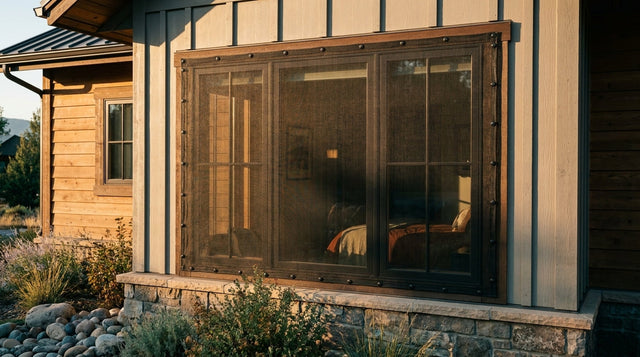
The EZ-Snap Sun Screen uses a mesh the company calls Optical Grade Thermo-Weave™ — the shade-side cousin of the Diamond Weave™ fabric used on its RV skirting kits. The black mesh is the one to reach for in a garage: it blocks up to 90% of solar heat while still letting you see out. White mesh trades some heat rejection for brighter, more diffuse daylight inside, which can be the right call over a workbench where you want light to see by. Both cut to any window shape with ordinary scissors and won't fray at the edge — which matters when your shop windows aren't standard sizes.
Black mesh or white mesh for a workshop?
- Black mesh — maximum heat rejection, up to 90% of solar heat blocked, crisp see-through view out. Best for the hottest west and south exposures.
- White mesh — more transmitted daylight for task lighting, still meaningful heat reduction, softer glare. Good over benches and for north-ish exposures where heat is milder.
No drilling into a steel header or a finished frame
The reason most people never put a shade on the outside of a garage window is the install. You don't want to drill a steel header, a vinyl frame, or a finished surround — and you shouldn't have to. EZ-Snap uses a patented no-drill Cap & Pin snap system that installs in an afternoon, backed by 3M™ VHB adhesive: the pins stick to the frame, the mesh snaps over them, and nothing penetrates the structure. The patent is real — U.S. 8,032,994, inventor Ray Waddell — and the company has been at this since 2006, with 38,000+ customers served.
A few install notes that matter for shop conditions specifically:
- The 3M VHB cures best around 60°F and reaches roughly 60 seconds of working set per stud, with full strength at about 72 hours — so a warm, dry day is your friend.
- Most single-window jobs go up in an afternoon with scissors and a tape measure. No tools you don't already own.
- Kits start at $66.95, with free shipping over $225 — so a multi-window shop usually clears the free-ship line on its own.
Sizing the job for garages, shops, and pole barns
Because the mesh cuts to shape, it doesn't care whether your opening is a tidy double-hung or an awkward awning window over the workbench. Measure the frame, order the kit that covers it, and trim. That same cut-to-fit logic is why exterior screens work across so many odd surfaces — the same product family covers RV and camper windows and shop skylights, which are often the single worst heat offender in a metal building. If your shop has a skylight punching afternoon sun straight down onto the floor, start there.
For the bigger picture on materials, exposures, and how exterior screens compare to film and interior blinds across the whole house, the Shop Exterior Shade Kits collection is the place to go deep. But for a garage or a shop, the takeaway is small and stubborn: the heat is a window problem, the window is on the outside, and so is the fix.
Sources
- "Exterior shutters and shades... are most effective at reducing solar heat gain." The page also states window awnings can reduce solar heat gain by up to 65% on south-facing windows and 77% on west-facing windows. U.S. Department of Energy (Energy Saver), 2024 ↗
- "Exterior window attachments block solar heat before it reaches the window." Interior attachments "can be less effective at reducing heat gain than comparable exterior shading systems because they do not block direct sunlight until after it has already passed through the window." DOE Building America Solution Center (Pacific Northwest National Laboratory), 2023 ↗
- "Depending on the material used, solar screens have the potential to block up to 90% of solar heat gain before it even reaches the window." U.S. Department of Energy, Office of Energy Efficiency & Renewable Energy (EERE), 2023 ↗
- "Heat gain and heat loss through windows are responsible for 25%-30% of residential heating and cooling energy use." U.S. Department of Energy — Energy Saver, 2024 ↗
- SHGC is "the fraction of solar radiation admitted through a window, door, or skylight — either transmitted directly and/or absorbed, and subsequently released as heat inside a home"; a low-SHGC product "is more effective at reducing cooling loads during the summer by blocking heat gain from the sun." U.S. Department of Energy — Energy Saver, 2024 ↗
- Windows "are known as the weakest link in the thermal envelopes" and are "attributable for approximately 10% of building energy use"; though only ~8% of envelope area, they can contribute "up to 45% of the envelope heat loss" in climate zones 4 and 5. Lawrence Berkeley National Laboratory — Windows & Daylighting, 2023 ↗
Common questions
Why does my garage or shop get so much hotter than my house?
Because a detached garage or shop usually has no AC quietly fighting the heat for you, so what comes through the glass just accumulates. Windows are the thermal weak link of a building, and heat moving through them accounts for 25 to 30% of residential heating and cooling energy use. An uninsulated, west-facing shop feels that unsoftened.
What is the best way to cool a hot garage or shop window?
Put an exterior solar screen on the outside of the glass. The U.S. Department of Energy names exterior shutters and shades as the option most effective at reducing solar heat gain, because they intercept the sun before it ever touches the glass. Depending on the mesh, a screen can block up to 90% of solar heat gain before it reaches the window.
Do outdoor shades work on non-standard shop or pole-barn windows?
Yes. The mesh cuts to any window shape with ordinary scissors and won't fray at the edge, so an awkward awning window, a pole-barn opening, or an odd size is a measure, order, and trim job. The same cut-to-fit material also covers shop skylights, which are often the worst heat offender in a metal building.
Can you install a shade without drilling into a steel or vinyl frame?
Yes. The patented no-drill Cap and Pin system uses 3M VHB adhesive, so the pins stick to the frame, the mesh snaps over them, and nothing penetrates the structure. Each stud sets in about 60 seconds and reaches full strength in roughly 72 hours, and most single-window jobs go up in an afternoon.
Should I use black or white mesh in a workshop?
Use black mesh on the hottest west and south exposures: it blocks up to 90% of solar heat while keeping a crisp see-through view. White mesh transmits more daylight for task lighting over a workbench and softens glare, with meaningful but milder heat reduction, so it suits north-ish exposures.
How much do garage window shades cost?
Kits start at $66.95, with free shipping on orders over $225. Because a shop often has several windows, a multi-window job usually clears the free-shipping line on its own. You cut the mesh to fit with scissors and a tape measure, no special tools required.