Boat Window Covers That Block Heat Without Drilling

Key Takeaways
- Exterior boat window covers block solar heat before it reaches the glass, which the U.S. Department of Energy identifies as the most effective way to reduce solar heat gain.
- EZ-Snap® Sun Screen mesh in black can block up to 90% of solar heat, while white mesh preserves more interior light with less heat rejection.
- The patented no-drill Cap & Pin snap with 3M VHB adhesive installs with scissors in an afternoon and never requires drilling into the hull or cabin trim.
- Windows are the thermal weak link of any enclosure, responsible for roughly 25 to 30 percent of heating and cooling energy use in typical buildings.
- EZ-Snap kits start at $66.95 with free shipping over $225 and carry a Limited Lifetime materials warranty from a company serving 38,000+ customers since 2006.
There is a particular kind of heat that builds inside a closed boat cabin on a still summer afternoon — radiant, silent, and stubborn — and most owners fight it the wrong way, drilling brackets into a hull they spent good money keeping pristine. There is a better order of operations, and it starts outside the glass.
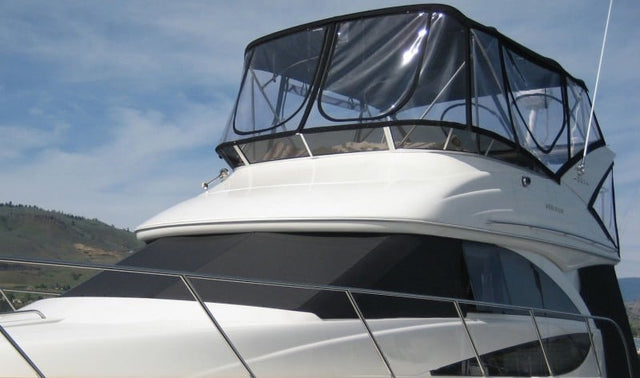
Boat window covers come in two philosophies. One treats the cover as decoration or privacy — a curtain, a snap-in panel, a blind you fuss with from inside. The other treats it as a thermal problem to be solved at the boundary, where sunlight first meets the glass. If your cabin turns into an oven at the dock, you want the second kind: an exterior cover that stops solar heat before it ever enters. This is the distinction that decides whether your air conditioning runs all day or barely runs at all.
Why the cabin gets so hot in the first place
Glass is the thermal weak link of almost any enclosure. On a boat, where windows wrap the salon and the cabin sits in full unshaded sun, that weakness is amplified. Researchers describe windows as "the weakest link in the thermal envelope," capable of contributing a wildly outsized share of heat transfer relative to their surface area.7 In a typical building, heat gain and loss through windows already account for 25 to 30 percent of heating and cooling energy use.4
The mechanism is straightforward once you name it. Solar radiation that passes through glass is admitted, absorbed, and then released as heat inside the space — the fraction that gets through is what window engineers call solar heat gain.5 Once that energy is inside your cabin, it has already become heat your air conditioner has to fight. The trick is to never let it in.
The case for stopping the sun outside the glass
This is the part most people get backwards. Interior blinds, curtains, and snap-in panels only act after sunlight has already passed through the window — by then the energy is in the room. If you're still weighing soft furnishings, our breakdown of boat window shades versus blinds walks through why placement matters more than material. The U.S. Department of Energy is blunt about it: exterior window attachments block solar heat before it reaches the window, while interior attachments are less effective precisely because they intervene too late.2
Stop the sun at the glass, and the heat never becomes your problem to remove.
The DOE goes further and names exterior shutters and shades as the most effective option for reducing solar heat gain, period.1 Exterior solar screen material, depending on weave and color, can block up to roughly 90 percent of solar heat gain before it even reaches the glass.3 That is the number that matters for a boat: not how the cover looks from the dock, but how much radiant load it intercepts before your cabin ever feels it. If you want the full primer on the science and the product line, our Shop Boat Shades collection is the place to start.
No-drill exterior boat window covers, explained
The historical objection to exterior covers on a boat was the mounting. Nobody wants to drill the hull or the cabin trim to hang a screen. The EZ-Snap Sun Screen system removes that objection entirely with a patented no-drill Cap & Pin snap that bonds with 3M VHB adhesive — no holes, no brackets, no compromise to the gelcoat.
Here is how the install actually goes, and why it fits an afternoon rather than a weekend — and if you want the full walkthrough, see our guide on how to install boat window shades with no drilling:
- Cut to shape. The Optical Grade Thermo-Weave™ mesh cuts to any window shape with ordinary scissors and won't fray — a real advantage on boats, where almost no two windows are simple rectangles. You can size your boat shade kit to fit your windows before you cut.
- Snap, don't screw. The Cap & Pin fasteners adhere directly to the surface. The 3M VHB grabs in about 60 seconds per stud and reaches full strength in roughly 72 hours, curing best above about 60°F.
- Choose your mesh. Black mesh blocks up to 90% of solar heat and is the choice for the hottest cabins; white mesh lets in more light while still cutting heat.
- Remove and re-snap. The covers come off when you want an open view and snap back when the sun returns.
Because there's no drilling, this is the rare exterior upgrade that doesn't permanently alter the boat. If you've already seen the approach on land — it's the same engineering behind our exterior window shades for homes and RVs — the marine application is simply the weave and the snaps doing their job in a tougher environment.
What no-drill heat-blocking covers do for cabin comfort
The practical payoff shows up the moment the sun swings onto the salon glass. Instead of a greenhouse that your air conditioning chases all day, you get a cabin that stays livable — often without running A/C at all on a moderate day. The same trick that lets houseboat owners stay cool at the dock without A/C applies just as well to a weekend cruiser. For an exterior boat window cover, the goal isn't to seal the cabin into darkness; it's to take the radiant edge off so the inside is a place you actually want to be.
A few things to weigh when you're choosing boat cabin window covers:
- Color vs. light. Black for maximum heat rejection; white when you want to preserve interior brightness and outward visibility.
- Coverage pattern. West- and south-facing glass takes the worst afternoon load — the DOE's own awning data shows west exposures are the heaviest hit — so prioritize those windows first.6
- Glare, not just heat. The same mesh that blocks solar gain also kills the harsh glare that makes a sunlit salon unpleasant.
Built for the marine environment — and backed
EZ-Snap has been making this exterior mesh since 2006 and has served more than 38,000 customers across boats, RVs, and homes. The screen material carries a Limited Lifetime materials warranty, and the no-drill snap is genuinely patented (U.S. Patent 8,032,994, inventor Ray Waddell) — not a marketing flourish. Whether mesh holds up to long-term salt spray and UV at the same rate it does inland is the kind of claim we won't dress up with a number we can't source. .
Kits start at $66.95, and shipping is free over $225 — modest against the cost of running cabin A/C off a generator all summer, or against re-drilling a hull you'd rather keep whole. The system also adapts beyond the salon: the same approach covers a single exterior shade on a fixed pane or a full wrap of cabin glass.
The heat is going to hit your boat's windows either way. The only real decision is whether you stop it at the glass — where the physics is on your side — or let it inside and pay to pump it back out. Exterior, no-drill, cut to your windows: that's the cover that earns its place on the water.
Sources
- "Exterior shutters and shades... are most effective at reducing solar heat gain." The page also states window awnings can reduce solar heat gain by up to 65% on south-facing windows and 77% on west-facing windows. U.S. Department of Energy (Energy Saver), 2024 ↗
- "Exterior window attachments block solar heat before it reaches the window." Interior attachments "can be less effective at reducing heat gain than comparable exterior shading systems because they do not block direct sunlight until after it has already passed through the window." DOE Building America Solution Center (Pacific Northwest National Laboratory), 2023 ↗
- "Depending on the material used, solar screens have the potential to block up to 90% of solar heat gain before it even reaches the window." U.S. Department of Energy, Office of Energy Efficiency & Renewable Energy (EERE), 2023 ↗
- "Heat gain and heat loss through windows are responsible for 25%-30% of residential heating and cooling energy use." U.S. Department of Energy — Energy Saver, 2024 ↗
- SHGC is "the fraction of solar radiation admitted through a window, door, or skylight — either transmitted directly and/or absorbed, and subsequently released as heat inside a home"; a low-SHGC product "is more effective at reducing cooling loads during the summer by blocking heat gain from the sun." U.S. Department of Energy — Energy Saver, 2024 ↗
- Exterior shutters and shades "are most effective at reducing solar heat gain," and exterior awnings can "reduce solar heat gain in the summer by up to 65% on south-facing windows and 77% on west-facing windows." U.S. Department of Energy — Energy Saver, 2024 ↗
- Windows "are known as the weakest link in the thermal envelopes" and are "attributable for approximately 10% of building energy use"; though only ~8% of envelope area, they can contribute "up to 45% of the envelope heat loss" in climate zones 4 and 5. Lawrence Berkeley National Laboratory — Windows & Daylighting, 2023 ↗
Common questions
What is the best way to block heat coming through boat windows?
Stop the sun outside the glass with an exterior cover, which the U.S. Department of Energy identifies as the most effective way to reduce solar heat gain. Exterior solar screen mesh can block up to roughly 90% of solar heat before it even reaches the glass. Interior blinds and curtains only act after sunlight has passed through, by which point the energy is already inside the cabin as heat the air conditioner has to fight.
How do you install boat window covers without drilling the hull?
Exterior sun screen mounts with a patented no-drill Cap and Pin snap that bonds with 3M VHB adhesive, so no holes or brackets touch the hull or gelcoat. The VHB grabs in about 60 seconds per stud and reaches full strength in roughly 72 hours, curing best above about 60 degrees Fahrenheit. The mesh cuts to any window shape with scissors and the job fits an afternoon.
Can the covers be removed and put back on?
Yes. The covers snap off when you want an open view and snap back when the sun returns, since the mesh attaches to the Cap and Pin fasteners rather than being fixed in place. Because there is no drilling, this is the rare exterior upgrade that doesn't permanently alter the boat.
Should you pick black or white mesh for a boat cabin?
Black mesh blocks up to 90% of solar heat and is the choice for the hottest cabins where maximum heat rejection matters most. White mesh lets in more light while still cutting heat, when you want to preserve interior brightness and outward visibility. Either way, the same mesh that blocks solar gain also kills the harsh glare in a sunlit salon.
Which boat windows should you cover first?
Start with the west- and south-facing glass, which takes the worst afternoon load. Covering those windows first intercepts the heaviest radiant load before the cabin ever feels it. From there you can extend coverage to the rest of the salon glass as needed.
How much do no-drill boat window covers cost?
Kits start at $66.95, with free shipping over $225, and carry a Limited Lifetime materials warranty. EZ-Snap has made this exterior mesh since 2006 and served more than 38,000 customers, and the no-drill snap is genuinely patented as U.S. Patent 8,032,994.