How to Install Boat Window Shades With No Drilling

Key Takeaways
- Exterior shades are the most effective way to cut solar heat gain because they block sunlight before it reaches the glass, unlike interior blinds that react to heat already inside.
- The EZ-Snap® boat install uses a patented no-drill Cap & Pin snap with 3M VHB tape, so there are no holes in your hull or gelcoat.
- 3M VHB sets in about 60 seconds per stud but needs roughly 72 hours and a surface near 60F to reach full strength, so install on a dry, mild day at the dock.
- The Optical Grade Thermo-Weave mesh cuts to any window shape with scissors and is non-fray, making it ideal for the odd trapezoids and curves of marine glass.
- Black EZ-Snap mesh blocks up to 90% of solar heat; white mesh lets in more light with less heat rejection.
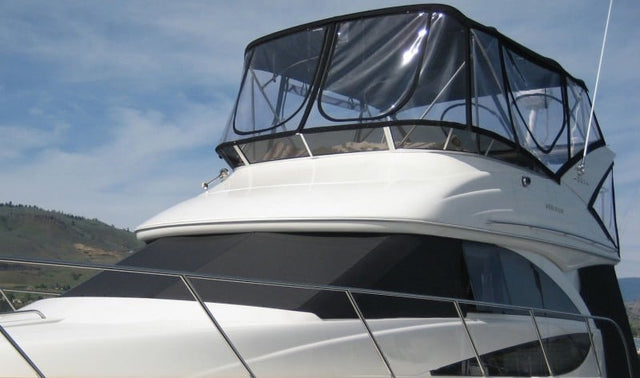
There is a particular kind of misery that lives below deck on a sunny afternoon, when the cabin has quietly become an oven and every window is doing its honest best to make things worse. The fix is older than air conditioning and far simpler: stop the sun at the glass, on the outside, before it ever gets in. This is a guide to doing exactly that on a boat, with scissors and a roll of tape, and not a single hole drilled into your hull or cabin trim.
How do you install boat window shades without drilling?
Install no-drill boat window shades by mounting EZ-Snap Cap & Pin studs with 3M VHB tape: wipe each spot with isopropyl alcohol, press the studs evenly around the window, trim the non-fray mesh to shape with scissors, then snap it on. No screws or holes — the whole job takes an afternoon and the surface stays yours.
That outside-the-glass detail is not a marketing flourish. The U.S. Department of Energy is blunt about it: exterior shutters and shades are the most effective way to reduce solar heat gain, because they intercept sunlight before it reaches the window.1 Interior blinds and curtains can only react to heat that has already passed through the glass and entered the space.2 On a boat, where the glass is often large, raked, and pointed straight at open water with no shade trees in sight, that distinction is the whole game — and it is exactly why, in any honest matchup of boat window shades versus blinds, the screen that lives outside the glass wins.
Why the shade has to live outside the glass
Picture the path of a sunbeam. It hits the window, and a fraction of its energy is admitted through, then released as heat inside the cabin — the metric engineers call Solar Heat Gain Coefficient.4 Once that energy is inside, you are no longer blocking heat; you are fighting it. An exterior solar screen changes the math entirely, because depending on the mesh it can block a large share of solar heat gain before it even reaches the window.3 The EZ-Snap Sun Screen uses an Optical Grade Thermo-Weave™ mesh for exactly this reason: in black, it blocks up to 90% of solar heat, while the white mesh trades some of that rejection for brighter, softer interior light. This is the same principle behind a good set of boat window covers that block heat without drilling.
An interior blind fights heat that has already arrived. An exterior screen makes sure it never shows up.
What no-drill marine window shade install actually means
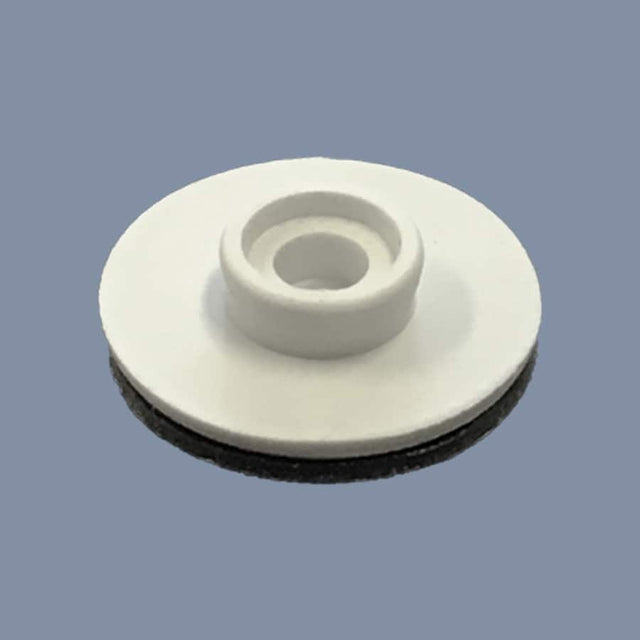
The reason most boaters never touch exterior shades is the fear of the drill — the idea that protecting a window means committing fasteners to fiberglass or gelcoat forever. The EZ-Snap system retires that fear. It mounts with a patented Cap & Pin snap bonded by 3M VHB tape, an industrial double-sided adhesive that grips the smooth surfaces boats are made of. No drilling, no screws, no holes to bed and re-bed in three seasons. If you ever remove the shades, you remove the snaps too, and the surface is yours again.
Before anything sticks, understand the cure. The 3M VHB bond reaches roughly 60 seconds of working set per stud, but it does not hit full strength until about 72 hours later, and it wants a surface that is around 60°F or warmer to cure properly. Plan the install for a dry, mild day at the dock — not the morning you intend to cast off into a chop.
The install, step by step
1. Clean like the bond depends on it (it does)
Wipe every spot where a snap will land with isopropyl alcohol and let it flash off completely. Salt film, wax, polish, and sunscreen are all bond-killers on a boat. This is the single step people rush and later regret.
2. Lay out and snap your studs
Position the Cap & Pin studs around the perimeter of the window, spacing them evenly so the mesh will pull flat without sag. Peel the VHB liner, press each stud firmly for that ~60-second initial set, and resist the urge to reposition once it grabs.
3. Trim the mesh to the window
This is where boat windows — rarely simple rectangles — stop being a problem. The Thermo-Weave™ mesh cuts to any shape with ordinary scissors and is non-fray, so trapezoids, rounded ports, and raked windshields are all fair game. Cut a touch generous, then snap and test before final trimming.
4. Snap, tension, and walk away
Press the mesh onto the studs, working around the perimeter so tension stays even and the screen sits taut. Then leave it. Give the VHB its ~72 hours to reach full strength before you subject the install to wind and travel. The whole job is an afternoon with scissors — genuinely.
Trimming odd marine glass without making a mistake
A boat throws shapes a house never will: a windshield that wraps, a cabin port shaped like a wedge, an opening hatch that has to keep opening. The forgiving move is to template first. Hold the uncut mesh over the window, mark with a grease pencil, and cut wide. Because the weave does not fray, you can shave it down in passes until it tucks cleanly to the snaps. For opening windows and hatches, mount the studs on the fixed frame rather than the moving sash so the screen stays put while the glass swings. The same approach scales straight to below deck — see how the same kit handles no-drill sailboat cabin shades — and the same logic that makes EZ-Snap work on a hull is what makes the broader line of no drill boat shades adaptable to RVs, skylights, and home windows — one snap, infinite shapes.
What you actually feel afterward
The payoff is not abstract. Windows are the thermal weak link of any enclosure, responsible for a disproportionate share of heat moving in and out relative to their area.5 On a boat that imbalance is brutal — lots of glass, no insulation behind it, and the sun reflecting up off the water for a second helping. Knock down the solar gain at the surface and the cabin stops cooking, the air conditioning stops straining, and the helm stops glaring. The screen you can see through from inside becomes nearly opaque from outside, which buys a little privacy at the dock as a bonus.
If you want the mechanical detail of how the Cap & Pin snap and VHB bond come together, the See How It Works walkthrough covers the system end to end. Boaters comparing options across the rest of the fleet can browse the dedicated boat shade install kits, which start at $66.95 with free shipping over $225, are non-fray, cut to any window, and carry a Limited Lifetime materials warranty from a company that has been doing this since 2006 for more than 38,000 customers. When you have your measurements, you can size your no-drill boat shade kit to fit. The patent behind the snap — U.S. 8,032,994 — is real, and so is the afternoon you get back the first time the cabin stays cool.
Sources
- "Exterior shutters and shades... are most effective at reducing solar heat gain." The page also states window awnings can reduce solar heat gain by up to 65% on south-facing windows and 77% on west-facing windows. U.S. Department of Energy (Energy Saver), 2024 ↗
- "Exterior window attachments block solar heat before it reaches the window." Interior attachments "can be less effective at reducing heat gain than comparable exterior shading systems because they do not block direct sunlight until after it has already passed through the window." DOE Building America Solution Center (Pacific Northwest National Laboratory), 2023 ↗
- "Depending on the material used, solar screens have the potential to block up to 90% of solar heat gain before it even reaches the window." U.S. Department of Energy, Office of Energy Efficiency & Renewable Energy (EERE), 2023 ↗
- SHGC is "the fraction of solar radiation admitted through a window, door, or skylight — either transmitted directly and/or absorbed, and subsequently released as heat inside a home"; a low-SHGC product "is more effective at reducing cooling loads during the summer by blocking heat gain from the sun." U.S. Department of Energy — Energy Saver, 2024 ↗
- Windows "are known as the weakest link in the thermal envelopes" and are "attributable for approximately 10% of building energy use"; though only ~8% of envelope area, they can contribute "up to 45% of the envelope heat loss" in climate zones 4 and 5. Lawrence Berkeley National Laboratory — Windows & Daylighting, 2023 ↗
Common questions
How do you install boat window shades without drilling?
Mount Cap and Pin studs with 3M VHB tape instead of screws: wipe each spot with isopropyl alcohol, press the studs evenly around the window, trim the non-fray mesh to shape with scissors, then snap it on. There are no holes in your hull or gelcoat, and the whole job takes an afternoon. If you ever remove the shades, the snaps come off too and the surface is yours again.
Will installing boat shades damage my hull or gelcoat?
No, the system uses a patented Cap and Pin snap bonded with 3M VHB tape, an industrial adhesive that grips the smooth surfaces boats are made of, so there is no drilling and no holes to bed and re-bed over time. Remove the shades later and you remove the snaps too, leaving the fiberglass or gelcoat intact.
When is the best time to install marine window shades?
Install on a dry, mild day at the dock, not the morning you plan to cast off into a chop. The 3M VHB bond sets in about 60 seconds of pressure per stud but needs roughly 72 hours to reach full strength, and it wants a surface around 60F or warmer to cure properly. Give the bond its full cure before subjecting it to wind and travel.
How do you cut shade mesh to fit odd-shaped boat windows?
Template first: hold the uncut mesh over the window, mark it with a grease pencil, and cut wide, then shave it down in passes until it tucks cleanly to the snaps. Because the Thermo-Weave mesh is non-fray, trapezoids, rounded ports, and raked windshields are all fair game with ordinary scissors. For opening windows and hatches, mount the studs on the fixed frame rather than the moving sash.
Why put shades on the outside of boat windows instead of inside?
Exterior shades are the most effective way to cut solar heat because they block sunlight before it reaches the glass, while interior blinds can only react to heat already inside the cabin. The Department of Energy backs this, and on a boat the effect is amplified because there is lots of glass, no insulation behind it, and sun reflecting up off the water for a second helping. Black EZ-Snap mesh blocks up to 90% of solar heat.
How much do no-drill boat shade kits cost?
Boat shade kits start at $66.95, with free shipping over $225. They cut to any window shape, are non-fray, and carry a Limited Lifetime materials warranty from a company that has been doing this since 2006 for more than 38,000 customers. Once you have your measurements, you can size a kit to fit your specific windows.