Low-E Window Reflection Damage: Melted Grass, Faded Furniture, and More

Key Takeaways
- Low-E glass reflects 30-50% of solar energy versus about 10% for clear glass, and a slight pressure-induced curve in the pane can focus that reflection into a beam measured above 200°F.
- The same reflected beam that melts vinyl siding can brown lawns, warp artificial turf, scorch plants, and accelerate fading on furniture and interiors.
- Interior blinds and films can't stop the problem because they only act after sunlight has passed through the glass; the U.S. DOE notes exterior shading blocks solar heat before it reaches the window.
- The U.S. Department of Energy identifies exterior shades as the most effective way to reduce solar heat gain, with exterior solar screens blocking up to 90% before the heat reaches the glass.
- An exterior EZ-Snap® Sun Screen diffuses the mirror-like reflection at the source window and cuts transmitted heat, solving the lawn scorch and the interior fading with one fix.
Somewhere on your block, a window is doing an impression of a magnifying glass held over an anthill — except the anthill is your lawn, your patio chairs, or the living-room sofa you just reupholstered. The strange thing about Low-E reflection damage is that nobody believes it until they're standing in the scorch mark, watching a star-shaped beam of light slowly cook a stripe across the grass.
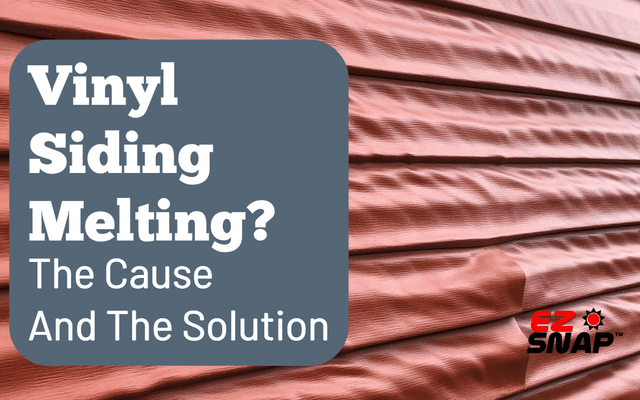
This is not folklore, and it is not ambient summer heat. Energy-efficient double-paned Low-E glass can warp into a shallow concavity from the pressure difference sealed between its panes, and that subtle curve focuses reflected sunlight like a lens — landing as a brilliant spot whose surface temperatures have been measured in excess of 200°F, hot enough to soften and distort vinyl siding that begins to deform around 160–165°F.1 A national lab studying the phenomenon found that ordinary clear glass reflects about 10% of solar energy, while Low-E coatings reflect 30–50% of it.1 That is the whole story in one sentence: a more efficient window throws back more energy, and a curved window aims it.
The beam is real, and physics is on its side
The Lawrence Berkeley National Laboratory, working through the U.S. Department of Energy, has formally examined glass solar reflectance as a cause of permanent vinyl siding distortion — looking at the environmental heat-transfer factors and the conditions that determine how much radiation a glass surface throws back.2 The Polymeric Exterior Products Association (the former Vinyl Siding Institute) puts the mechanism plainly: energy-efficient windows are capable of concentrating and reflecting solar energy onto a wide variety of materials, and the "zone" where that beam is most concentrated shifts with the curvature of the glass — which itself changes in the same window under different temperatures and atmospheric pressures.3
That last detail is why the damage feels haunted. The beam moves. It wanders across a season as the glass flexes, which is why one week it's browning a patch of turf and the next it's working on the neighbor's fence. If the reflection is coming from next door rather than your own glass, the fix is the same physics but a different conversation — there's a whole playbook for when a neighbor's Low-E windows are melting your siding.
The full damage taxonomy: who the beam actually hits
Vinyl siding gets all the headlines because it melts photogenically — a diagonal warp that home inspectors recognize on sight, with reflected heat capable of affecting siding up to 20 feet away.4 But siding is only the loudest victim. Once you know the beam exists, you start seeing its fingerprints everywhere.
- Low-E windows melting grass and turf. Natural lawn browns in a hard-edged stripe; artificial turf, which is plastic, can warp, fuse, and develop a glossy melted scar. The synthetic blades have no defense — they're closer to siding than to grass.
- Burning the lawn and scorching plants. A focused reflection will cook a flowerbed or shrub along the beam's path, leaving healthy growth on either side and a dead lane down the middle.
- Faded furniture and interiors. Concentrated, repeated solar exposure accelerates UV fading on upholstery, rugs, and wood far faster than ordinary daylight does.
- Soft outdoor materials. Patio furniture, planters, gutters, and trim — anything plastic in the focal zone is fair game.
A more efficient window doesn't waste energy — it returns it, and a curved one returns it to a single point.
If you've searched do low-e windows fade furniture and walked away unsure, the honest answer is that the same reflectance that scorches a lawn is the same reflectance pouring extra solar load through nearby glass and onto your interiors. It's all one beam, just hitting different surfaces, and it's the core reason so many homeowners end up saying they hate their Low-E windows once the damage starts adding up.
Why you can't fix it at the glass you can see
The reflex is to treat the symptom — replant the grass, replace the siding panel, draw the curtains on the room that's fading. None of that touches the cause, because the cause is a window throwing light, not a window letting light in. You can't reason with a reflection by standing behind it.
Interior blinds and films are the wrong tool here for a structural reason: exterior window attachments block solar heat before it reaches the window, while interior attachments are less effective at reducing heat gain because they don't intercept direct sunlight until after it has already passed through the glass.6 By then the energy is already inside — and on the reflection side, an interior shade does nothing at all to the beam leaving the pane. You have to address the sunlight at the surface that's reflecting or transmitting it, which is the whole point of learning how to stop the sun from reflecting off your windows at the source.
Diffuse the beam at the source: exterior shade over the glass
The Department of Energy is unambiguous about which approach wins: exterior shutters and shades are the most effective option for reducing solar heat gain, and exterior solar screens can block up to 90% of solar heat gain before it even reaches the window.57 A screen over the offending pane does two jobs at once — it breaks up the mirror-smooth reflection that forms the beam, and it cuts the transmitted heat that fades your interiors. The same fix solves the lawn and the sofa. If it's your own glass throwing the beam, you can shop no-drill solar window screens sized to the exact window.
This is exactly what the EZ-Snap Sun Screen is built for. Its Optical Grade Thermo-Weave™ mesh in black blocks up to 90% of solar heat; you can Shop Exterior Sun Screens and treat the specific windows causing trouble rather than re-skinning the whole house. The patented no-drill Cap & Pin snap with 3M VHB means there's nothing drilled into the frame — it installs in an afternoon with scissors, cuts to any window shape, and won't fray at the edges.
What setup actually looks like
You measure, cut the mesh to the opening, and snap it onto the caps; the 3M VHB adhesive reaches roughly 60-second hold per stud and full strength in about 72 hours above a 60°F cure. Kits start at $66.95 with free shipping over $225, and the materials carry a Limited Lifetime warranty from a company that's been doing this since 2006 for more than 38,000 customers. For odd-shaped openings or a sunroom that's part of the problem, the skylight shade kits use the same system overhead.
Low-E glass is genuinely good technology — it's not the villain, and you shouldn't rip it out. You just have to give that reflected energy somewhere soft to land before it finds your lawn. Shade the source, and the beam, the brown stripe, and the fading all disappear together.
Sources
- Double-paned low-E glass may warp slightly into a concavity from barometric pressure differences; this concavity focuses reflected sunlight like a magnifying glass, landing as a brilliant star-shaped spot whose concentrated heat reaches surface temperatures well above direct sunlight — measured in excess of 200°F, more than enough to soften and distort any normal grade of vinyl siding (which begins to soften at 160–165°F). Clear glass reflects ~10% of solar energy, low-E reflects 30–50%. National Association of Home Builders (David N. Crump, Jr., Director of Legal Research), 2014 ↗
- Glass solar reflectance contributes to permanent vinyl siding distortion; the white paper examines environmental heat-transfer factors, vinyl siding properties affecting heat build-up, and the factors determining reflected solar radiation from glass surfaces, including insulating window glass. Lawrence Berkeley National Laboratory (Hart, Curcija, Arasteh, Goudey, Kohler, Selkowitz), via U.S. DOE OSTI.GOV, 2011 ↗
- Energy-efficient windows are capable of concentrating and reflecting solar energy, which causes damage to a wide variety of materials; the 'zone' of distance from the window where the reflected beam is most concentrated depends mostly on the curvature of the glass, which can change in the same window under different temperature and atmospheric-pressure conditions. Polymeric Exterior Products Association (PEPA, formerly the Vinyl Siding Institute), 2024 ↗
- Low-E windows can be the culprit of melted vinyl siding: the intense reflected heat can be focused similar to focusing the sun's rays through a magnifying glass; the hot glare can affect siding up to 20 feet away, and the melted siding usually exhibits a diagonal pattern. Traditional vinyl siding begins to warp and distort at around 170°F. InterNACHI (International Association of Certified Home Inspectors), 2020 ↗
- "Exterior shutters and shades... are most effective at reducing solar heat gain." The page also states window awnings can reduce solar heat gain by up to 65% on south-facing windows and 77% on west-facing windows. U.S. Department of Energy (Energy Saver), 2024 ↗
- "Exterior window attachments block solar heat before it reaches the window." Interior attachments "can be less effective at reducing heat gain than comparable exterior shading systems because they do not block direct sunlight until after it has already passed through the window." DOE Building America Solution Center (Pacific Northwest National Laboratory), 2023 ↗
- "Depending on the material used, solar screens have the potential to block up to 90% of solar heat gain before it even reaches the window." U.S. Department of Energy, Office of Energy Efficiency & Renewable Energy (EERE), 2023 ↗
Common questions
Can Low-E windows really melt siding and burn grass?
Yes, Low-E windows can melt vinyl siding and scorch lawns. Low-E glass reflects 30 to 50% of solar energy versus about 10% for clear glass, and a slight pressure-induced curve in the pane can focus that reflection into a beam measured above 200 degrees Fahrenheit. That concentrated beam can distort siding, brown grass, warp artificial turf, and scorch plants along its path.
Why can't interior blinds or films stop Low-E reflection damage?
Interior blinds and films cannot stop the problem because they only act after sunlight has already passed through the glass. On the reflection side, an interior shade does nothing to the beam leaving the pane. The U.S. Department of Energy notes that exterior shading blocks solar heat before it reaches the window, so the fix has to happen at the outside surface of the glass.
What is the best way to stop Low-E window reflection?
The most effective fix is an exterior shade placed over the glass, which the U.S. Department of Energy identifies as the best way to reduce solar heat gain. Exterior solar screens can block up to 90% of solar heat before it reaches the window. A screen breaks up the mirror-smooth surface that forms the beam and cuts the transmitted heat at the same time.
Do Low-E windows also fade furniture and interiors indoors?
Yes, the same reflectance that scorches a lawn also pours extra solar load through nearby glass and onto your interiors, accelerating UV fading on upholstery, rugs, and wood faster than ordinary daylight. It is all one beam hitting different surfaces, so shading the source window addresses both the outdoor scorching and the interior fading with a single fix.
How is the EZ-Snap Sun Screen installed on a window?
The EZ-Snap Sun Screen installs with no drilling using a patented Cap and Pin snap with 3M VHB adhesive, so nothing is drilled into the frame. You measure, cut the mesh to the opening with scissors, and snap it onto the caps, and it installs in an afternoon. The VHB holds in about 60 seconds per stud and reaches full strength in roughly 72 hours above a 60 degree cure. Kits start at $66.95 with free shipping over $225.