How to Stop the Sun From Reflecting Off Your Windows

- Low-E glass reflects 30 to 50% of solar energy versus roughly 10% for clear glass, and a slight concave flex can focus that into a hot spot above 200°F.
- Interior blinds, curtains and films cannot stop an outbound window reflection, because the sunlight already bounced off the outer coating before reaching anything mounted inside.
- The U.S. Department of Energy identifies exterior shades and shutters as most effective at reducing solar heat gain, since they block sunlight before it reaches the glass.
- An exterior mesh sun screen scatters light across thousands of fibers so the glass stops forming a coherent beam, breaking up glare and the concentrated hot spot at the source.
- EZ-Snap®'s exterior sun screen mounts with a patented no-drill snap and 3M VHB adhesive, cuts to any window shape with scissors, and blocks up to 90% of solar heat.
Key Takeaways
- Low-E windows reflect 30-50% of solar energy (versus ~10% for clear glass), and a slight concave flex can focus that reflection into a hot spot measured above 200°F.
- Interior blinds and films can't stop an outbound reflection because the light has already bounced off the glass before reaching them; the fix must sit outside the window.
- The U.S. Department of Energy identifies exterior shades as the most effective way to reduce solar heat gain because they block sunlight before it reaches the glass.
- An exterior mesh screen diffuses light across its fibers so the glass stops acting like a mirror, breaking up both glare and the concentrated heat beam at the source.
- EZ-Snap's exterior sun screen installs with a patented no-drill snap and 3M VHB adhesive, cuts to any window shape with scissors, and blocks up to 90% of solar heat in black mesh.
Stand in the right spot on a summer afternoon and an ordinary window stops being a window. It becomes a mirror with intent — a blade of light that follows you across the lawn, washes out the television, and lands on the neighbor's siding like a brand. Stopping the sun from reflecting off your windows is not about the glass being broken. It is about the glass doing exactly what modern glass is built to do, and learning to interrupt it at the source.
How do you stop the sun from reflecting off your windows?
Add an exterior treatment, not an interior one. Because Low-E glass reflects light off its outer coating, blinds and films behind the glass can't help. An exterior mesh sun screen scatters incoming light before it hits the coating, diffusing the beam at the source — and it blocks up to 90% of solar heat in the process.
Why your windows turned into mirrors
The reflection you are fighting is usually a feature, not a flaw. Energy-efficient Low-E glass is engineered with a microscopic metallic coating to bounce heat away from the home, and it does so well — clear glass reflects roughly 10% of solar energy, while Low-E glass reflects 30 to 50%.1 That rejected light has to go somewhere, and on a bright day it goes outward, sideways, and into whatever is unlucky enough to be standing in the beam. If you have ever caught yourself muttering that you hate your Low-E windows, the coating you paid for is exactly why.
It gets stranger. A double-paned unit can flex slightly into a shallow concave dish under barometric pressure changes, and that curvature focuses the reflected light like a magnifying glass — a brilliant, star-shaped hot spot that has been measured well above 200°F.1 The exact distance where the beam is most concentrated shifts with temperature and pressure, so the bright spot wanders through the day.2 This is the same mechanism behind the reflection damage to grass and furniture you may have read about, where a neighbor's window scorches vinyl up to 20 feet away in a telltale diagonal pattern.3
A Low-E window doesn't leak heat. It aims it.
The fixes that don't actually work
Most first instincts treat the symptom on the wrong side of the glass. Interior blinds, curtains, and roller shades feel like the obvious answer, but they fail at the reflection problem for a simple geometric reason: they sit behind the glass. The sunlight has already hit the coating and bounced outward before any indoor treatment gets a vote. The Department of Energy is blunt about it — interior attachments "do not block direct sunlight until after it has already passed through the window," which makes them less effective than exterior shading.5
The other tempting routes are expensive or partial:
- Replacing the glass — thousands of dollars to swap the very windows you bought for efficiency, with no guarantee the new units won't flex and reflect too.
- Reflective interior film — can dull glare from inside, but does nothing for the outbound beam hitting the lawn or the neighbor.
- Landscaping — a tree takes a decade and doesn't follow the sun.
If your real goal is to stop window glare outside — the reflection landing in a yard, a pool deck, or a neighbor's wall — the treatment has to live on the outside of the glass.
Diffuse the mirror at the source
The cleanest way to kill a reflection is to stop the glass from behaving like a polished mirror. An exterior mesh screen sits a breath off the glass and scatters incoming light across thousands of tiny fibers before it can hit the coating and re-form into a coherent beam. Instead of one concentrated blade of light bouncing back out, you get soft, diffuse light — the hot spot is broken up before it ever leaves the window.
This is also why exterior treatment is the heavyweight answer to heat. The DOE calls exterior shades and shutters "most effective at reducing solar heat gain,"4 precisely because they block solar energy before it reaches the glass.5 A solar screen mesh can intercept up to 90% of solar heat gain before it touches the window.6 The same physics that reduces reflection from windows also keeps the room cooler — one screen, two problems solved.
What an exterior sun screen actually is
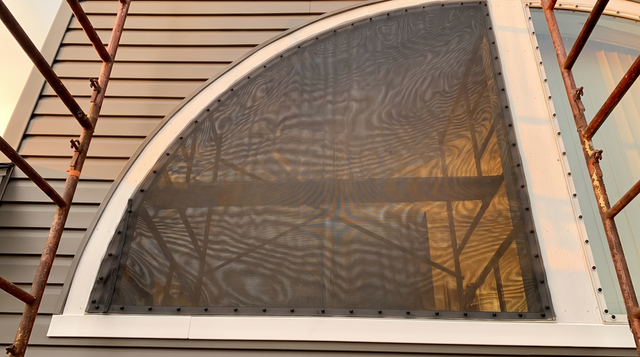
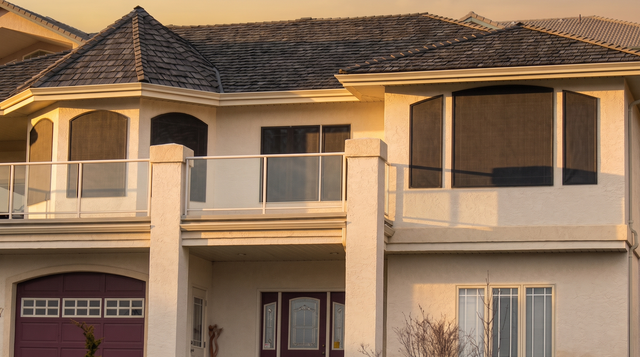
The EZ-Snap Sun Screen is built for exactly this job. Its Optical Grade Thermo-Weave™ mesh is woven to diffuse light rather than mirror it. The black mesh blocks up to 90% of solar heat while still letting you see out; the white mesh trades some of that heat rejection for brighter, softer interior light. You keep your view and your daylight — you just lose the glare and the heat beam. Browse the full range of solar screens for Low-E windows to match your glass.
Because it is a mesh and not a film, it cuts to any window shape with scissors and won't fray at the edge — round-tops, half-moons, picture windows, and odd RV and skylight glass all included. There is no glass to replace and no special skill required.
Installing it without drilling a single hole
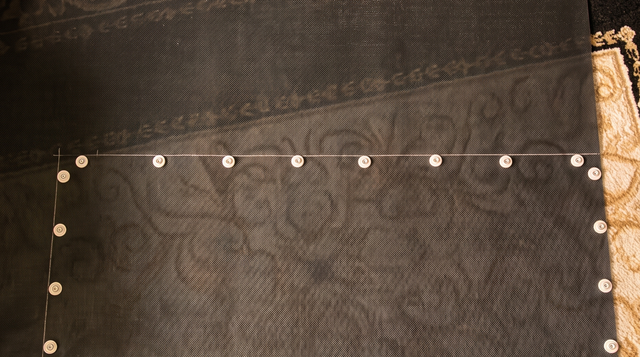
The part that usually scares homeowners — mounting something to the outside of the house — is the part EZ-Snap deliberately disarmed. The patented no-drill Cap & Pin snap system anchors to the window frame with 3M VHB adhesive, no holes through siding, brick, or trim. A few notes from the field:
- The VHB tabs cure best around 60°F and reach roughly 60 seconds of working bond per stud, climbing to full strength over about 72 hours.
- The mesh snaps onto the pins, so you can take it down seasonally and put it back without re-mounting anything.
- Most homeowners cover a window in an afternoon with nothing more exotic than scissors.
The company has been refining this no-drill approach since 2006 and now counts more than 38,000 customers, with a Limited Lifetime warranty on the materials — the patented snap is real engineering, U.S. Patent 8,032,994.
When the reflection is your neighbor's window, not yours
The hardest version of this problem is the one you didn't cause: a window reflecting sun into a neighbor's yard or onto your siding. You can't shade someone else's glass, but the source-side fix still applies — the screen has to go on the window doing the reflecting. If you are the one watching a neighbor's Low-E windows melt your siding, the honest path is a calm conversation: share what you know about Low-E concentration2 and offer the exterior-screen solution as the low-cost, no-damage option that spares everyone a glass-replacement bill. It diffuses the beam at its origin, which is the only place it can truly be stopped.
Whether the trouble is a hot spot on the couch, a glare that erases your monitor, or a beam scorching a wall across the property line, the answer rhymes: don't fight the light after it has bounced — keep the glass from bouncing it in the first place.
Sources
- Double-paned low-E glass may warp slightly into a concavity from barometric pressure differences; this concavity focuses reflected sunlight like a magnifying glass, landing as a brilliant star-shaped spot whose concentrated heat reaches surface temperatures well above direct sunlight — measured in excess of 200°F, more than enough to soften and distort any normal grade of vinyl siding (which begins to soften at 160–165°F). Clear glass reflects ~10% of solar energy, low-E reflects 30–50%. National Association of Home Builders (David N. Crump, Jr., Director of Legal Research), 2014 ↗
- Energy-efficient windows are capable of concentrating and reflecting solar energy, which causes damage to a wide variety of materials; the 'zone' of distance from the window where the reflected beam is most concentrated depends mostly on the curvature of the glass, which can change in the same window under different temperature and atmospheric-pressure conditions. Polymeric Exterior Products Association (PEPA, formerly the Vinyl Siding Institute), 2024 ↗
- Low-E windows can be the culprit of melted vinyl siding: the intense reflected heat can be focused similar to focusing the sun's rays through a magnifying glass; the hot glare can affect siding up to 20 feet away, and the melted siding usually exhibits a diagonal pattern. Traditional vinyl siding begins to warp and distort at around 170°F. InterNACHI (International Association of Certified Home Inspectors), 2020 ↗
- "Exterior shutters and shades... are most effective at reducing solar heat gain." The page also states window awnings can reduce solar heat gain by up to 65% on south-facing windows and 77% on west-facing windows. U.S. Department of Energy (Energy Saver), 2024 ↗
- "Exterior window attachments block solar heat before it reaches the window." Interior attachments "can be less effective at reducing heat gain than comparable exterior shading systems because they do not block direct sunlight until after it has already passed through the window." DOE Building America Solution Center (Pacific Northwest National Laboratory), 2023 ↗
- "Depending on the material used, solar screens have the potential to block up to 90% of solar heat gain before it even reaches the window." U.S. Department of Energy, Office of Energy Efficiency & Renewable Energy (EERE), 2023 ↗
Common questions
How do you stop the sun from reflecting off your windows?
Add an exterior treatment, not an interior one. Because Low-E glass reflects light off its outer coating, blinds and films behind the glass cannot help. An exterior mesh sun screen scatters incoming light before it hits the coating, diffusing the beam at the source while blocking up to 90% of solar heat.
Why do Low-E windows reflect so much sunlight?
Low-E glass carries a microscopic metallic coating designed to bounce heat away from the home, so it reflects 30 to 50% of solar energy versus about 10% for clear glass. That rejected light travels outward, and a slight concave flex in the sealed pane can focus it into a hot spot measured above 200 degrees F.
Will interior blinds or film stop a window reflection?
No. Interior blinds, curtains, and film sit behind the glass, so sunlight has already hit the coating and bounced outward before they get a vote. The Department of Energy notes interior attachments do not block sunlight until after it passes through the window, which makes them less effective than exterior shading.
What actually stops window glare at the source?
An exterior mesh screen mounted a breath off the glass scatters incoming light across thousands of fibers so the glass stops acting like a mirror. This breaks up the reflected beam before it forms, and because it sits outside it also blocks up to 90% of solar heat, solving glare and heat with one screen.
Can an exterior sun screen be installed without drilling?
Yes. The patented no-drill Cap and Pin snap anchors to the window frame with 3M VHB adhesive, with no holes through siding, brick, or trim. Each stud sets in about 60 seconds and reaches full strength over roughly 72 hours, and the mesh cuts to any window shape with scissors.
What can I do if my neighbor's window is reflecting onto my house?
You cannot shade someone else's glass, so the fix has to go on the window doing the reflecting. The honest path is a calm conversation: share that Low-E glass concentrates reflected sun, and offer an exterior screen as a low-cost, no-damage alternative to a glass-replacement bill.