My Neighbor's Low-E Windows Are Melting My Siding: What You Can Do

Key Takeaways
- Low-E windows reflect 30–50% of solar energy versus about 10% for clear glass, and a slightly concave double-pane can focus that reflection into a beam exceeding 200°F — hotter than vinyl siding's 160–165°F softening point.
- Reflected-beam siding damage has a diagnosable signature: a diagonal melt pattern, a moving bright star-shaped spot in late afternoon, and effects on siding up to 20 feet from the source window.
- The damage cannot be fixed on the affected wall; replaced panels will re-melt unless the concentrated reflection is stopped at the source window.
- The U.S. Department of Energy identifies exterior shading as the most effective way to reduce solar heat gain because it blocks sunlight before it reaches the glass, and exterior solar screens can block up to 90% of solar heat gain.
- A no-drill exterior sun screen installed on the neighbor's window scatters the reflection before it can focus, offering a fast, reversible, low-cost alternative to a liability dispute.
You walk the dog one July evening and notice it: a ripple in your siding, a smear of warped vinyl below the window line, the panels sagging like wax left too near a candle. The strange part is that nothing on your house could have done it — the heat came from across the property line, bounced off the new windows your neighbor just installed.
This is one of the genuinely odd failure modes in residential construction, and it catches people off guard because it violates intuition. Siding doesn't melt from a hot afternoon. It melts from a beam — a focused, concentrated reflection that behaves less like weather and more like a magnifying glass aimed at a leaf.
Why a window across the yard can ruin your siding
Modern energy-efficient windows are coated with a microscopically thin low-emissivity (low-E) layer that throws solar energy back instead of letting it pass through. Clear glass reflects roughly 10% of solar energy; low-E glass reflects 30–50% of it.1 That alone wouldn't be a problem — diffuse reflection just makes a window look bright. The damage comes from a second, sneakier effect.
A sealed double-paned unit traps a fixed pocket of air between the panes. When barometric pressure drops or the gas warms, that pocket pushes outward; when it cools, the panes draw inward into a slight concavity. A concave mirror focuses light. So the window stops scattering sunlight and starts aiming it, landing as a brilliant star-shaped spot whose surface temperature has been measured in excess of 200°F.1 Vinyl siding begins to soften around 160–165°F, so the math is brutally simple. If you've come to resent your own low-E windows for the same reason, the mechanism is identical — only the victim changes.
Your siding didn't fail in the heat. It was focused on, like a leaf under a child's magnifying glass.
This isn't fringe speculation. Lawrence Berkeley National Laboratory, working through the U.S. Department of Energy, published a white paper specifically examining glass solar reflectance as a cause of permanent vinyl siding distortion.2 The trade body for siding manufacturers — now the Polymeric Exterior Products Association — confirms that energy-efficient windows can concentrate and reflect solar energy onto a range of materials, and that the "zone" where the beam is hottest shifts with the glass curvature, which itself changes with temperature and atmospheric pressure.3 The same focused beam has been documented melting more than siding — it scorches grass, patio furniture, and other exterior materials in its path.
How to confirm it's reflected heat from a neighbor's window
Before you knock on a door, make sure you're reading the evidence correctly. A few telltale signatures separate reflected-beam damage from ordinary heat or a defective batch of siding.
- The diagonal smear. Home inspectors note that melted siding from a reflected beam usually shows a diagonal pattern, because the focal spot tracks across the wall as the sun moves.4
- The distance. The hot glare can affect siding up to 20 feet away,4 so the damage doesn't have to be on a shared wall — a window across a side yard counts.
- The timing. Walk the wall in the late afternoon and look for a moving bright spot. If you see a star of light crawling across the panels, you've found your culprit in real time.
- The geometry. Trace a straight line from the damage back toward the offending window. Reflected beams travel in straight lines; a sun-faded wall does not have a point source.
Document it. Photograph the damage, the bright spot, and the window at the hour it concentrates. This matters for both the conversation and any claim that follows.
Who is liable for melted vinyl siding
This is where it gets uncomfortable, because the law is genuinely unsettled and varies by state. Cases have been argued both ways, and outcomes hinge on local nuisance law, whether the window was a known defect, and whether either party acted reasonably once notified. The practical reality is that lawsuits between neighbors are slow, expensive, and corrosive to the one relationship you can't move away from.
Which is exactly why the most effective move is usually not legal at all — it's a fix that's cheap, fast, and reversible enough that a reasonable neighbor will say yes to it. You're not asking them to replace a wall of windows. You're asking to break a reflection.
The fix lives on the window, not on your wall
Here's the counterintuitive part: you don't repair this from your side. You can replace every warped panel and the beam will simply re-melt it next summer. The damage stops when the concentrated reflection stops — and that means treating the source window. The same logic applies to any glare problem, which is why the proven approaches to stopping the sun from reflecting off a window all work at the glass, not the target.
The Department of Energy is unambiguous that exterior shading is the most effective way to reduce solar heat gain,5 precisely because an exterior attachment blocks solar energy before it reaches the glass, while interior treatments only act after the sun has already passed through.6 For a reflected-beam problem this is the whole game: a screen on the outside of the offending window scatters the light before the curved glass can ever focus it. Depending on the material, an exterior solar screen can block up to 90% of solar heat gain before it reaches the window.7
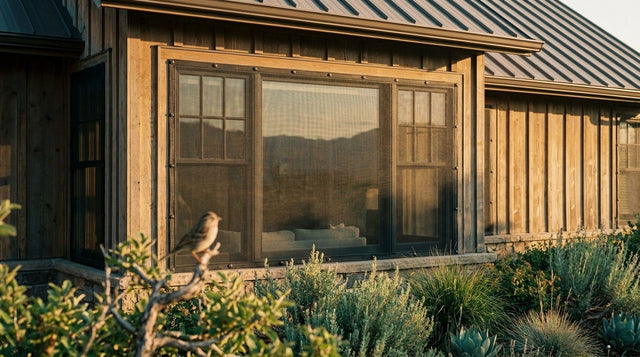
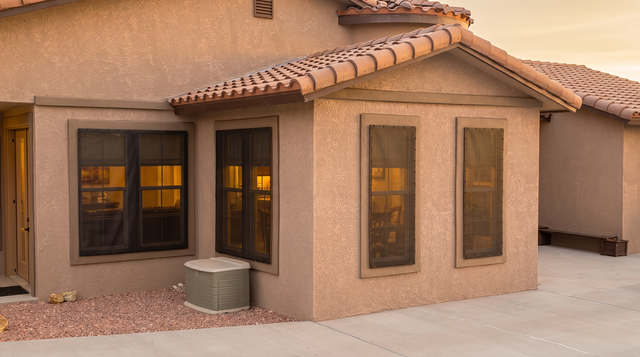
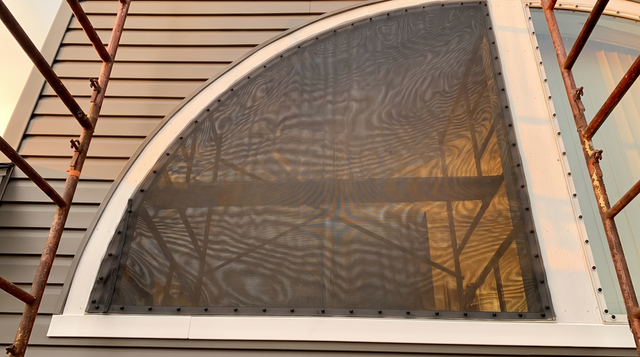
That's what an exterior sun screen does. The EZ-Snap® Sun Screen uses an Optical Grade Thermo-Weave™ mesh; the black mesh blocks up to 90% of solar heat, while white mesh lets through more light with less heat. Mounted on the outside of the neighbor's window, it diffuses the reflection so the beam never forms — without changing how their windows look from inside or touching your wall at all.
Why a no-drill screen makes the diplomatic ask easy
The reason this works as neighbor diplomacy is that it asks almost nothing of them. The system snaps on with a patented no-drill Cap & Pin fastener and 3M VHB adhesive — no holes in their window frames, no contractor, no permanent change. It cuts to any window shape with scissors and installs in an afternoon, and because there's no drilling, it comes off cleanly if they ever sell or swap the window.
Offer to buy it. Offer to install it. You can size a screen for the offending window right from the kit builder. Kits start at $66.95 with free shipping over $225 — a rounding error next to a siding replacement or a lawyer's retainer, and a far better Saturday than a property dispute. EZ-Snap has done exactly this kind of reflected-heat and solar-screen work since 2006 for over 38,000 customers, all backed by a Limited Lifetime materials warranty.
If you want the full breakdown of how the mesh, mounting, and material choices fit different windows and homes, the Exterior Sun Screens guide walks through it. The siding can be replaced. The neighbor stays. And the beam — the actual cause — simply stops existing.
Sources
- Double-paned low-E glass may warp slightly into a concavity from barometric pressure differences; this concavity focuses reflected sunlight like a magnifying glass, landing as a brilliant star-shaped spot whose concentrated heat reaches surface temperatures well above direct sunlight — measured in excess of 200°F, more than enough to soften and distort any normal grade of vinyl siding (which begins to soften at 160–165°F). Clear glass reflects ~10% of solar energy, low-E reflects 30–50%. National Association of Home Builders (David N. Crump, Jr., Director of Legal Research), 2014 ↗
- Glass solar reflectance contributes to permanent vinyl siding distortion; the white paper examines environmental heat-transfer factors, vinyl siding properties affecting heat build-up, and the factors determining reflected solar radiation from glass surfaces, including insulating window glass. Lawrence Berkeley National Laboratory (Hart, Curcija, Arasteh, Goudey, Kohler, Selkowitz), via U.S. DOE OSTI.GOV, 2011 ↗
- Energy-efficient windows are capable of concentrating and reflecting solar energy, which causes damage to a wide variety of materials; the 'zone' of distance from the window where the reflected beam is most concentrated depends mostly on the curvature of the glass, which can change in the same window under different temperature and atmospheric-pressure conditions. Polymeric Exterior Products Association (PEPA, formerly the Vinyl Siding Institute), 2024 ↗
- Low-E windows can be the culprit of melted vinyl siding: the intense reflected heat can be focused similar to focusing the sun's rays through a magnifying glass; the hot glare can affect siding up to 20 feet away, and the melted siding usually exhibits a diagonal pattern. Traditional vinyl siding begins to warp and distort at around 170°F. InterNACHI (International Association of Certified Home Inspectors), 2020 ↗
- "Exterior shutters and shades... are most effective at reducing solar heat gain." The page also states window awnings can reduce solar heat gain by up to 65% on south-facing windows and 77% on west-facing windows. U.S. Department of Energy (Energy Saver), 2024 ↗
- "Exterior window attachments block solar heat before it reaches the window." Interior attachments "can be less effective at reducing heat gain than comparable exterior shading systems because they do not block direct sunlight until after it has already passed through the window." DOE Building America Solution Center (Pacific Northwest National Laboratory), 2023 ↗
- "Depending on the material used, solar screens have the potential to block up to 90% of solar heat gain before it even reaches the window." U.S. Department of Energy, Office of Energy Efficiency & Renewable Energy (EERE), 2023 ↗
Common questions
Can a neighbor's windows really melt my vinyl siding?
Yes, energy-efficient low-E windows can melt siding across a property line. Low-E glass reflects 30 to 50% of solar energy versus about 10% for clear glass, and a slightly concave double-pane can focus that reflection into a beam measured above 200°F, hotter than vinyl siding's 160 to 165°F softening point. The hot glare can reach siding up to 20 feet from the window.
How do I know if reflected window heat caused the damage and not sun fade?
Reflected-beam damage has a diagnosable signature: a diagonal melt pattern, plus a moving bright star-shaped spot that crawls across the panels in late afternoon. Trace a straight line from the damage back to the window, since reflected beams travel in straight lines while a sun-faded wall has no point source. Photograph the damage, the bright spot, and the window at the hour it concentrates.
Can I just replace the melted siding panels?
No, replacing panels alone will not fix it, because the beam will re-melt the new siding next summer. The damage only stops when the concentrated reflection is stopped at the source window, not on the affected wall.
What actually stops the reflected heat damage?
Treating the offending window with exterior shading is the effective fix. The U.S. Department of Energy identifies exterior shading as the most effective way to reduce solar heat gain because it blocks sunlight before it reaches the glass, and an exterior solar screen can block up to 90% of solar heat gain. Scattering the light before the curved glass can focus it means the beam never forms.
Who is liable for siding melted by a neighbor's windows?
Liability is genuinely unsettled and varies by state, with cases argued both ways depending on local nuisance law and how each party acted once notified. Because neighbor lawsuits are slow, expensive, and hard on the relationship, documenting the damage and proposing a low-cost fix at the source window is usually the better path.
Will my neighbor agree to put a screen on their window?
A no-drill exterior screen makes the ask easy because it asks almost nothing of them. It snaps on with a patented no-drill fastener and 3M VHB adhesive, leaves no holes in the window frame, cuts to any shape with scissors, installs in an afternoon, and comes off cleanly later. Kits start at $66.95 with free shipping over $225, far less than a siding replacement or a lawyer.