Camper Skirting: No-Drill Winterizing Without Holes in Your Rig

Key Takeaways
- Camper skirting works by sealing the belly gap to trap a still-air pocket around tanks and water lines — not by adding R-value insulation.
- EZ Snap® no-drill skirting bonds with a patented Cap & Pin and 3M™ VHB to fiberglass, aluminum, vinyl, gelcoat, or glass — no holes.
- Diamond Weave™ fabric is built for extreme cold and can deliver heating and propane savings of up to 40% on a properly skirted rig.
- DOE recommends insulated skirting and air-sealing the underbelly to cut floor heat loss and prevent pipes — which can freeze near 20°F — from freezing.
It's your first cold season in the rig, and the advice you keep getting all ends the same way: grab a drill. Foam board screwed to the frame, vinyl panels lag-bolted to the body, brackets sunk into the skirt. Camper skirting that actually works shouldn't cost you a row of holes in a coach you may want to sell, trade, or simply keep looking like new.
What camper skirting actually does
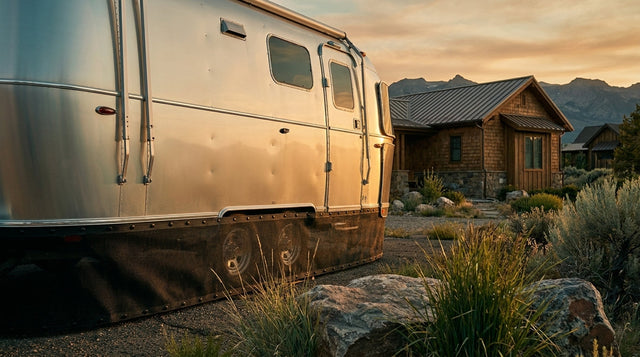
Skirting isn't insulation in the R-value sense, and it doesn't need to be. The job is simpler and smarter than that: enclose the gap between your camper's belly and the ground so the wind can't tear heat out from underneath.1 That sealed band traps a pocket of still air around your tanks, valves, and water lines — and still air is one of the best thermal buffers there is.3 It's the same principle as a double-pane window, just wrapped around the bottom of your rig. That matters most for your plumbing, which generally isn't insulated and can begin to freeze once temperatures fall to around 20°F.2 If you want the full picture on how RV skirting keeps the cold out and your pipes from freezing, that's the mechanism in a nutshell.
Get that pocket right and the payoffs are immediate. Your furnace stops fighting a draft it can never win, your underbelly holds above freezing through colder nights, and the propane lasts. EZ Snap® reports heating and propane savings of up to 40% with a properly skirted rig — which, across a full winter of fills, is the kind of number that pays for the kit.

No-drill camper skirting, and why that matters
This is where the dignity part comes in. EZ Snap® skirting mounts with a patented no-drill Cap & Pin system backed by 3M™ VHB adhesive — the same bonding tech used in modern construction. The stud bonds directly to your camper's surface, whether that's fiberglass, aluminum, vinyl, gelcoat, or glass. No pilot holes, no lag screws, no sealant smeared over a future leak.
The fabric itself is Diamond Weave™, built for extreme cold, so it won't get brittle on the coldest mornings or sag in shoulder-season sun. And here's the part first-winter owners tend to exhale at: it comes back off. The skirting unsnaps and stores flat for spring. The studs are the only thing that stays — low-profile, permanent, ready for next season — so you're not re-prepping the whole rig every fall.
You're not modifying your camper. You're giving it a winter coat that snaps on at your own pace and snaps off when the thaw comes — no holes, no regret, no resale hit.
Installing before the first freeze
A typical skirting install is a DIY job with household scissors, no drilling, at your own pace — you cut the fabric to your rig's footprint on site, snap the panels to the studs, and you're done. Each stud takes about 60 seconds to set. Two things worth planning around:
- Mind the cure window. 3M™ VHB reaches full strength in about 72 hours, so don't schedule your install for the day before a storm rolls in.
- Cold-weather installs need the right stud. VHB adhesive needs roughly 60°F to cure properly. If you're skirting once it's already cold, choose the Screw or Combo studs so you're not depending on adhesive that can't bond.

Why this beats the drill-and-foam route
Foam board is cheap until you count the cost: screws through your skirt, panels that crack and crumble in a year, and a storage problem the size of your camper. It's worth doing the math on what foam board actually costs you by the third winter before you commit to it. Drilled vinyl skirting looks tidy but commits you to permanent holes and a fixed shape. No-drill camper skirting sidesteps all of it — reversible, re-usable, and shaped to your exact rig because you cut it to fit. If you're weighing building your own panels, an honest look at DIY RV skirting shows where the kit tends to win.
EZ Snap® has been selling factory-direct since 2006 — twenty years — to more than 38,000 customers, and the skirting line carries a 4.9 rating across 164 reviews. The materials are backed by a Limited Lifetime warranty, which for a product that lives outdoors through deep-freeze nights is the assurance that actually counts. Kits run $899–$2,099 depending on your rig's size, and orders over $225 ship free via FedEx.
Your first winter shouldn't be the one where you put holes in something you're still falling in love with. When you're ready to size a kit to your exact footprint, you can build your RV skirting kit and have it cut to your rig before the first hard freeze.
Sources
- DOE lists "Install insulated skirting" and "Add insulation to the belly" among the energy-efficiency improvements that substantially reduce heat loss in manufactured homes; it also recommends air sealing openings around plumbing and ducts. U.S. Department of Energy (Energy Saver), 2024 ↗
- Southern states generally start having issues with frozen pipes when the temperature reaches about 20 degrees Fahrenheit; bathroom and kitchen pipes are generally not insulated and rely on the heating system to keep warm. U.S. Department of Energy (Energy Saver), 2024 ↗
- DOE/NREL Weatherization job aid 15-1 directs installers to fill the entire belly cavity to the prescribed R-value 'while ensuring plumbing has sufficient insulation value to prevent condensation or freezing,' creating a 'consistent thermal boundary between conditioned and unconditioned space,' and to reinstall any removed skirting. U.S. Department of Energy / National Renewable Energy Laboratory (Weatherization Assistance Program, Job Aid 15-1), 2024 ↗
Common questions
How does camper skirting keep pipes from freezing?
Skirting seals the gap between the camper's belly and the ground so wind can't strip heat from underneath, trapping a pocket of still air around your tanks, valves, and water lines. Still air is one of the best thermal buffers there is, which keeps the underbelly above freezing on colder nights. That matters because RV plumbing generally isn't insulated and can begin to freeze once temperatures fall to around 20 degrees Fahrenheit.
Is camper skirting the same as insulation?
No, skirting isn't insulation in the R-value sense, and it doesn't need to be. Its job is to enclose the belly gap and trap a still-air pocket around your plumbing, the same principle as a double-pane window wrapped around the bottom of the rig. That sealed band of still air, not bulk insulation, is what holds the heat in.
How much can skirting save on heating and propane?
A properly skirted rig can deliver heating and propane savings of up to 40%. The furnace stops fighting a draft it can never win, the underbelly holds above freezing, and the propane lasts longer. Across a full winter of fills, that is the kind of number that pays for the kit.
Can you install camper skirting without drilling holes in your rig?
Yes, the no-drill system bonds with a patented Cap and Pin and 3M VHB adhesive to fiberglass, aluminum, vinyl, gelcoat, or glass, with no pilot holes or lag screws. The skirting unsnaps and stores flat for spring, and only the low-profile studs stay on for next season. It is reversible, reusable, and cut to your exact rig with household scissors.
Can you install RV skirting in cold weather?
You can, but plan around the adhesive: 3M VHB needs roughly 60 degrees Fahrenheit to cure properly and reaches full strength in about 72 hours. If you're skirting once it's already cold, choose Screw or Combo studs so you aren't depending on adhesive that can't bond. Don't schedule an adhesive install for the day before a storm rolls in.
What is camper skirting made of and will it survive deep cold?
The panel is Diamond Weave™, built for extreme cold, so it won't get brittle on the coldest mornings or sag in shoulder-season sun. It's backed by a Limited Lifetime materials warranty, which for a product that lives outdoors through deep-freeze nights is the assurance that counts. Kits run $899 to $2,099 depending on your rig's size, with orders over $225 shipping free.