RV Skirting for Winter: What Keeps the Cold Out (and Pipes From Freezing)

Key Takeaways
- RV skirting works by sealing the underbelly into a still-air pocket that stops wind from stripping heat off your pipes and tanks — not by R-value.
- EZ-Snap® owners report heating and propane savings of up to 40% over a winter by keeping the sealed underbelly warm.
- Install in fall: 3M™ VHB needs roughly 60°F to cure and full strength in ~72 hours — in the cold, use Screw or Combo studs.
- Diamond Weave™ skirting kits run $899–$2,099, ship free over $225, and carry a Limited Lifetime materials warranty.
The regret always sounds the same: it was fine until the first hard freeze, and then a line let go under the rig overnight. By the time you hear the drip, the damage is already done.
RV skirting for winter is the one upgrade that decides whether the cold season is comfortable or catastrophic. It isn't an accessory you bolt on for looks — it's the difference between a heated, sealed underbelly and a wide-open wind tunnel running straight at your plumbing.

Does RV skirting keep pipes from freezing in winter?
Yes. RV skirting keeps pipes from freezing by sealing the gap between your rig and the ground, trapping a still pocket of air underneath. That stops wind from stripping heat off your tanks and supply lines, holds the furnace's warmth against the floor, and keeps the underbelly above freezing through hard winter nights.
What RV Skirting Actually Does in Winter
An unskirted RV in winter has a brutal problem: the entire underside is exposed to moving air. Wind pulls heat out of your tanks, valves, and supply lines all night long, and your furnace fights a losing battle trying to keep up. The pipes that freeze first are almost never inside the cabin — they're the ones hanging in that open, windswept space underneath. Uninsulated plumbing relies on surrounding warmth to stay liquid, and freezing risk generally begins once temperatures reach about 20°F.2
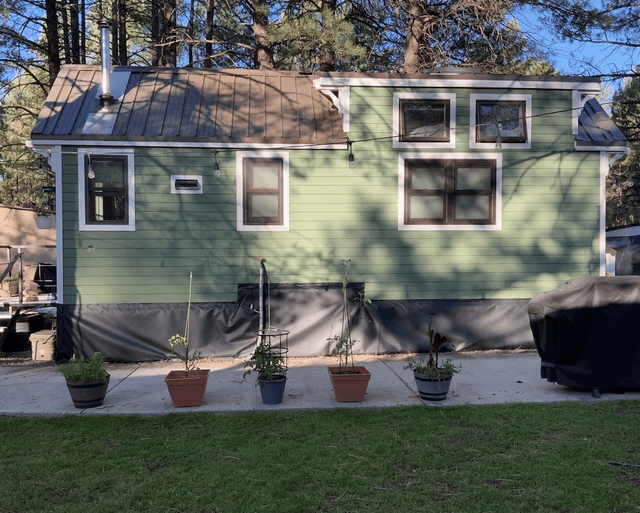
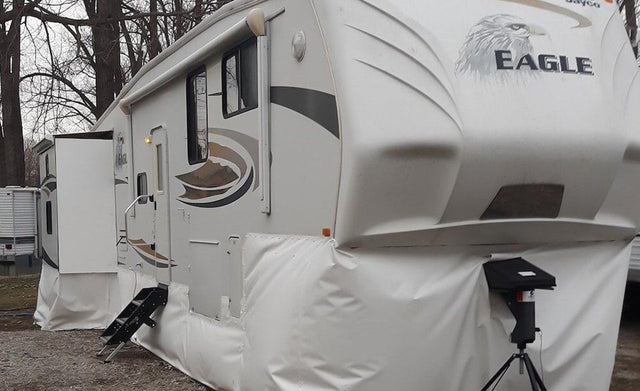
Skirting solves it by enclosing the perimeter from the body of the rig to the ground. Once that gap is closed, the air trapped beneath the RV stops moving, creating a consistent thermal boundary between the conditioned floor and the cold outside that helps prevent pipe freezing and condensation.3 That still pocket of air is the whole mechanism. Still air is a poor conductor of heat, so the warmth radiating off your tanks and any heat source you add stays put instead of being stripped away by the wind.
This is why people get hung up on the wrong question. They ask what the R-value of the skirting is — but skirting doesn't insulate the way a foam panel does, and it's worth understanding what foam board really costs you by the third winter before you go that route. The barrier creates the sealed, still-air pocket; the pocket is what protects you. A thin, tough membrane that seals cleanly beats a thick one that gaps at the corners and lets the wind back in.
Pipes don't freeze because the air is cold. They freeze because cold, moving air is pulling heat away faster than you can replace it. Stop the air, and you've stopped the freeze.
The Fabric Built for the Cold Season
The skirting panels use Diamond Weave™ fabric, built for extreme cold — engineered to stay flexible and intact through a real winter, not just a mild shoulder season. That cold-weather build matters because the material that's going to take the brunt of a January wind needs to hold its shape and its seal when it's well below freezing, not crack or go brittle the first cold snap.
And the payoff isn't only frozen-pipe insurance. By keeping the underbelly sealed and warm, skirting takes a heavy load off your heating system by reducing heat loss through the floor of the rig.1 EZ-Snap owners report heating and propane savings of up to 40% over a winter — which is the kind of number that pays for the kit across a season or two of full-time cold-weather living.

Installing Before the Freeze (and One Winter Catch)
The install is genuinely a DIY job you do at your own pace — household scissors, no drilling. The system uses a patented no-drill EZ-Snap Cap & Pin with 3M™ VHB adhesive — no holes in your RV, ever — and that no-drill way of winterizing without holes in your rig is the whole reason owners stick with it. The studs bond to glass, vinyl, fiberglass, aluminum, and gelcoat, and the panels snap on and off, so the skirting is fully removable while the studs stay permanent. You measure, cut the fabric to fit with household scissors, set each stud in about 60 seconds, and snap the panels into place. If you're weighing it against building your own, it's worth an honest look at DIY RV skirting and when the kit wins.
There is one timing detail that trips people up, and it's the reason this is a fall job, not a deep-winter one. The 3M™ VHB adhesive needs roughly 60°F to cure and reaches full strength in about 72 hours. If you wait until it's already freezing to install, the adhesive studs won't bond properly. The two ways to handle it:
- Install in the fall, before the cold sets in — give the VHB warm temperatures and its full ~72-hour cure window, then forget about it all winter.
- Doing it in the cold anyway? Use the Screw or Combo studs instead of relying on VHB, since the adhesive can't cure in freezing temperatures.
This is exactly why the smart move is to prep in the fall. The rig you skirt in October is the rig whose pipes you're not thinking about in January.
What It Costs — and Why People Don't Regret It
EZ-Snap has sold factory-direct since 2006 — 20 years — to more than 38,000 customers, and the materials carry a Limited Lifetime warranty. Complete skirting kits run $899 to $2,099 depending on the size of your rig, and shipping is free over $225, via FedEx. Against the cost of a single burst line, a flooded underbelly, or a winter of overworked propane, the math tends to make itself.
The skirting line carries a 4.9 rating across 164 reviews — and the through-line in them is the same one this whole post is about: the people who skirt before winter aren't the ones telling frozen-pipe stories in the spring.
Ready to seal your rig before the cold arrives? Build Your RV Skirting Kit sized to your RV, and get the studs set while the weather still lets the adhesive cure.
Sources
- DOE lists "Install insulated skirting" and "Add insulation to the belly" among the energy-efficiency improvements that substantially reduce heat loss in manufactured homes; it also recommends air sealing openings around plumbing and ducts. U.S. Department of Energy (Energy Saver), 2024 ↗
- Southern states generally start having issues with frozen pipes when the temperature reaches about 20 degrees Fahrenheit; bathroom and kitchen pipes are generally not insulated and rely on the heating system to keep warm. U.S. Department of Energy (Energy Saver), 2024 ↗
- DOE/NREL Weatherization job aid 15-1 directs installers to fill the entire belly cavity to the prescribed R-value 'while ensuring plumbing has sufficient insulation value to prevent condensation or freezing,' creating a 'consistent thermal boundary between conditioned and unconditioned space,' and to reinstall any removed skirting. U.S. Department of Energy / National Renewable Energy Laboratory (Weatherization Assistance Program, Job Aid 15-1), 2024 ↗