Fifth Wheel Skirting: The Drop, the Landing Gear, the King Pin

Key Takeaways
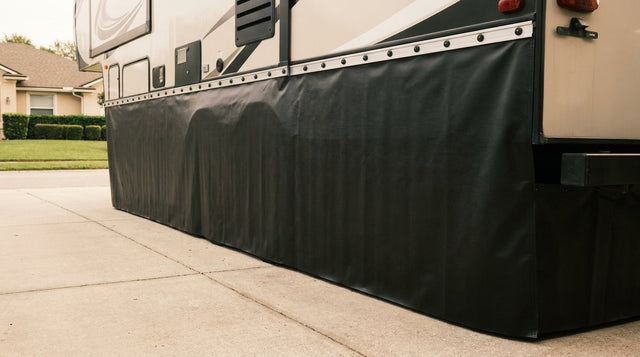
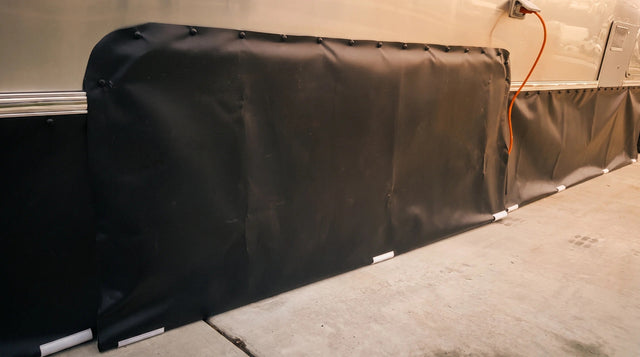
- Fifth wheel skirting must conform to the drop, landing gear, and king pin — flexible EZ Snap® Diamond Weave™ panels follow these shapes where rigid foam board gaps and cracks.
- Skirting works by trapping a still-air pocket that kills wind off tanks and floor, so it needs no R-value — sealing, not thickness, is the job.
- DOE lists insulated skirting and a sealed underbelly among the improvements that substantially reduce manufactured-home floor heat loss and prevent pipe freezing.
- EZ Snap® reports heating and propane savings up to 40%; kits run $899–$2,099 and install yourself with household scissors, no drilling, at your own pace.
A fifth wheel doesn't present a flat wall to the ground. It presents a drop, a set of landing gear, and a king pin — three of the most awkward shapes in RVing to seal against winter. Fifth wheel skirting is the one job where rigid foam board fights you and flexible snap-fabric wins.
The mechanics of a fifth wheel are exactly what makes the underbelly hard to close off. The front overhangs the truck bed, so the floor steps up at the pin box. The landing gear legs drop straight through your skirting line. And the body sits high, with a deep, irregular gap between coach and dirt. A wall material has to bend around all of it — or you spend a weekend cutting and taping foam that still leaks at every corner.
Why fifth wheel skirting fights rigid materials
Foam board insulation and plywood are flat, brittle, and the wrong answer for a curved, stepped underbelly. They crack when the rig flexes, gap at every contour change, and turn into a chainsaw project the moment you need to route a sewer hose or shore-power cord underneath. Worse, a rigid panel that doesn't seal cleanly defeats the entire point of skirting — and the savings math behind what foam board really costs you by the third winter rarely survives contact with a fifth wheel's geometry.
Skirting doesn't keep your rig warm by being thick. It works by trapping a pocket of still air between the panel and the ground, killing the wind that strips heat off your tanks and floor.1 That's a sealing problem, not an insulation-thickness problem — which is exactly why skirting needs no R-value to do its job, and exactly why a panel that conforms to the shape beats a panel that's merely stiff.

The three trouble spots — the drop, the landing gear, the king pin
Every fifth wheel skirting job comes down to the same three geometry problems. Here's how flexible snap-fabric handles each one.
The drop
The front cap of a fifth wheel steps up and overhangs. A flat board can't turn that inside corner without a seam; EZ Snap® Diamond Weave™ fabric simply follows the body line, snapping to studs along the wall and dropping to the ground in one continuous piece. You cut it to length on-site with household scissors — no saw, no second trip to the hardware store.
The landing gear
The front legs drop straight through where your skirting wants to run. With fabric, you trim a slot, snap the panel up to either side of the leg, and the material closes back around it. With rigid board, that same cut becomes a permanent weak point that gaps every time you raise or lower the gear.
The king pin and the cavity behind it
The space under the pin box is the deepest, most irregular cavity on the rig. Flexible panels tuck into it and conform; rigid panels bridge over it and leave a wind tunnel. This is where most foam-board jobs quietly fail. For this exact spot, spec the fifth wheel front hitch enclosure kit.
Rigid materials make you fight the shape of your rig. Flexible skirting lets the shape of your rig decide where the panel goes — and that's the whole difference between a sealed underbelly and a drafty one.

How the no-drill system handles a fifth wheel
The attachment method matters as much as the fabric. EZ Snap® uses a patented Cap & Pin stud backed by 3M™ VHB adhesive — the same no-drill winterizing approach that leaves no holes in your rig. The studs bond to glass, vinyl, fiberglass, aluminum, or gelcoat in about 60 seconds each and reach full strength in roughly 72 hours, so the panels stay flush in wind while the studs stay permanent. When spring comes, the panel unsnaps and stores flat; the studs remain.
Two notes for cold-weather DIYers. The 3M VHB needs roughly 60°F to cure, so a true winter install calls for the Screw or Combo studs instead of pure adhesive — plan your stud type around when you're mounting. And the Diamond Weave™ fabric itself is built for extreme cold, so once it's up it stays put through the season.
What sealing the underbelly actually buys you
The payoff is the reason regret-driven buyers find this page in the first place. A sealed still-air pocket keeps wind off your holding tanks and plumbing, which is the difference between frozen pipes in January and a rig you can actually live in.2 EZ Snap® reports heating and propane savings of up to 40% from skirting alone — money back every cold month, on a kit you install yourself with household scissors, no drilling, at your own pace.

EZ Snap® has shipped factory-direct since 2006, serves 38,000+ customers, and backs the skirting materials with a Limited Lifetime warranty. Kits run $899–$2,099 depending on rig size, with free shipping over $225. The skirting line carries a 4.9 rating across 164 reviews.
Ready to spec a panel set to your drop, your landing gear, and your king pin? Build Your RV Skirting Kit and size it to your rig.
Sources
- DOE lists "Install insulated skirting" and "Add insulation to the belly" among the energy-efficiency improvements that substantially reduce heat loss in manufactured homes; it also recommends air sealing openings around plumbing and ducts. U.S. Department of Energy (Energy Saver), 2024 ↗
- DOE/NREL Weatherization job aid 15-1 directs installers to fill the entire belly cavity to the prescribed R-value 'while ensuring plumbing has sufficient insulation value to prevent condensation or freezing,' creating a 'consistent thermal boundary between conditioned and unconditioned space,' and to reinstall any removed skirting. U.S. Department of Energy / National Renewable Energy Laboratory (Weatherization Assistance Program, Job Aid 15-1), 2024 ↗