Foam Board RV Skirting: What It Costs You by the Third Winter

Key Takeaways
- A skirt's real job is to trap a sealed, still-air pocket around the underbelly, not to be a thick high-R wall.
- DOE lists insulated skirting and a sealed, insulated belly among the changes that substantially cut floor heat loss.
- EZ-Snap® skirting uses Diamond Weave™ fabric built for extreme cold and delivers heating and propane savings of up to 40%.
- Studs bond with no-drill 3M™ VHB at about 60 seconds each; deep-winter installs use Screw or Combo studs.
Foam board RV skirting wins on the receipt and loses on the calendar. The first winter it looks like a steal — a stack of rigid panels for a fraction of what a finished system costs. By the third, you've usually bought it twice, taped it once, and spent two cold weekends rebuilding what the wind took apart.
Is foam board RV skirting cheaper over three winters?
No. Foam board is cheapest only at checkout. Because rigid foam cracks, needs re-taping every season, and gets partly rebuilt after harsh winters, the "one-time" cost quietly becomes a recurring one — so by the third winter a sealed, reusable kit often costs less than the foam you've bought and patched twice.
This isn't an argument against doing it yourself. It's an argument against measuring a skirting decision by its sticker price instead of its cost over time — because foam board is where that gap is widest.

Why foam board RV skirting is cheap on day one
The appeal is honest. Rigid foam insulation is sold by the sheet at any home center, it cuts with a utility knife, and it gives you a real R-value on paper. For one careful weekend you can wall off the underbelly of a travel trailer for less than a tank of propane.
The problem is that foam board was engineered to sit inside a wall — flat, dry, fastened on every edge, and never touched again. An RV skirt asks it to do the opposite: stand exposed on a windy pad, flex when you bump it, get pulled off and put back when you need to reach a valve, and survive a freeze-thaw cycle that runs all winter long. If you're weighing the trade-offs honestly, our honest look at DIY RV skirting walks through where the homemade approach holds up and where the kit wins.
What it actually costs you by the third winter
Run the math past day one and the budget choice starts spending your money in installments:
- The re-buy. Sun and cold make rigid foam brittle. Panels can crack at the fasteners, corners crumble, and a strong gust can fold a sheet in half. Foam skirts often get patched in a later season and partly replaced down the line — so the "one-time" cost can quietly become a recurring one.
- The tape tax. Foam doesn't seal to itself or to your rig. The fix is tape — rolls of it — reapplied every fall and peeled off every spring, often taking the panel's face with it.
- The labor. Cutting, foaming, and bracing a full skirt is hours of cold-weather work you repeat each season. That time has a price even when no one invoices you for it.
- The propane you didn't save. A skirt only earns its keep when it seals. Every gap a cracked panel opens is heat leaving the underbelly — and the loss compounds across the months you needed it most.
Foam board isn't the cheap option. It's the option you buy more than once — and the third receipt is the one that tells the truth.
Foam board vs. a sealed snap-on kit, over time
The two approaches diverge most where it matters — at the seal, and across the seasons you reuse them:
| Approach | Holds a sealed dead-air pocket | No-drill / no holes in rig | Removable & reusable | Cost over 3 winters |
|---|---|---|---|---|
| Foam board panels | Limited — cracks and gaps open seams | Yes (loose-set) | Brittle — often re-bought | $$$ (bought more than once) |
| Tarp / plastic sheeting | Limited — flaps, tears in wind | Yes | No — disposable | $$ (seasonal replace) |
| EZ-Snap Diamond Weave™ panel kit | Yes — one continuous sealed skirt | Yes (patented no-drill) | Yes — snaps off, studs stay | $ (one kit, reused) |
The mechanism most foam setups get wrong
Here's the part the R-value label hides: a skirt's real job isn't to be a thick wall. It's to trap a sealed pocket of still air around your underbelly so the ground's stable temperature can do the work.2 The U.S. Department of Energy lists insulated skirting and a sealed, insulated belly among the changes that substantially reduce heat loss through a manufactured home's floor.1 A continuous, sealed skirt that holds that dead-air pocket outperforms a high-R panel that's cracked and gapping at every seam. That sealed pocket is also what keeps the cold out and your pipes from freezing through the coldest stretch of the season.
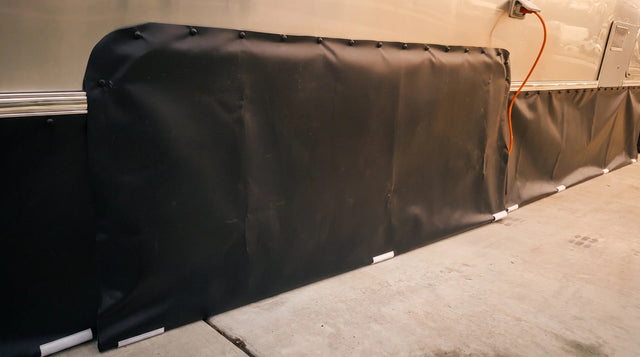
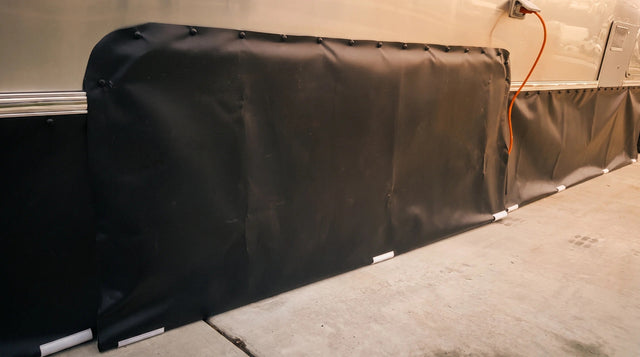
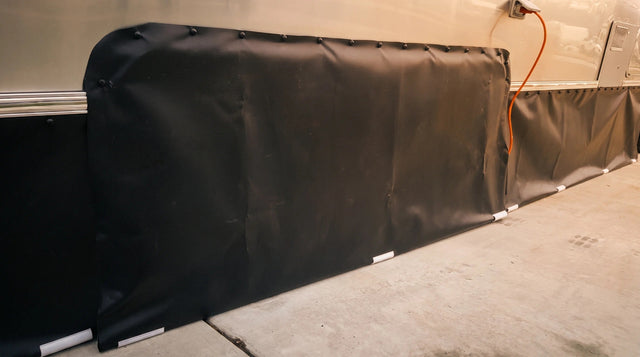
That's why a flexible, sealed system can quietly beat a rigid one. EZ-Snap skirting uses our Diamond Weave™ fabric, built for extreme cold, to wrap the rig in one continuous skirt with no brittle panels to crack — the seal is the point, and a sealed skirt is what delivers heating and propane savings of up to 40%.

What you're really buying instead
The contrast isn't DIY versus done-for-you — EZ-Snap is a kit you install yourself. It's brittle-and-disposable versus flexible-and-permanent. The studs mount with patented no-drill adhesive that winterizes without holes in your rig, bonding to fiberglass, aluminum, and gelcoat at roughly 60 seconds per stud. You cut the fabric to fit with household scissors and snap the skirt on at your own pace, no drilling. Come spring it unsnaps for storage; the studs stay put for next year.
One note for cold-weather setups: VHB needs about 60°F to cure to full strength (roughly 72 hours), so a deep-winter install should use our Screw or Combo studs rather than waiting on adhesive. Plan the build before the first freeze and the seal is ready when you need it.
Factory-direct since 2006 and 38,000+ customers in, EZ-Snap kits run $899–$2,099 and carry a Limited Lifetime materials warranty — the kind of number that gets cheaper, not more expensive, every winter you don't have to buy it again. Free shipping over $225, shipped FedEx.
If you've already done the foam-board math and you're tired of paying it twice, the next step is sizing a skirt that seals once and stays. Build Your RV Skirting Kit to see what fits your rig.
Sources
- DOE lists "Install insulated skirting" and "Add insulation to the belly" among the energy-efficiency improvements that substantially reduce heat loss in manufactured homes; it also recommends air sealing openings around plumbing and ducts. U.S. Department of Energy (Energy Saver), 2024 ↗
- DOE/NREL Weatherization job aid 15-1 directs installers to fill the entire belly cavity to the prescribed R-value 'while ensuring plumbing has sufficient insulation value to prevent condensation or freezing,' creating a 'consistent thermal boundary between conditioned and unconditioned space,' and to reinstall any removed skirting. U.S. Department of Energy / National Renewable Energy Laboratory (Weatherization Assistance Program, Job Aid 15-1), 2024 ↗