Class C RV Skirting: Winterizing the Cab-Over

Key Takeaways
- Class C skirting wraps the ground-level footprint, not the cab-over overhang; the bunk sits too high to affect the heated pocket below.
- EZ-Snap® skirting works by blocking the wind and sealing a still-air pocket; owners report heating and propane savings of up to 40%.
- Diamond Weave™ fabric is built for extreme cold and snaps on with patented no-drill 3M™ VHB studs in about 60 seconds each.
- Install in the fall: 3M™ VHB needs roughly 60°F to cure and reaches full strength in about 72 hours; kits run $899–$2,099.
The cab-over bunk is what makes a Class C a Class C — and it is also the reason most skirting kits leave you with cold spots. Sealing a Class C is less about the long sidewalls and more about the awkward gaps no one photographs: the dropped chassis, the entry steps, the storage bays that interrupt an otherwise clean line.
If you have read our by-type guides on Airstreams, fifth wheels, and travel trailers, this is the one that completes the set. Class C RV skirting is its own problem, and once you understand the footprint, it is a straightforward DIY job you do at your own pace.
Why Class C skirting is different
A travel trailer is essentially a box on a level frame. A Class C is built on a cutaway van or truck chassis, which means the floor sits at several different heights as you walk from the cab to the rear. The front wheels, the engine, the entry steps, and the pass-through storage bays all break up the line your skirting has to follow.
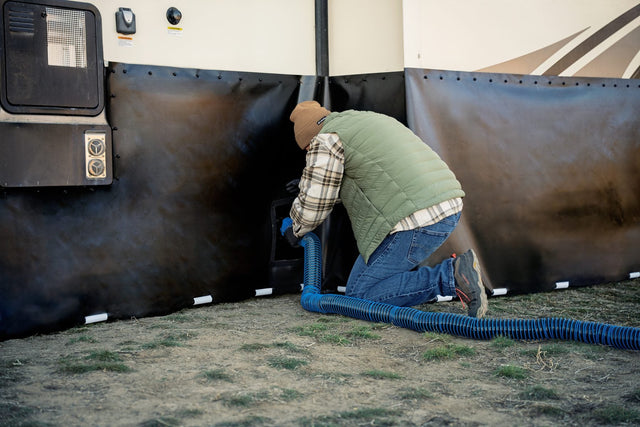
The good news: the cab-over itself does not need to be skirted. The overhang sits well above the ground, so it has no bearing on the heated pocket below. What matters is the footprint at ground level — the rectangle of warm, still air you are trying to trap under the coach. Your job is to wrap that perimeter without leaving a single open seam for cold air to wash through.

The mechanism: a sealed still-air pocket
Skirting like EZ-Snap's works by stopping air movement. Wind is what strips heat out from under an RV, and a barrier that holds the air still keeps that wind out. The U.S. Department of Energy lists insulated skirting and belly insulation among the improvements that substantially reduce heat loss in manufactured homes.1 EZ-Snap skirting itself is solid woven vinyl, not insulated skirting: its job is to block the wind and hold that still-air pocket in place, and a clean seal beats a padded one that leaks at the corners. DOE's manufactured-home weatherization guidance fills the belly cavity to a prescribed R-value to create the consistent thermal boundary that keeps the cold out and the pipes from freezing, so the seal works alongside belly insulation, not instead of it.2
A winter coat with the zipper undone keeps you no warmer than no coat at all. Skirting is the zipper.
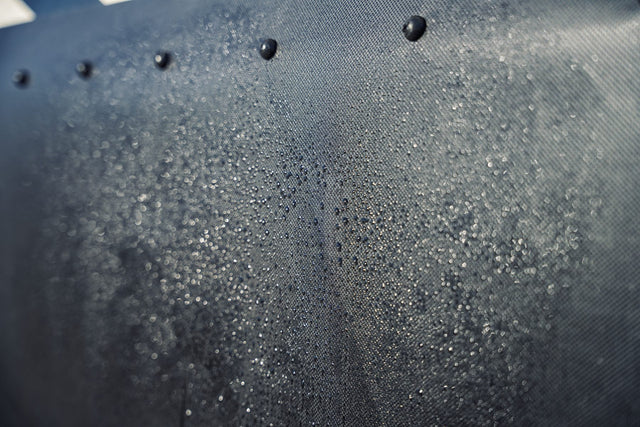
The panel itself is our Diamond Weave™ fabric, built for extreme cold, so it holds up through a hard winter and the shoulder seasons on either side. Owners who skirt consistently report heating and propane savings of up to 40% — which, on a coach you are living in through the cold months, adds up fast.
Handling the cab-over chassis gaps
Here is where a Class C earns its reputation. Three spots take a little planning:
- The entry steps. Skirt up to the step well on each side and seal the short return back to the body, rather than trying to wrap the steps themselves.
- The storage bays. Run the skirting flush below the bay doors so they still open freely while the panel below them stays sealed.
- The dropped front chassis. The lower clearance at the front of a Class C means a shorter panel run here than at the rear — measure each face separately rather than assuming one height.
Because EZ-Snap cuts to size with household scissors, none of these require a custom-sewn panel. You trim each face to its own height and snap it on. The patented no-drill Cap & Pin studs use 3M™ VHB adhesive that bonds to fiberglass, aluminum, and vinyl — so you can do the whole job without a single hole in your rig, and the studs stay put while the skirting comes off in spring.

Install it before the cold sets in
This is the part many buyers learn the hard way. The 3M™ VHB adhesive needs roughly 60°F to cure, so a stud applied to a frozen panel in January will not hold. Skirt in the fall, before the cold sets in. Each stud takes about 60 seconds to set, and the adhesive reaches full strength in around 72 hours, so plan the install for a mild stretch and let it cure before the first freeze.
If you are wintering somewhere with deep, sustained sub-freezing cold, you can add rigid foam board behind the skirting for extra resistance. Some full-timers also add a thermostatically controlled heat source under the rig in hard cold, on top of a clean seal.
What you are buying
EZ-Snap has been factory-direct since 2006 — twenty years and more than 38,000 customers — and the skirting carries a Limited Lifetime materials warranty. Kits run $899 to $2,099 depending on the length and height of your coach and ship free over $225. No special tools, no drilling, no professional install.
Measure your footprint face by face, account for the steps and bays, and you have a Class C that holds its heat all winter. When you are ready to spec yours, build your RV skirting kit and we will help you size it to the coach. You can also size a Class C motorhome skirting kit from our motorhome collection.
Sources
- DOE lists "Install insulated skirting" and "Add insulation to the belly" among the energy-efficiency improvements that substantially reduce heat loss in manufactured homes; it also recommends air sealing openings around plumbing and ducts. U.S. Department of Energy (Energy Saver), 2024 ↗
- DOE/NREL Weatherization job aid 15-1 directs installers to fill the entire belly cavity to the prescribed R-value 'while ensuring plumbing has sufficient insulation value to prevent condensation or freezing,' creating a 'consistent thermal boundary between conditioned and unconditioned space,' and to reinstall any removed skirting. U.S. Department of Energy / National Renewable Energy Laboratory (Weatherization Assistance Program, Job Aid 15-1), 2024 ↗