Insulated RV Skirting: Why Sealing Air Beats Chasing R-Value

Key Takeaways
- RV skirting insulates by sealing the perimeter to trap a still-air pocket underneath — not by stacking R-value.
- Convection (wind under the rig) steals far more heat than conduction, so a complete seal beats a thick, gappy panel.
- EZ-Snap® Diamond Weave™ fabric is built for extreme cold and flexes to seal around tires, slides, and uneven ground.
- Sealed skirting can cut heating and propane use up to 40%; install in fall since 3M™ VHB needs ~60°F to cure.
Every skirting buyer eventually meets the same rabbit hole: foam-board R-values, fiberglass batts, debates over whether R-5 beats R-10 under an RV. Here's the counter-intuitive part — for most rigs, the number that actually keeps your pipes from freezing isn't an R-value at all. It's whether you've stopped the wind.
Insulated RV skirting starts with sealing air, not stacking R-value
The phrase "insulated RV skirting" sends people shopping for the thickest, highest-rated panel they can bolt to the chassis. That instinct comes from house-building, where insulation lives inside a sealed wall cavity. But the space under your RV isn't a wall — it's an open-bottomed box exposed to wind on every side. And in that environment, the enemy isn't conducted heat loss through a panel. It's convection: cold air sweeping through, scrubbing warmth off your tanks, lines, and underbelly faster than anything inside can replace it.
The U.S. Department of Energy lists installing insulated skirting and air-sealing the underbelly among the improvements that substantially reduce heat loss through the floor of a manufactured home.1 Wrap a rig in the most over-built R-30 foam panel money can buy, but leave gaps where wind rips through underneath, and you've insulated nothing. The cold air doesn't care about the rating of the panel it just blew past.

The mechanism: a sealed still-air pocket does the insulating
Here's what's actually happening when skirting works. Once you ring the rig with a continuous, sealed barrier, the air trapped underneath stops moving. Still air is one of the best insulators there is — it's the whole reason a down jacket or a double-pane window works. The trapped pocket warms gently from ground heat and any residual warmth bleeding off the underbelly, and because nothing is stirring it, that warmth stays put.
That's the answer to "what R-value do I need for RV skirting?" — you don't need one. The panel isn't the insulation. The sealed pocket of dead air it creates is the insulation. A thin, tough, continuous skirt that seals completely will out-perform a thick, rigid panel riddled with gaps every single time.
Skirting doesn't insulate your RV. It stops the wind so the still air underneath can.
This is why chasing R-value is the wrong fight. The variable that matters is sealing — how completely the barrier hugs the ground, the wheel wells, the slide-outs, and every awkward contour your rig throws at it. A rigid 4×8 foam sheet can't bend around a curved fender or a sloped site. Where it can't conform, air leaks. Where air leaks, the R-value on the box is just a number — and the gaps quietly multiply, which is a big part of what foam board really costs you by the third winter.
Why a conforming barrier beats a rigid panel
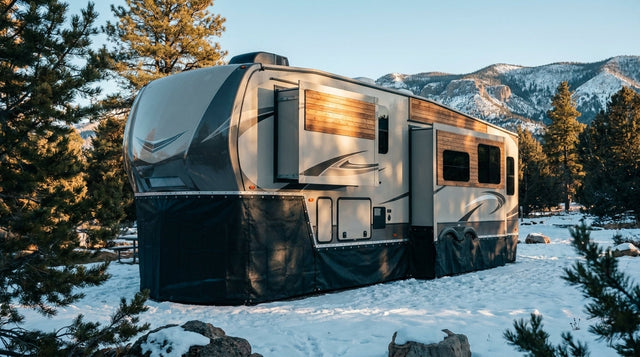
EZ-Snap skirting is built around this exact principle. The fabric is Diamond Weave™, built for extreme cold, so it stays flexible and intact through a hard winter instead of cracking like rigid foam. Because it's a flexible textile rather than a stiff board, it follows the real shape of your rig — down to uneven ground, around tires, under slides — and seals where panels gap. That conforming seal is exactly what keeps the cold out and pipes from freezing when temperatures actually drop.

That seal is held by the patented no-drill EZ-Snap Cap & Pin system on 3M™ VHB adhesive studs — it bonds to fiberglass, aluminum, gelcoat, and vinyl without a single hole in your rig. Setting a stud takes about 60 seconds, and the whole skirt goes up DIY with nothing more than household scissors — no drilling, at your own pace. The studs stay permanent; the skirt unsnaps and stores when the season turns. If putting holes in your rig is the part that's been holding you back, that's the whole case for no-drill winterizing without holes in your rig.
One install note that follows directly from the physics: VHB needs roughly 60°F to cure and reaches full strength in about 72 hours. If you're skirting in genuine cold, use the Screw or Combo studs instead — adhesive won't bond reliably in freezing temps. The smart move is to skirt in fall, before the first hard freeze, while the adhesive can set.
What sealing actually buys you
- Pipes that don't freeze. A still, ground-warmed pocket keeps tanks and supply lines above freezing far more reliably than a windswept underbelly with "insulated" panels — the same sealed, insulated underbelly enclosure the DOE/NREL weatherization guidance calls for to prevent pipes from freezing.2
- Lower heating costs. By killing the convection that drags heat out from under your floor, sealed skirting can cut heating and propane use by up to 40%.
- A barrier that lasts. Flexible fabric doesn't shatter, sag, or blow apart the way rigid foam does — backed by a Limited Lifetime materials warranty from a company that's been factory-direct since 2006, serving over 38,000 customers.
So before you spend a weekend comparing foam-board R-values, reframe the question. The goal isn't a thick wall. It's a complete seal — a continuous barrier that traps still air and stops the wind that was stealing your heat all along. Get the seal right, and the "R-value" takes care of itself.
Ready to skirt your rig the way the physics actually wants? Build Your RV Skirting Kit and dial in a custom-fit seal for your make and model.
Sources
- DOE lists "Install insulated skirting" and "Add insulation to the belly" among the energy-efficiency improvements that substantially reduce heat loss in manufactured homes; it also recommends air sealing openings around plumbing and ducts. U.S. Department of Energy (Energy Saver), 2024 ↗
- DOE/NREL Weatherization job aid 15-1 directs installers to fill the entire belly cavity to the prescribed R-value 'while ensuring plumbing has sufficient insulation value to prevent condensation or freezing,' creating a 'consistent thermal boundary between conditioned and unconditioned space,' and to reinstall any removed skirting. U.S. Department of Energy / National Renewable Energy Laboratory (Weatherization Assistance Program, Job Aid 15-1), 2024 ↗