RV Underpinning: What It Means and the No-Drill Way to Do It

Key Takeaways
- RV underpinning and skirting describe the same job: closing the open perimeter gap beneath the rig to seal it from wind and cold.
- It works by blocking the wind and trapping a sealed, still-air pocket under the coach.
- DOE lists insulated skirting and belly insulation among the improvements that substantially reduce heat loss in manufactured homes, and recommends air sealing around plumbing and ducts.
- EZ-Snap®'s no-drill Cap & Pin studs with 3M™ VHB bond without holes; panels snap off, and kits run $899–$2,099.
If you've heard the term "RV underpinning" and weren't sure whether it meant something different from skirting, you're not alone. They describe the same job — closing off the open gap beneath your rig — and the way you do it decides whether your floors stay warm or your pipes freeze.
What RV underpinning actually means
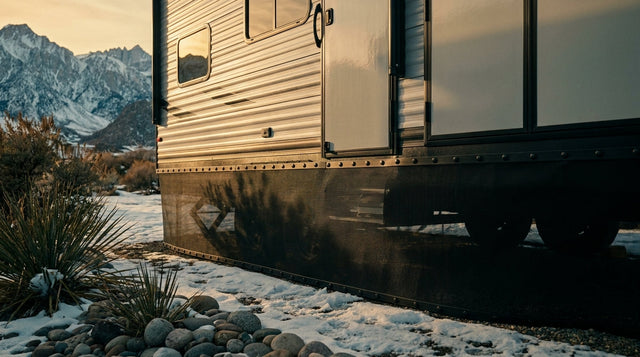
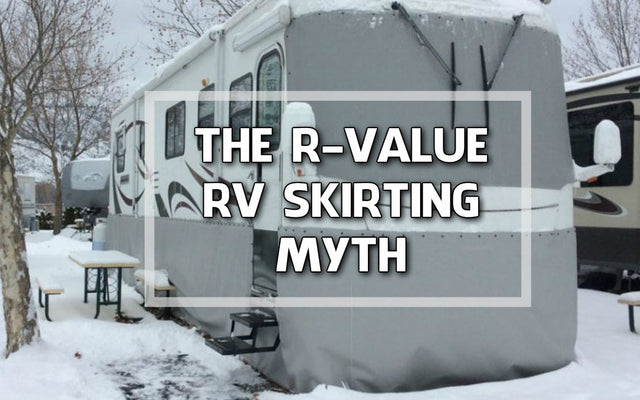
RV underpinning is the panel system that wraps the perimeter between your coach and the ground, sealing off the open cavity where wind, snow, and cold air would otherwise circulate. "Underpinning" and "skirting" are used interchangeably — the first leans toward permanent and full-timer setups, the second toward seasonal campers — but the mechanism is identical. You are not adding a rated layer of insulation. You are sealing off the gap so wind cannot strip the gentle warmth your tanks, plumbing, and floor radiate into that still-air pocket all winter. DOE lists insulated skirting and belly insulation among the improvements that substantially reduce heat loss in manufactured homes.1
That still-air pocket is the whole point. Moving air strips heat away; trapped air holds it. Once the perimeter is closed, the ground beneath your RV stays dramatically more stable than the open air around it, and the underbelly stops acting like a wind tunnel for your water lines. Paired with belly insulation, which DOE's manufactured-home weatherization guidance fills to a prescribed R-value, that is what keeps the cold out and pipes from freezing through a hard season.2
Why the no-drill way matters for RV underpinning
The traditional approach — screwing furring strips and panels straight into your RV's body — works, but it leaves permanent holes in your siding and a wall of fasteners to wrestle every season. EZ-Snap takes a different route: a patented no-drill Cap & Pin stud backed with 3M™ VHB adhesive. The studs bond to glass, vinyl, fiberglass, and aluminum, and the panels snap on and off them.
The studs stay put. The panels come off whenever you want them gone. That removability is exactly what makes no-drill winterizing without holes in your rig work for both crowds: the weekender who pulls everything in spring, and the full-timer who leaves it sealed for months and snaps a single panel open to reach a valve.
Underpinning is a sealed, still-air pocket beneath the rig, not a rated layer of insulation. Trap the air, and your tanks and plumbing stop fighting the wind.
The fabric that does the work
EZ-Snap skirting panels use Diamond Weave™ fabric, built for extreme cold — engineered to hold its shape through a hard winter rather than crack or sag in the cold. Sealing the perimeter this way is where the energy story comes from: customers report heating and propane savings of up to 40% once the air pocket is closed and the furnace stops working against a constant draft.
For full-timers, that's the difference between a livable winter footprint and a propane bill that never quits. For seasonal owners, it's protection against the single most expensive winter mistake — a frozen, split water line discovered in spring.

Installing it yourself, at your own pace
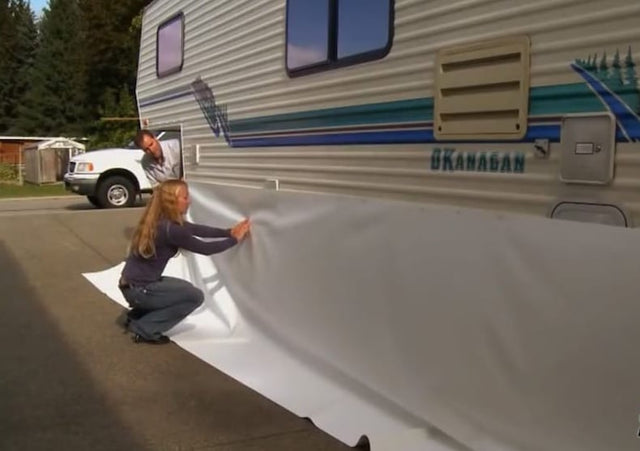
You don't need a contractor or power tools. A typical underpinning install goes on DIY with household scissors — no drilling, at your own pace. The rhythm is simple:
- Place the studs. Clean the bonding surface, peel the VHB liner, and press each stud in place — roughly 60 seconds per stud.
- Snap on the panels. Cut the Diamond Weave™ panels to length on site and snap them to the caps.
- Seal the perimeter. Close every gap around the base so the air pocket is fully enclosed.
Two timing notes worth respecting. The 3M™ VHB adhesive reaches full strength in about 72 hours, so plan your install ahead of the first hard freeze rather than the night before. And because VHB needs roughly 60°F to cure, a true winter install calls for the Screw or Combo studs instead of relying on adhesive alone. If you're prepping in fall — the ideal window — the standard no-drill studs cure with room to spare.
One system, weekenders to full-timers
The reason the same kit serves a casual camper and a year-round resident is that nothing about it is disposable. The studs hold with a strong, weather-resistant bond; the panels are removable; the fabric is built for extreme cold. Skirting kits run $899–$2,099 depending on your rig's footprint, and EZ-Snap has been shipping factory-direct since 2006 — 20 years and 38,000+ customers — backed by a Limited Lifetime materials warranty.
Whether you're closing up for one cold weekend or settling in for the season, underpinning your RV the no-drill way means warmer floors, protected plumbing, and a perimeter you can open and reseal as many times as winter demands. When you're ready to spec it to your rig, build your RV skirting kit and size it to your coach.
Sources
- DOE lists "Install insulated skirting" and "Add insulation to the belly" among the energy-efficiency improvements that substantially reduce heat loss in manufactured homes; it also recommends air sealing openings around plumbing and ducts. U.S. Department of Energy (Energy Saver), 2024 ↗
- DOE/NREL Weatherization job aid 15-1 directs installers to fill the entire belly cavity to the prescribed R-value 'while ensuring plumbing has sufficient insulation value to prevent condensation or freezing,' creating a 'consistent thermal boundary between conditioned and unconditioned space,' and to reinstall any removed skirting. U.S. Department of Energy / National Renewable Energy Laboratory (Weatherization Assistance Program, Job Aid 15-1), 2024 ↗