Installing in the Cold: The 60°F / 72-Hour Cure Window
Key Takeaways
- 3M™ VHB needs roughly 60°F to cure and reaches full strength in about 72 hours under normal conditions.
- Below ~60°F the adhesive can't wet into the surface, so a stud that feels stuck may never actually bond.
- For cold-weather skirting installs, use EZ-Snap® Screw or Combo studs — they hold the instant they're driven, no cure window.
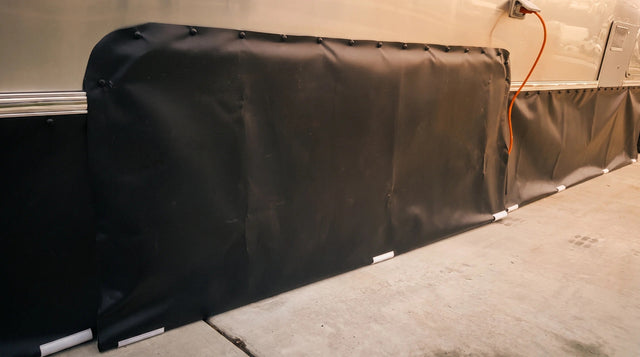
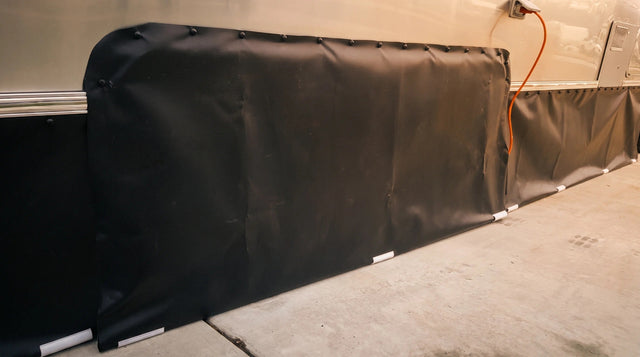
- Diamond Weave™ skirting (built for extreme cold) seals a still-air pocket to cut heating and propane costs up to 40%.
The 3M™ VHB adhesive at the heart of every EZ-Snap install is a remarkable piece of chemistry — but it has one non-negotiable demand. It needs warmth to cure. If you are planning a 3M VHB cold weather install this winter, the difference between a skirting kit that holds for a decade and one that peels off in the first hard freeze comes down to a single decision you make before the first stud goes on.
This is not a comfort note about working in gloves. It is a materials-science line in the sand, and crossing it is the most common avoidable mistake we see from new installers.
Can you install 3M VHB in cold weather?
Not with adhesive alone. 3M™ VHB needs a surface at roughly 60°F to wet in and cure, reaching full strength in about 72 hours; below that it never truly bonds. When the surface is too cold to warm, use EZ-Snap Screw or Combo studs — mechanical fasteners that hold the instant they are driven.
Why 3M VHB needs roughly 60°F to bond
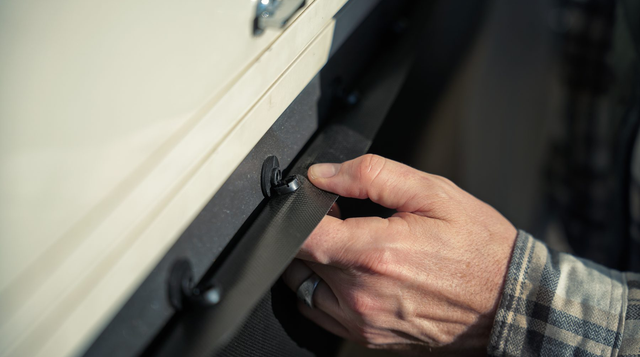
The patented no-drill EZ-Snap Cap & Pin studs bond to glass, vinyl, fiberglass, aluminum, and gelcoat using 3M™ VHB — the same adhesive family that holds curtain walls onto skyscrapers.1 It is not glue in the household sense. It is a pressure-activated acrylic foam tape that flows microscopically into the surface texture, then builds strength over time. Press a stud on and you get roughly 60 seconds of working tack per stud. Reach full strength and you have a bond engineered to outlast the panel it is holding — the mechanics of which we break down in our guide to how no-drill snap fasteners actually hold.
The catch: that flow-and-build process is temperature dependent. Below about 60°F, the adhesive turns stiff and glassy instead of tacky. It cannot wet into the surface, so it never develops a real bond — it just sits there looking attached until cold, wind, or the weight of a panel pries it loose. A stud that “felt stuck” on a 40°F afternoon is a stud that was never actually bonded, and knowing whether the VHB will actually hold in your conditions is the whole game.

The 72-hour cure window — and the winter workaround
Under normal conditions, 3M VHB reaches full strength in about 72 hours. That window is the part most people get impatient with. The studs feel solid within minutes, so it is tempting to hang panels and call it done. But the bond is still building for three days, and rushing it — or starting it cold — is exactly how snaps come loose down the line.
So what do you do when it is genuinely winter and you need skirting on now, before the ground freezes and the propane bill climbs? You stop relying on adhesive alone.
If the surface is below 60°F and you cannot warm it, do not trust the VHB to cure. Use Screw or Combo studs — a mechanical fastener that holds regardless of temperature, the moment it is driven.
This is the entire point of the EZ-Snap Screw and Combo stud options. A standard adhesive stud asks the weather for permission. A Screw stud does not — it bites into the substrate and holds immediately, no cure window required. The Combo stud pairs a screw with the VHB pad, giving you mechanical hold today and a full adhesive bond later if temperatures recover. For a cold-weather skirting job, these are not the upgrade. They are the correct part.
How to choose for a cold-weather install
- Surface at or above ~60°F (warm garage, heated bay, mild day): standard adhesive studs are fine — just respect the full 72-hour cure before stressing the panels.
- Surface below ~60°F and you can warm it: bring panels and studs indoors, warm the mounting surface, work in sections, and let each cure before moving on.
- Surface below ~60°F with no way to warm it: use Screw or Combo studs. This is the winter answer.

Why this matters most for skirting
Skirting is, by definition, a cold-season job. The whole reason to install Diamond Weave™ skirting — built for extreme cold — is to seal a still-air pocket under the rig and cut heating and propane costs by up to 40%. That means most people are reaching for a skirting kit in fall and winter, precisely when the VHB cure window is hardest to hit. The big pre-season prep push happens in the fall for exactly this reason: warm enough to bond, early enough to beat the freeze.
If you miss that warm window and the temperature has already dropped, you have not missed your install — you have just changed which stud you order. EZ-Snap has been factory-direct since 2006, with 38,000+ customers and a Limited Lifetime materials warranty, and the cold-weather path has always been the same: mechanical fasteners over a cure you cannot finish.
The honest takeaway is simple. Warmth is a feature of the adhesive, not a suggestion. Plan your 3M VHB cold weather install around the surface temperature, not the calendar — and when in doubt, choose the stud that does not wait for the thermometer.
For step-by-step stud selection, surface prep, and cure timing, see the EZ-Snap Install Guide.
Sources
- U.S. Patent 8,032,994 B2, "Marking and fastening device and method of using same" (inventors Raymond J. Waddell & Dean A. Myrfield; originally assigned to EZ-Snap Products Inc), describes a male member with a projection plus a female member with an aperture forming a ratchet system that removably secures the female onto the male member to fasten covers without drilling. United States Patent and Trademark Office (via Google Patents), 2011 ↗