Trailer & Camper Skirting: Sealing the Gap Under Any Towable

Key Takeaways
- Trailer skirting works by killing wind and trapping a sealed still-air pocket under the rig — not by adding R-value insulation.
- EZ-Snap® owners report heating and propane savings of up to 40%, and a sealed underbelly helps protect tanks and water lines from freezing.
- The no-drill EZ-Snap Cap & Pin bonds with 3M™ VHB in about 60 seconds per stud and cuts to fit with household scissors.
- Diamond Weave™ fabric is built for extreme cold; skirting kits run $899–$2,099 and ship free over $225.
Cold air does not announce itself. It slides under your trailer, pools in the dark cavity between the chassis and the ground, and goes to work on your holding tanks and water lines while you sleep. Trailer skirting closes that gap — and done right, it turns the coldest, draftiest part of any towable into a sealed, defensible pocket of still air.
What trailer skirting actually does
Trailer skirting is a panel system that wraps the open perimeter beneath a camper, fifth wheel, or park model, sealing the underbelly off from wind and weather. The mechanism is simple and it is not insulation in the R-value sense — it is a trapped pocket of still air. Wind is what strips heat away and freezes exposed plumbing; once the underside is enclosed, that moving air stops, the ground gives up a little residual warmth, and the temperature under the rig stabilizes well above the open-air low.2

That is why skirting earns its keep two ways. In winter it protects your tanks and pipes from freezing and cuts what you burn keeping the floor warm — EZ-Snap owners report heating and propane savings of up to 40%.1 That freeze protection is the whole reason most people skirt at all, and it is worth understanding what actually keeps the cold out and pipes from freezing before the first hard front. The rest of the year a sealed underbelly is one less highway for drafts, pests, and blowing debris.
Why most trailer skirting fails — and what to look for
The gap under a towable is rarely friendly. The ground is uneven, the frame height changes from the hitch to the bumper, and whatever you install has to survive wind loading, UV, and a deep freeze without tearing, sagging, or pulling its own fasteners loose. Plywood and rigid foam crack and look it — and the cheap panels rarely stay cheap once you tally what foam board really costs by the third winter. Loose tarps flog themselves to shreds in the first storm. Custom vinyl is effective but priced and scheduled like a contractor job.
The questions worth asking before you buy any trailer skirting:
- Will the material survive your winter? EZ-Snap skirting uses Diamond Weave™ fabric built for extreme cold — it flexes in a deep freeze instead of cracking.
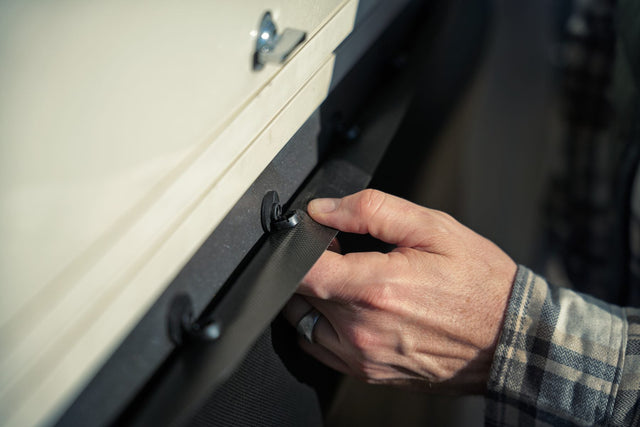
- Does it mount without drilling your rig? The patented no-drill EZ-Snap Cap & Pin uses 3M™ VHB adhesive that bonds to fiberglass, aluminum, vinyl, and gelcoat. Studs go on in about 60 seconds each; the panels snap off seasonally and the studs stay put.
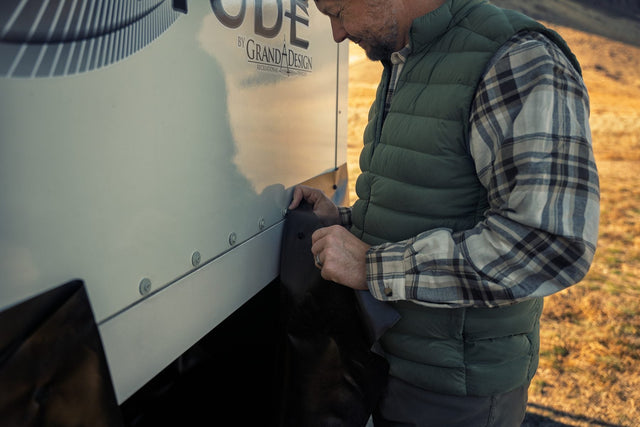
- Can one person install it without a pro? The system cuts to your rig's exact profile with household scissors and installs no-drill, at your own pace — no fabricator, no appointment.
- Is it removable? Snap the panels off for storage or travel; the permanent studs mean re-installing next season is minutes, not a rebuild.
Skirting is not about adding insulation under your trailer. It is about taking the wind away — seal the perimeter, trap the still air, and the freeze loses its grip on your plumbing.
Installing trailer skirting on any towable
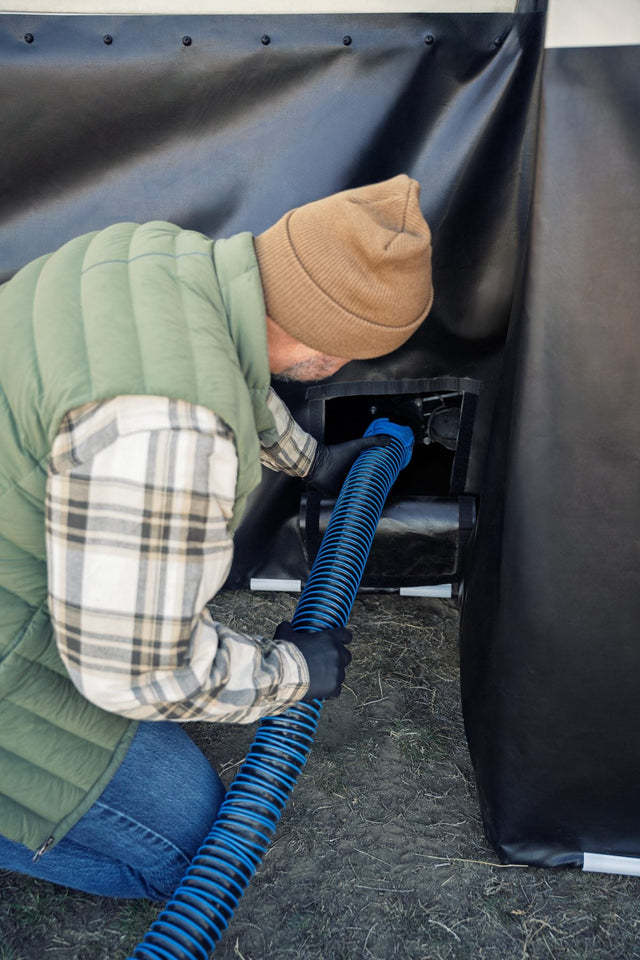
Because the EZ-Snap system is cut-to-fit rather than pre-formed to one floorplan, it follows the real shape of your rig — around stabilizer jacks, slide-outs, steps, and the changing frame height most kits cannot handle. That adaptability is exactly what makes the awkward profiles workable, from a low travel trailer to the deep drop, landing gear, and king pin of a fifth wheel.

The sequence is straightforward: measure your perimeter, peel and press the snap studs along the lower body, cut the Diamond Weave™ fabric to length, and snap it on. One timing note that matters more than any other — the 3M™ VHB needs roughly 60°F to cure and reaches full strength in about 72 hours, so adhesive studs are a fall-prep job, not a January one. If you have already missed the warm window, EZ-Snap offers Screw and Combo studs for cold-weather installs so a hard freeze does not leave your tanks exposed.
This is why the seasonal play for skirting is fall. Get the studs bonded while the days are still mild, and the skirt is ready to snap on the night the first cold front rolls through.
Is trailer skirting worth it?
If you camp, store, or live in a towable anywhere the temperature drops below freezing, the math is hard to argue with. A single frozen-and-burst water line can cost more than the skirting, and the propane you save across one cold season starts paying the kit back immediately. EZ-Snap has shipped factory-direct since 2006 to more than 38,000 customers, carries a Limited Lifetime materials warranty, and its skirting line holds a 4.9 rating across 164 reviews. Kits run $899–$2,099 depending on your rig's footprint, ship free over $225, and arrive ready to cut to your exact trailer.
The gap under your trailer is the one part of the rig the manufacturer left open. When you are ready to close it for good, build your RV skirting kit sized to your towable.
Sources
- DOE lists "Install insulated skirting" and "Add insulation to the belly" among the energy-efficiency improvements that substantially reduce heat loss in manufactured homes; it also recommends air sealing openings around plumbing and ducts. U.S. Department of Energy (Energy Saver), 2024 ↗
- DOE/NREL Weatherization job aid 15-1 directs installers to fill the entire belly cavity to the prescribed R-value 'while ensuring plumbing has sufficient insulation value to prevent condensation or freezing,' creating a 'consistent thermal boundary between conditioned and unconditioned space,' and to reinstall any removed skirting. U.S. Department of Energy / National Renewable Energy Laboratory (Weatherization Assistance Program, Job Aid 15-1), 2024 ↗