Cheap RV Skirting Ideas That Actually Survive a Winter

Key Takeaways
- RV skirting works by trapping a sealed, still-air pocket around your tanks and plumbing to block the wind that would otherwise let them freeze.
- DOE lists insulated skirting and belly insulation among the improvements that substantially reduce heat loss in manufactured homes.
- Snap-on vinyl panels win on endurance and reuse: built for extreme cold, they roll up and travel when you change sites.
- EZ-Snap® skirting reports heating and propane savings up to 40%; kits run $899-$2,099, factory-direct since 2006.
Most cheap RV skirting ideas look great in October and look like a mistake by February. The cheapest option on install day is rarely the cheapest one by spring — so here we've ranked the popular DIY approaches by the only two things that matter once the cold sets in: how well they survive a winter, and how much of them you can reuse next year.
The job of skirting is simple. By sealing off the gap under your rig, you trap a still pocket of air around your tanks and plumbing and keep the wind from stripping away its warmth. DOE lists insulated skirting among the improvements that substantially reduce heat loss in manufactured homes.1 That matters for your pipes: DOE, citing Weather.com, notes that southern states generally start having issues with frozen pipes at about 20°F.2 That's the mechanism: a sealed, still-air pocket that blocks the wind, not a substitute for insulation. DOE's manufactured-home weatherization guidance fills the belly to a prescribed R-value, so skirting works alongside belly insulation, not instead of it.3 What the skirting itself needs is to stay sealed when the wind picks up and the temperature drops.
How we ranked these RV skirting ideas
Two scores, both earned in the worst weather of the year. Endurance: does it stay sealed and intact through wind, snow load, and a freeze-thaw cycle, or does it sag, crack, and gap? Reuse: when you move sites or pack up in spring, does it roll up and come with you, or do you abandon it and start over next fall? A genuinely cheap idea wins on both. If you're weighing whether to assemble something yourself at all, it's worth taking an honest look at DIY skirting before you buy materials.

Hay bales — cheapest to buy, first to fail
Stacked bales are nearly free and they do insulate. But they're a fire hazard, they wick up meltwater, and they're an open invitation to mice looking for a warm place to nest next to your wiring. Endurance: low. Reuse: none — by spring they're a soggy, rodent-chewed mess you're hauling to the dump.
Packed snow — free, until it isn't
Pile and pack snow against the base and it's a surprisingly good insulator at zero cost. The catch is total dependence on weather: hit a freeze with bare ground and you've got no skirting and no plan. Endurance: weather-dependent. Reuse: melts every spring — there's nothing to keep.
Foam insulation board — popular, but it flies away
Rigid foam panels are inexpensive, easy to cut, and a favorite for a reason. The problem is they're so light that a winter gust will peel them off unless you build a frame to hold them — which is more work, more cost, and an eyesore. Foam also gets brittle and crumbles over a few seasons, which is why it's worth running the numbers on what foam board really costs you by the third winter. Endurance: medium, only with a frame. Reuse: poor — the frame stays behind when you move, and chewed-up panels rarely make a second winter.
Plywood — durable and heavy, in every sense
Sheets of plywood are tough and available everywhere, and the weight means they won't blow away. But that same weight makes them a chore: you'll want a frame, paint, and trim to keep it from looking like a barricade, and on rigs that flex as you move inside, the panels can scuff and scratch your exterior. Endurance: good. Reuse: poor — too heavy and too custom-cut to travel with.
The cheapest skirting on install day and the cheapest skirting by April are almost never the same thing — endurance and reuse are what close the gap.
The cheap RV skirting idea that actually survives — and travels
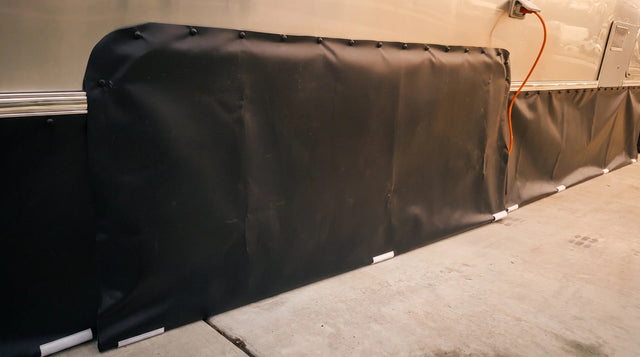
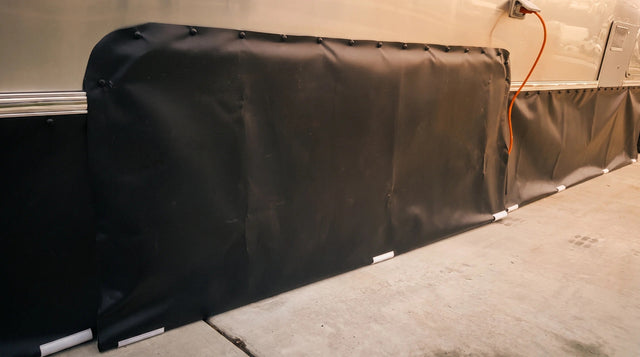
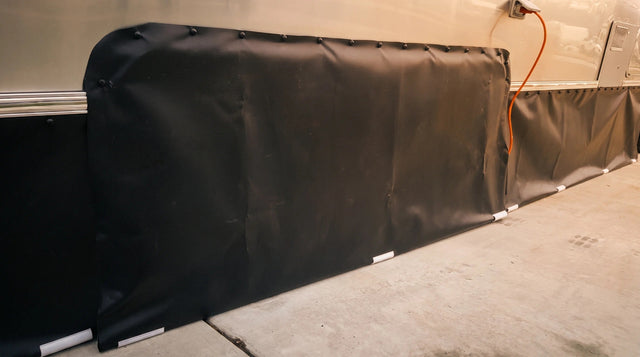
The approach that wins on both scores is a panel of purpose-built vinyl fabric that snaps on and rolls up. EZ-Snap skirting uses a Diamond Weave™ material built for extreme cold, so it doesn't go brittle in a cold snap the way foam does. It seals tight enough that owners report heating and propane savings of up to 40% — the still-air pocket doing exactly its job.

It installs DIY at your own pace. The patented no-drill way to winterize without holes in your rig uses the EZ-Snap Cap & Pin with 3M™ VHB adhesive, which bonds to fiberglass, aluminum, vinyl, and glass — and you trim each panel to fit with ordinary scissors. The studs hold with a strong, weather-resistant bond; the skirting itself is removable, so when you change sites it rolls up and comes with you. That's the reuse score most DIY ideas can't touch.
One winter note: VHB adhesive needs roughly 60°F to cure, so a true cold-weather install should use the Screw or Combo studs rather than relying on the tape in freezing temps.
The endurance-and-reuse scorecard
- Hay bales — cheap to buy, fire and rodent risk, zero reuse.
- Packed snow — free, totally weather-dependent, gone by spring.
- Foam board — light and brittle; needs a frame to survive wind.
- Plywood — durable but heavy, custom-cut, hard to move.
- Snap-on vinyl panels — built for extreme cold, seal for up to 40% heating savings, roll up and reuse.
EZ-Snap has shipped factory-direct since 2006, served 38,000+ customers, and backs the material with a Limited Lifetime warranty — the kind of track record that separates a one-winter idea from a buy-it-once one. Kits run $899–$2,099 depending on your rig.
When you've settled on the approach that survives the season, the next step is sizing it to your rig. Build Your RV Skirting Kit to match your length, height, and undercarriage.
Sources
- DOE lists "Install insulated skirting" and "Add insulation to the belly" among the energy-efficiency improvements that substantially reduce heat loss in manufactured homes; it also recommends air sealing openings around plumbing and ducts. U.S. Department of Energy (Energy Saver), 2024 ↗
- Citing Weather.com: southern states generally start having issues with frozen pipes when the temperature reaches about 20 degrees Fahrenheit; bathroom and kitchen pipes are generally not insulated and rely on the heating system to keep warm. U.S. Department of Energy (Energy Saver), 2024 ↗
- DOE/NREL Weatherization job aid 15-1 directs installers to fill the entire belly cavity to the prescribed R-value 'while ensuring plumbing has sufficient insulation value to prevent condensation or freezing,' creating a 'consistent thermal boundary between conditioned and unconditioned space,' and to reinstall any removed skirting. U.S. Department of Energy / National Renewable Energy Laboratory (Weatherization Assistance Program, Job Aid 15-1), 2024 ↗