Class A Motorhome Skirting: Sealing a Big Coach, No Dealer

Key Takeaways
- Class A skirting works by trapping a still-air pocket against the ground, blocking wind that strips heat from tanks, plumbing, and floor.
- DOE recommends insulated skirting and underbelly air-sealing to substantially reduce floor heat loss in manufactured homes.
- EZ-Snap®'s Diamond Weave™ fabric is built for extreme cold; owners report heating and propane savings up to 40%.
- Factory-direct EZ-Snap skirting kits run $899–$2,099, install DIY with scissors at your own pace, and snap off for travel.
A Class A motorhome is a lot of coach to seal. Thirty-plus feet of chassis, two or three slide-outs, and a row of pass-through bays — and when the temperature drops, every one of those openings becomes a chimney for the warm air under your floor. The dealer quote to fix it can run steep. It shouldn't.
The dealer-skirt gap on a big coach
Ask a dealer to skirt a 36-foot diesel pusher and the quote reflects what you're paying for — custom-cut panels, a shop appointment, sometimes a permanent rail bonded to your basement. For a vinyl or insulated-board job on a coach that size, that math is hard to love. You're paying for labor, a fitting bay, and a fixed installation you can't take to the next site.
Class A RV skirting doesn't have to be a capital project. The reason a big coach feels expensive to seal is the same reason it's expensive to heat: surface area. More skirt to cut, more snaps to set, more openings to work around. But area is just time, not difficulty — and as our honest look at DIY RV skirting lays out, a DIY system turns that time into a job you do yourself with a pair of household scissors — no drilling, at your own pace — instead of a line item on a dealer invoice.
Why a sealed pocket beats a thick panel
People assume a bigger rig needs a beefier, higher-R skirt. It doesn't. Skirting doesn't insulate the way a wall does — it works by trapping a column of still air against the ground, blocking the wind that strips heat from your holding tanks, plumbing runs, and floor.1 Kill the draft and that pocket of dead air does the insulating for you. That's the same mechanism that keeps a sealed rig's pipes from freezing through a hard winter, and it scales to any length of coach without needing a thicker material.
The U.S. Department of Energy and NREL make the same point for manufactured homes: sealing and insulating the underbelly creates a consistent thermal boundary between the conditioned space and the ground, cutting floor heat loss and helping keep plumbing from freezing or sweating.2 A skirted Class A works on that same principle at a larger scale.
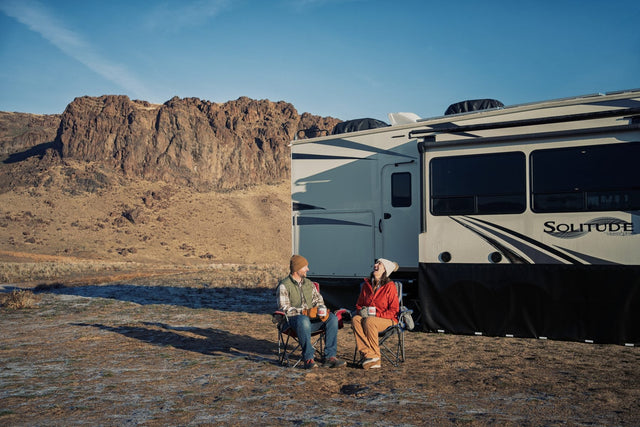
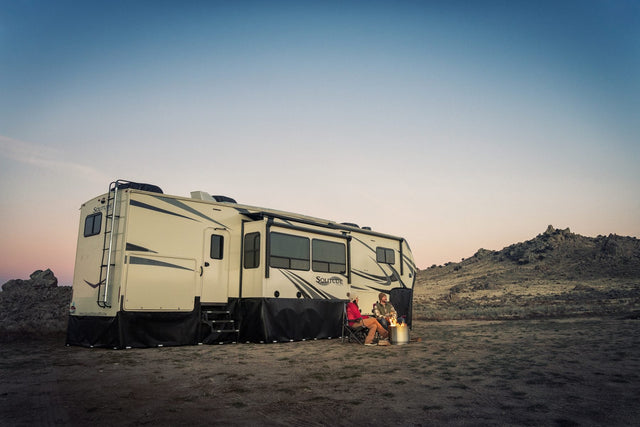
EZ-Snap's Diamond Weave™ fabric is built for that job. It's built for extreme cold, sheds wind instead of sailing in it, and seals the perimeter so the wind that strips heat from your underbody stops at the skirt instead of raking the chassis. Owners who seal a coach this way report heating and propane savings up to 40% over an unskirted winter — the difference between a furnace that cycles all night and one that rests.
The mechanism isn't thickness. It's the still-air pocket — and a draft-free pocket under a 40-foot coach does exactly what it does under a 20-foot trailer.
Bays and slide-outs: the parts that scare people off
The real reason owners assume a Class A "needs a pro" is the geometry. Three places trip up a first-timer, and all three are solvable at the kitchen table:
- Pass-through storage bays. The skirt runs behind the bay doors, not across them — you keep full access to your basement while the seal stays continuous underneath. Cut the panel to clear the door swing and snap it to the frame above.
- Slide-outs. Skirt to the coach body, not the slide. Because the panels are flexible fabric and the studs are low-profile, you can drop and stow a section when the slide moves, then re-snap it — no rail or fixed obstruction in the way.
- Leveling jacks and uneven pads. Flexible fabric forgives terrain that a rigid panel fights. You trim to the ground line you actually have, not the one a shop measured last spring.
How the no-drill part works
The system is a patented EZ-Snap Cap & Pin backed by 3M™ VHB adhesive. The studs bond to glass, fiberglass, aluminum, or vinyl — that's the same no-drill, no-holes approach we use on every rig. Each stud takes about 60 seconds to set; the VHB reaches full strength in roughly 72 hours, and the studs hold with a strong, weather-resistant bond while the skirt itself snaps on and off for travel.
One seasonal note for a winter install: VHB needs about 60°F to cure, so if you're sealing the coach in the cold, switch to the Screw or Combo studs. The DIY-with-scissors workflow doesn't change — just the anchor.

What it costs, factory-direct
EZ-Snap has sold direct since 2006 — 20 years, 38,000-plus customers, and a Limited Lifetime materials warranty on the fabric. Skirting kits run $899 to $2,099 depending on the size of the coach, and shipping is free over $225 (FedEx). You can shop Class A motorhome skirting kits to compare sizes. Even at the top of that range for a long Class A, you're a fraction of the dealer number — and you own a removable system you can re-fit at the next site instead of a fixed install bonded to one rig.
For a big coach, the value-anchor is simple: the pocket of still air does the work, the no-drill studs keep your bays and slides usable, and the DIY hours you spend are the ones you'd otherwise pay a shop for. When you're ready to size it to your own chassis, build your RV skirting kit and spec the length and stud type to match your winter.
Sources
- DOE lists "Install insulated skirting" and "Add insulation to the belly" among the energy-efficiency improvements that substantially reduce heat loss in manufactured homes; it also recommends air sealing openings around plumbing and ducts. U.S. Department of Energy (Energy Saver), 2024 ↗
- DOE/NREL Weatherization job aid 15-1 directs installers to fill the entire belly cavity to the prescribed R-value 'while ensuring plumbing has sufficient insulation value to prevent condensation or freezing,' creating a 'consistent thermal boundary between conditioned and unconditioned space,' and to reinstall any removed skirting. U.S. Department of Energy / National Renewable Energy Laboratory (Weatherization Assistance Program, Job Aid 15-1), 2024 ↗