Class B Camper Van Skirting: Sealing a Van Build for Winter
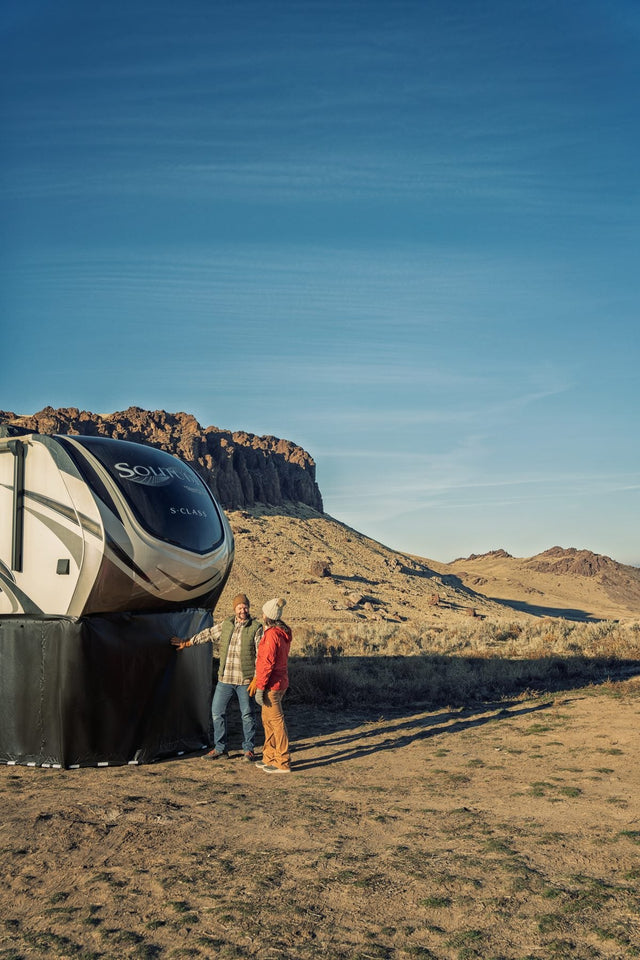
The smallest motorhome is one of the easiest to skirt. How to seal a Class B camper van's underbody for winter: the short perimeter run, the sliding-door and running-board gaps, and the no-drill install.

Key Takeaways
- A Class B is the smallest motorhome — a camper built inside a single van body — so its skirting is the shortest, tidiest perimeter run of any RV.
- Skirting works by sealing a still-air pocket under the van, not by adding thickness; owners who skirt report heating and propane savings of up to 40%.
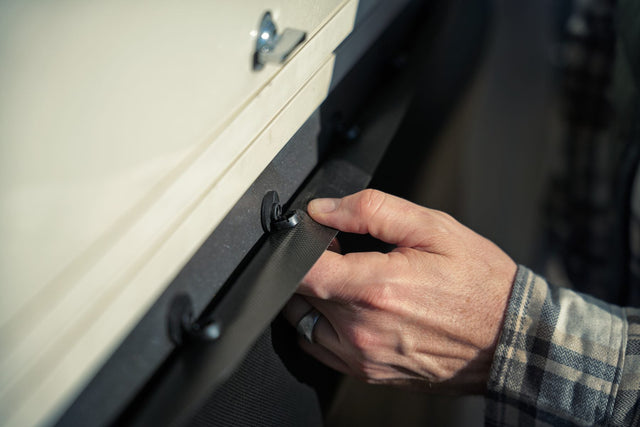
- Diamond Weave™ fabric cuts to size with household scissors and snaps on with patented no-drill 3M™ VHB studs — no holes in your van, and the skirt comes off in spring.
- Install in the fall: 3M™ VHB needs roughly 60°F to cure and reaches full strength in about 72 hours. Kits run $899–$2,099; a van sits at the smaller end.
A Class B camper van is the easiest RV to drive and, it turns out, one of the easiest to skirt. There is no gooseneck, no cab-over, and no forty feet of sidewall — just a compact van on a short wheelbase. But “small” is not the same as “nothing to think about.” A van sits low, its lower body curves, and the running boards and sliding door interrupt the line your skirting follows. Get those three details right and a Class B holds its heat as well as any coach twice its size.
If you are still sorting out which motorhome you actually own, our guide to RV types lays out the tell for each class. If you already know it is a Class B, read on.
Why a Class B skirts differently
A Class B is a camper built inside a single van body — a Sprinter, ProMaster, or Transit — rather than a coach dropped onto a bare chassis. That one fact drives everything about its skirting:
- The perimeter is short, so you work with far less material than a Class A or a fifth-wheel. A van build is where a skirting kit costs the least.
- The ground clearance is low, which means a shorter drop from the body to the ground and less panel height to cut.
- The lower body is rounded, not a flat slab, so the skirt hangs from the body line straight to the ground rather than tracing every curve of the sheet metal.

The mechanism: a sealed still-air pocket
Skirting does not work by being thick — it works by stopping air movement. Wind is what strips heat out from under a van, and a barrier that holds the air still does far more than a sewn-in inch of fill ever could. The U.S. Department of Energy lists insulated skirting and belly air-sealing among the improvements that substantially reduce heat loss through the floor of a manufactured home.1 That is why EZ-Snap® skirting has no R-value to quote: the sealed still-air pocket is the insulation, and it keeps the plumbing and tanks in that enclosure warmer while guarding against condensation.2
The panel is our Diamond Weave™ fabric, built for extreme cold, so it holds up through a hard winter and the shoulder seasons on either side. Owners who skirt consistently report heating and propane savings of up to 40% — meaningful on a van you are boondocking or living in through the cold months.
The smallest rig still loses its heat to the wind. A short, clean seal fixes it.
Handling the van-specific gaps
Three spots take a moment of planning on a Class B:
- The sliding door. Run the skirting below the door sill so the door still slides freely, and seal the short return so no gap opens when the door is closed.
- The running boards and steps. Skirt up to a step and seal back to the body rather than trying to wrap the step itself.
- The wheel wells. Trim neatly around each tire; the panel picks back up on the far side so the run stays continuous.
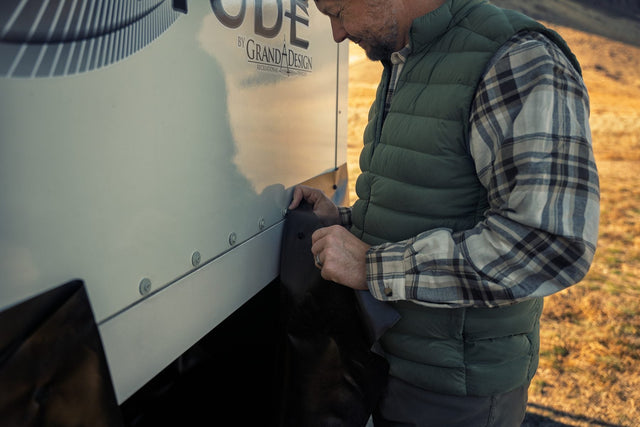
Because EZ-Snap cuts to size with household scissors, none of this needs a custom-sewn panel — you trim each face to its own height and snap it on. The patented no-drill Cap & Pin studs use 3M™ VHB adhesive that bonds to the smooth, clean panels of a van body, so you seal the underbody without a single hole in your rig, and the studs stay put while the skirting comes off in spring.
Install it before the cold sets in
This is the part regret-driven buyers learn the hard way. The 3M™ VHB adhesive needs roughly 60°F to cure, so a stud pressed onto a frozen panel in January will not hold. Skirt in the fall. Each stud takes about 60 seconds to set, and the adhesive reaches full strength in around 72 hours, so plan the install for a mild stretch and let it cure before the first freeze.
What you are buying
EZ-Snap has been factory-direct since 2006 — twenty years and more than 38,000 customers — and the skirting carries a Limited Lifetime materials warranty. Kits run $899 to $2,099 depending on length and height; a Class B van, with the shortest perimeter of any RV, sits at the smaller end of that range. Free shipping over $225, no special tools, no drilling, no professional install.
Measure your van's perimeter, account for the sliding door and running boards, and you have a Class B that stays warm all winter. When you are ready, build your RV skirting kit, pick Class B from the type list, and we will size it to your van.
Sources
- DOE lists "Install insulated skirting" and "Add insulation to the belly" among the energy-efficiency improvements that substantially reduce heat loss in manufactured homes; it also recommends air sealing openings around plumbing and ducts. U.S. Department of Energy (Energy Saver), 2024 ↗
- DOE/NREL Weatherization job aid 15-1 directs installers to insulate the belly cavity "while ensuring plumbing has sufficient insulation value to prevent condensation or freezing," creating a "consistent thermal boundary between conditioned and unconditioned space," and to reinstall any removed skirting. U.S. Department of Energy / National Renewable Energy Laboratory (WAP Job Aid 15-1), 2024 ↗