RV Types Explained: How to Tell Class A, B, and C Apart
The names sound like a ranking, but they describe the chassis. A quick visual guide to telling every RV type apart by one distinguishing feature: Class A, B, C, travel trailer, fifth-wheel, and park model, plus what each means for skirting.

Key Takeaways
- Six shapes cover almost every rig: two towables (travel trailer, fifth-wheel) and four that stand on their own (Class A, Class B, Class C, park model).
- The fastest tell is the front: a flat vertical bus face is a Class A, a plain van is a Class B, and a van cab with a bunk hanging over it is a Class C.
- A raised front that overhangs a truck bed is a fifth-wheel; a flat box with an A-frame tongue is a travel trailer; a little house on a low frame is a park model.
- For skirting it comes down to one thing: every type wraps the full flat side to the ground, and only a fifth-wheel adds the raised gooseneck up front.
“Do you make skirting for my RV?” is the question we hear most, and underneath it is usually a simpler one: what kind of RV do I even have? The labels — Class A, Class B, Class C — sound like a ranking, but they describe the chassis a coach is built on, not its size or quality. Learn the one feature that defines each shape and you will never second-guess it again.
This is the map: six illustrations, one distinguishing feature each, and a link to the right skirting guide for yours. If you already know your type, skip ahead and build your kit.
Towables: pulled by a separate vehicle
Travel trailer

The most common RV on the road. A travel trailer is a single-level box on a level frame, pulled by a bumper hitch, with an A-frame tongue and coupler reaching out the front. No engine, no raised nose. If it is a rectangle you back into a campsite, it is a travel trailer. See travel trailer skirting →
Fifth-wheel

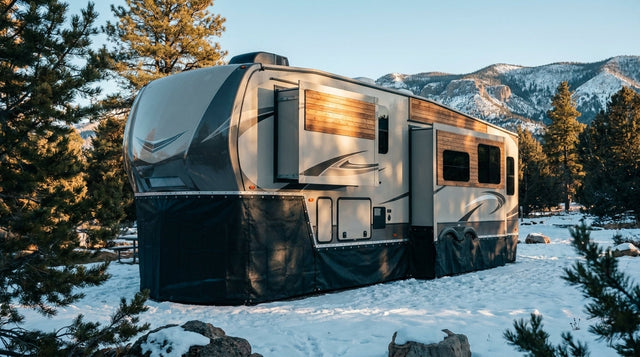
Also towed, but instead of a bumper hitch it connects to a hitch in the bed of a pickup through a raised, forward section — the gooseneck — that overhangs the truck. That stepped-up nose is the giveaway, and it is the one type that skirts a little differently: the raised front is closed with a separate hitch-enclosure kit. See fifth-wheel skirting →
Motorhomes: they drive themselves
All three motorhome classes have their own engine. The class refers only to the chassis underneath, which is exactly why the front end tells you which is which.
Class A

The big one. A Class A is built on a heavy bus or truck chassis with a tall, flat, vertical front and a large windshield — you walk straight through from the driver's seat into the living space. If it looks like a tour bus, it is a Class A.
Class B

The smallest motorhome, and the one people mislabel most. A Class B is a camper built inside a single van body (think Sprinter, ProMaster, or Transit), often with a raised high-top roof but no bed over the cab and no box tacked on behind. If it still looks like one continuous van, it is a Class B. See Class B skirting →
Class C

The tell here is unmistakable: a Class C is built on a cutaway van or truck cab with a sleeping bunk that projects forward over the cab. That over-cab overhang is the single feature that separates it from a Class B.
Park model: a home that happens to be on a frame

A park model RV looks less like a vehicle and more like a small cabin: residential siding, a pitched roof with eaves, house windows and a real door, sitting low on a frame it rarely leaves. Because it stays put seasonally, it is one of the best skirting candidates of all — a sealed perimeter turns the open space beneath it into a warm, still pocket. See tiny-home & park model skirting →
The class is not a ranking. It is a chassis. Read the front end and the rest falls into place.
What your type means for skirting
Here is the practical payoff. For skirting, almost every type behaves the same: you wrap the full length of the flat sides to the ground and seal the still-air pocket underneath, which is how skirting keeps the cold out. The one exception is the fifth-wheel, whose raised gooseneck is closed with a separate front enclosure. A Class C's cab-over sits high above the ground, so it never factors in — you skirt the footprint below it. And because EZ-Snap® cuts to size with household scissors and snaps on with patented no-drill studs, the same kit adapts to any of these shapes; you are only ever changing the measurements, not the method.
Sizing is driven by your rig's length, not its class — so once you know your type, the builder does the rest. Build your RV skirting kit →, pick your type from the list, and we will size it to your rig.
Sources
- The RV Industry Association's consumer resource defines the standard motorhome classes (A, B, and C) and the towable categories (travel trailer, fifth-wheel, and park model) referenced throughout this guide. Go RVing (RV Industry Association) — Explore RV Types →