RV Pipes Freezing? Why It Happens at the Underbelly First

Key Takeaways
- RV plumbing lives in the underbelly below the heated floor, so it freezes there first — long before cabin air gets cold.
- DOE notes uninsulated pipes rely on the heating system and can start freezing around 20°F.
- Skirting works as an air barrier, not insulation: it traps a sealed still-air pocket under the rig, so it carries no R-value.
- EZ-Snap® skirting installs no-drill at your own pace and can cut heating and propane use up to 40%.
If you searched RV pipes freezing at 11 p.m. with a space heater roaring and a faucet that won't run, here's the part nobody tells you: the problem almost never starts where you're looking. It starts underneath you—at the underbelly—hours before the tap goes dry.
Understanding why the cold wins down there first is the difference between mopping up a split line in February and never thinking about it again. This is a prevention story, not a repair one—the same logic behind keeping the cold out so pipes don't freeze in the first place.
Why RV pipes freeze at the underbelly first
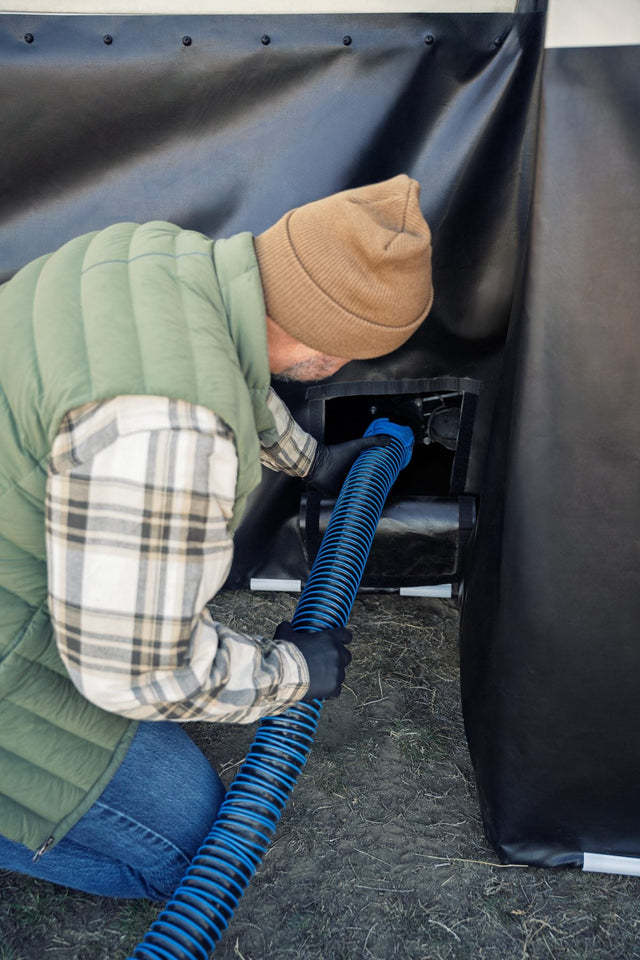
RV pipes freeze at the underbelly first because your fresh-water lines, tanks, and low points all sit in the belly of the rig—below the heated floor and exposed to wind on every side. That still, thin-walled water reaches 32°F long before the cabin air you're heating does, so the plumbing freezes while the inside still feels warm.
The heated floor is the boundary, not a blanket—everything below it sits outside the space your furnace is actually warming. That's the coldest real estate you own in winter, and it's exposed on every side that matters.
Most RV plumbing isn't insulated on its own—it leans on the rig's heating system to stay warm, and the U.S. Department of Energy notes that uninsulated pipes can start freezing once temperatures reach about 20°F.1
Three things gang up on it at once:
- Wind. An RV sits on wheels, which means a continuous gap of moving air runs the entire length of the underbelly. Wind doesn't just chill the coroplast—it strips away any warmth your furnace bleeds downward, replacing it with whatever the night is serving.
- Ground radiance. Frozen earth and a concrete or gravel pad act like a heat sink, pulling warmth out of the floor from below.
- Mass and stillness. Water in a tank or a dead-leg line isn't moving. Still water in a thin, exposed plastic line is the first thing to reach 32°F—long before the cabin air you're heating ever does.
So when you feel the cabin is warm and assume the plumbing is fine, you're reading the wrong thermometer. The underbelly is running its own private winter.

The mechanism that actually stops freezing
Once you see the underbelly as the battleground, the fix gets obvious. You don't need to out-heat the entire outdoors. You need to stop the air from moving under the rig—exactly what sealing the gap under the rig is built to do.
That's what skirting does. By enclosing the perimeter from the bottom of the coach to the ground, you trap a pocket of still air around the underbelly and cut the heat loss through the floor of the rig.2 Still air is a poor conductor—it's the same principle as a double-pane window or a sleeping bag. The ground beneath a skirted rig sits well above freezing thanks to stored warmth, and the enclosed pocket holds that heat in place instead of letting the wind scrub it away.
You're not trying to heat the great outdoors. You're trying to stop the wind from stealing the warmth that's already there—and that single move is what keeps a fresh-water line liquid at 2 a.m.
This is why skirting doesn't carry an R-value the way wall insulation does. It isn't a thick insulating blanket—it's an air barrier. The sealed, still-air pocket is the mechanism: a consistent thermal boundary around the underbelly that holds enough warmth to keep the plumbing from freezing.3 Add a small heat source inside that pocket on the worst nights and the underbelly stays comfortably above the freeze line while your neighbor's unprotected lines are splitting.

What the prevention setup actually looks like
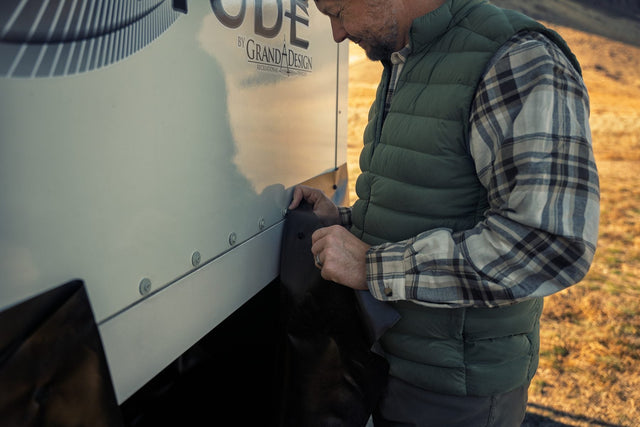
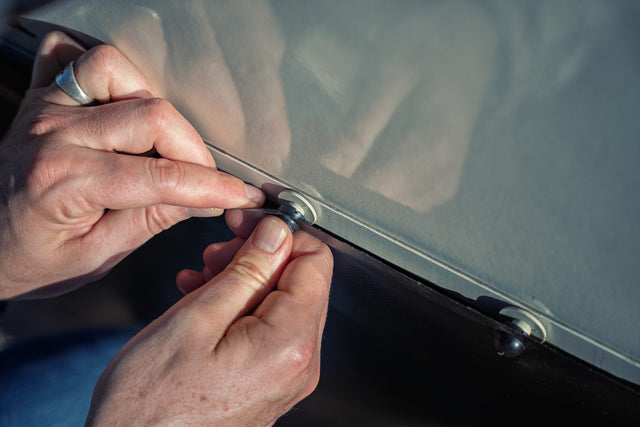
The EZ-Snap skirting system is built for exactly this problem. The Diamond Weave™ fabric is built for extreme cold, so it holds up through a real winter and stows for summer. It attaches with a patented no-drill Cap & Pin fastener and 3M™ VHB adhesive that bonds to fiberglass, aluminum, vinyl, and gelcoat—a no-drill way to winterize without holes in your rig. You install it yourself with household scissors — no drilling, at your own pace, roughly 60 seconds per stud.
The payoff isn't only frozen-pipe insurance. By cutting the wind under your rig, skirting can reduce heating and propane use up to 40%—so the system that protects your plumbing is also trimming the bill that drove you to research this in the first place.
One winter note worth flagging: VHB needs about 60°F to cure properly, so if you're already in the cold, plan on Screw or Combo studs instead of waiting on adhesive.
The honest takeaway
A frozen pipe is a repair. A wind-blocked underbelly is a prevention. EZ-Snap has been shipping this system factory-direct since 2006 to more than 38,000 customers, backed by a Limited Lifetime materials warranty—and skirting kits run $899–$2,099 depending on your rig.
If you found this page because something already froze, the move now is to make sure next winter never gets the chance. When you're ready, you can build your RV skirting kit to fit your exact coach.
Sources
- Southern states generally start having issues with frozen pipes when the temperature reaches about 20 degrees Fahrenheit; bathroom and kitchen pipes are generally not insulated and rely on the heating system to keep warm. U.S. Department of Energy (Energy Saver), 2024 ↗
- DOE lists "Install insulated skirting" and "Add insulation to the belly" among the energy-efficiency improvements that substantially reduce heat loss in manufactured homes; it also recommends air sealing openings around plumbing and ducts. U.S. Department of Energy (Energy Saver), 2024 ↗
- DOE/NREL Weatherization job aid 15-1 directs installers to fill the entire belly cavity to the prescribed R-value 'while ensuring plumbing has sufficient insulation value to prevent condensation or freezing,' creating a 'consistent thermal boundary between conditioned and unconditioned space,' and to reinstall any removed skirting. U.S. Department of Energy / National Renewable Energy Laboratory (Weatherization Assistance Program, Job Aid 15-1), 2024 ↗