RV Skirt vs. Real Skirting: What the Term Actually Means

Key Takeaways
- An RV skirt and RV skirting are the same thing: a sealed barrier that stops wind under your rig.
- Skirting works by trapping a wind-protected pocket of still air, not by adding R-value — so fit matters more than fabric thickness.
- A properly sealed skirt can cut winter heating and propane use up to 40%.
- EZ Snap installs with no drilling — patented Cap & Pin studs on 3M VHB, cut to fit with scissors at your own pace.
Short answer: an RV skirt and RV skirting are the same thing — a barrier that seals the open gap between your rig and the ground so the cold can't get underneath. The word changes; the job doesn't.
If you've spent any time in a winter-camping forum, you've seen both terms used interchangeably, plus a few cousins: "RV underbelly cover," "trailer skirt," "winter wrap." None of them are wrong. But the casual phrasing hides a real distinction — between a tarp you tucked under the frame and a system engineered to hold a sealed pocket of still air. That difference is the whole point of this post.
What "RV skirt" actually means
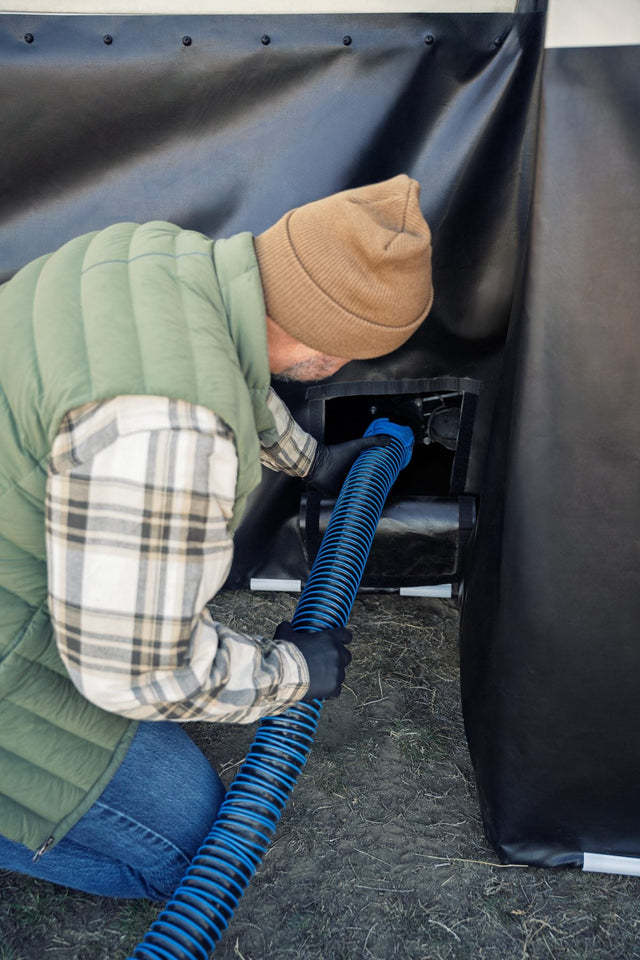
An RV skirt is the panel of material that runs from the body of your rig down to the ground, all the way around the perimeter. Its job is not to add insulation in the way a wall does. Its job is to trap a layer of still air underneath your coach. That trapped pocket — protected from wind — stays dramatically warmer than the open air outside, and it's the difference that keeps your holding tanks, water lines, and underbelly out of the deep freeze.1
This is why a true skirt doesn't need a published R-value, and why anyone quoting one is misreading the mechanism. Skirting works the same way a dead-air gap in a double-pane window works: it's the still air doing the insulating, not the panel itself, forming a consistent thermal boundary between the conditioned underbelly and the unconditioned outside that helps keep plumbing from freezing.2 Stop the wind, hold the pocket, and the ground's own residual warmth does a lot of the heavy lifting.

"Real skirting" vs. the tarp you've been told to use
Here's where the term earns its keep. Plenty of owners hear "RV skirt" and picture a blue tarp, some bungees, and a row of bricks. That'll block some wind, but it leaves gaps, flaps in a storm, and tears by February. The pocket leaks, and so does your propane budget. The same goes for the foam-board route — it looks solid the first season, but an honest accounting of what it costs by the third winter tells a different story.
"Real skirting" means a fitted, sealed system that holds the air pocket continuously — no gaps at the corners, no billowing on the windward side. The payoff is measurable: a properly sealed skirt can cut heating and propane use up to 40% over a winter. That's the number that turns a skirt from a nice-to-have into the thing that pays for itself before spring.
| Option | Stops wind / holds air pocket | No-drill install | Removable | Relative cost |
|---|---|---|---|---|
| Blue tarp + bungees | Partial — leaks at gaps | Yes | Yes | $ |
| Foam board panels | Yes, when sealed | Yes | Limited — brittle, breaks down | $$ |
| Built wood frame | Yes | No — drilling/framing | No | $$$ |
| EZ Snap® sealed Diamond Weave™ panels | Yes — continuous seal | Yes | Yes | $$ |
Want to see how the sealed-panel option lines up against the rest? Compare the sealed RV skirting kits side by side.
A skirt isn't insulation you bolt on. It's a wind-proof seal that lets a pocket of still air do the insulating — which is exactly why the fit matters more than the fabric's thickness.
How a snap-on RV skirt actually attaches
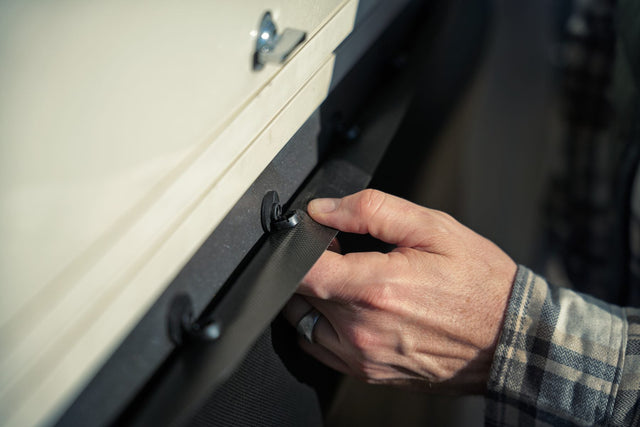
The old objection to "real" skirting was the install: drilling into your rig, building wood frames, or paying a shop. EZ Snap® was built to kill that objection with a no-drill approach that puts no holes in your rig. The system uses a patented no-drill Cap & Pin stud backed by 3M™ VHB adhesive — the same industrial bonding tape used in architectural and automotive work. It bonds to fiberglass, aluminum, vinyl, gelcoat, and glass, so there are no holes in your coach.
- No drilling. Studs adhere to the body. Each one takes about 60 seconds to place.
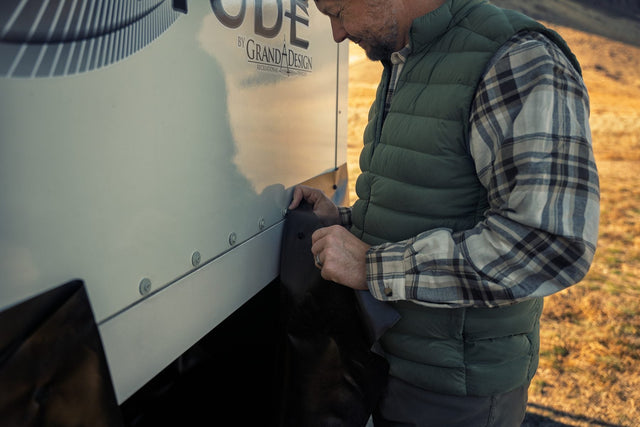
- Cut to fit on site. You trim the fabric with household scissors — no special tools, no drilling, and you work at your own pace.
- Removable, but the studs stay. Pull the panels off in spring; the studs stay put for next winter. Setup gets faster every year.
The fabric itself is Diamond Weave™, built for extreme cold — engineered to take a real winter and a hot installation season without going brittle.

One timing note before you order
If you're skirting in the cold, plan the adhesive step carefully. The 3M™ VHB needs roughly 60°F to cure and reaches full strength in about 72 hours. For a genuine winter install — studs going on when it's already freezing — use the Screw or Combo studs instead of relying on VHB alone. The smart move is to do the prep in the fall, during the pre-season ramp, while it's still warm enough to bond.
So, do you need a "skirt" or "skirting"?
Both. They're the same answer to the same problem: stopping the wind under your rig before it freezes your lines and drains your propane. The only real question is whether you get a tarp that fails by midwinter or a sealed system that holds the pocket and keeps paying you back — backed by factory-direct pricing since 2006, a Limited Lifetime materials warranty, and 38,000+ owners who've already done it.
When you're ready to spec one to your exact rig — band height, length, and color — build your RV skirting kit and see what the sealed-pocket approach looks like for your coach.
Sources
- DOE lists "Install insulated skirting" and "Add insulation to the belly" among the energy-efficiency improvements that substantially reduce heat loss in manufactured homes; it also recommends air sealing openings around plumbing and ducts. U.S. Department of Energy (Energy Saver), 2024 ↗
- DOE/NREL Weatherization job aid 15-1 directs installers to fill the entire belly cavity to the prescribed R-value 'while ensuring plumbing has sufficient insulation value to prevent condensation or freezing,' creating a 'consistent thermal boundary between conditioned and unconditioned space,' and to reinstall any removed skirting. U.S. Department of Energy / National Renewable Energy Laboratory (Weatherization Assistance Program, Job Aid 15-1), 2024 ↗