Bay & Bow Window Shades: Cooling Multi-Panel Windows From the Outside

Key Takeaways
- Bay and bow windows catch direct sun across multiple angled panels throughout the day, making them one of the hottest spots in a home; exterior shading addresses the heat at the source.
- Exterior shades are the most effective way to cut solar heat gain because they block sunlight before it passes through the glass, while interior blinds act only after the heat is already inside.
- EZ-Snap®'s black Optical Grade Thermo-Weave mesh blocks up to 90% of solar heat gain while preserving the view, and exterior solar screens can block up to that share before light reaches the window.
- The EZ-Snap Sun Screen installs panel-by-panel with a patented no-drill Cap & Pin snap and 3M VHB tape, cuts to any window shape with scissors, and goes up in an afternoon without drilling into trim or cladding.
- Windows account for roughly 25-30% of residential heating and cooling energy use, so reducing solar heat gain on a multi-panel bay directly lightens the summer cooling load.
Stand inside a bay window on a July afternoon and you can feel the geometry working against you. Where a flat window faces the sun for part of the day, a bay or bow catches it in stages — one panel at dawn, the center at noon, the third as the light swings west — so the heat never really lets up. That curved wall of glass is the prettiest seat in the house and, in summer, often the hottest.
It is a comfort problem and an energy problem at the same time. The good news is that the fix is well understood, and it happens on the outside of the glass, not the inside.
Why bay and bow windows run so hot
A standard window is a single plane pointed in one direction. A bay window steps out from the wall in three angled sections; a bow window curves through four, five, or six. Each panel faces the sky at a slightly different bearing, which means that across a single afternoon, the sun finds a near-perpendicular shot at one section after another. The projection also exposes more glass to open sky than a flush window of the same footprint. More glass, more angles, more hours of direct strike.
That matters because glass is the thermal weak point of almost any wall. Windows make up only a small share of a building's envelope area, yet researchers describe them as "the weakest link in the thermal envelopes," capable of accounting for a wildly disproportionate share of heat movement.6 The Department of Energy puts numbers on it: heat gain and loss through windows are responsible for 25 to 30 percent of residential heating and cooling energy use.4 Concentrate that into one multi-angled glass alcove and you have built yourself a small greenhouse.
The sun has to be stopped at the glass
Here is the part most people get backwards. Interior shades, blinds, and curtains feel like the obvious answer because that is the side of the window you can reach. But by the time sunlight hits an inside blind, it has already passed through the glass and become heat inside the room. The DOE's building-science lab is blunt about it: interior attachments "can be less effective at reducing heat gain than comparable exterior shading systems because they do not block direct sunlight until after it has already passed through the window."2
Exterior treatments intercept the light first. The Department of Energy names exterior shutters and shades as "most effective at reducing solar heat gain."1 And the upside is large: depending on the material, exterior solar screens can block up to 90 percent of solar heat gain before it ever reaches the window.3 If you want the full logic behind that, our guide to shading windows from the outside walks through why the order of operations matters so much.
Shade the glass from the inside and you are mopping the floor with the tap still running. Shade it from the outside and you turn the tap off.
This is why exterior coverage is the whole premise of our Exterior Shades line. The job is to catch the sun in the air, before it becomes a problem you have to air-condition away.
Wrapping each panel: the multi-panel window sun shade approach
A bay or bow window is not one surface, it is several — which is exactly why a one-size curtain rod or a single rolling awning struggles with it. The EZ-Snap Sun Screen treats each panel as its own job. The mesh is our Optical Grade Thermo-Weave™, and it installs panel by panel so every angled section of the bay gets its own dedicated coverage. No section gets left in the sun because the geometry was awkward.
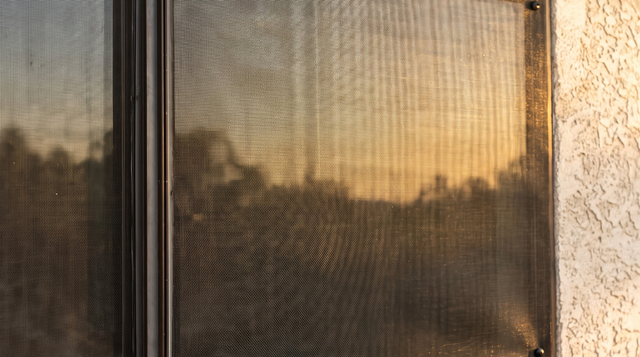
The material itself does the heavy lifting. Black Thermo-Weave™ mesh blocks up to 90 percent of solar heat while you still see through it to the yard. If you want a brighter room and are willing to trade away some of the heat rejection, the white mesh lets more light pass. Either way the weave is engineered to shade without turning your bay into a cave.
Cuts to any window shape
The reason this works for an exterior bay window shade specifically: the material cuts to any window shape with ordinary scissors and does not fray at the edge. A bay's trapezoidal side panels, a bow's gentle curve, the odd transom above — none of it requires a special-order size. You measure, you cut, you fit. The same flexibility is what lets the system handle arched and curved openings and even triangular gable windows elsewhere in the house. Our shades for arched and curved windows collection is built for exactly those openings.
How it stays on without a single drill hole
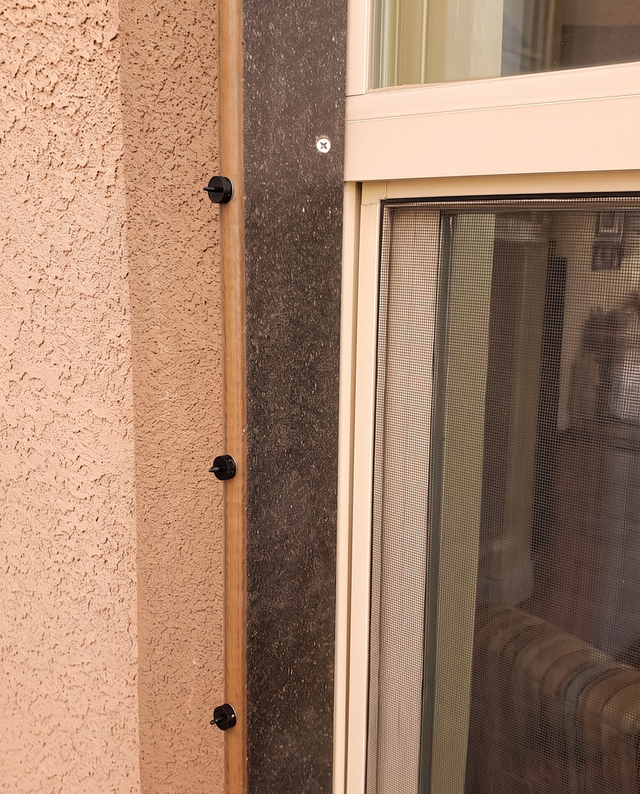
Bay and bow windows are often trimmed in fine woodwork or wrapped in vinyl and aluminum cladding you really do not want to drill into. The EZ-Snap system avoids that entirely with a patented no-drill Cap & Pin fastener — a ratcheting snap secured by industrial 3M VHB tape rather than screws.7 The adhesive sets in about 60 seconds per stud, cures best around 60°F, and reaches full strength in roughly 72 hours. Most homeowners shade an entire bay in an afternoon with nothing more exotic than scissors.
If you would rather see the snap mechanism and adhesive sequence in motion before you commit, the how-it-works walkthrough lays out every step. And because the panels are surface-mounted rather than fastened into the frame, the screens come off cleanly when you want the unobstructed winter view back.
What you actually get back
The honest framing is energy and comfort. Solar heat gain coefficient — the share of the sun's energy a window lets through and then re-releases as indoor heat — is the number that governs your summer cooling load.5 Knock that down at the glass and the air conditioner simply has less to fight on the sunniest face of the house, which on a bay is most of the house.
- Targeted coverage for every angle of a bay or bow, instead of one shade trying to cover three orientations.
- Up to 90% solar-heat rejection with the black mesh, while keeping the view out.3
- No drilling into trim, cladding, or that expensive bow-window woodwork.
- A clean removal when the cooling season ends.
EZ-Snap has been making no-drill exterior shading since 2006 and has served more than 38,000 customers, and the screen materials carry a Limited Lifetime warranty. Kits start at $66.95, with free shipping over $225. When you are ready, build your exterior window shade kit to fit each panel of the bay. Before you order, it is worth running through how to measure your windows for exterior shades so each panel comes out right the first time. And if you want to see the weave in hand first, you can order mesh samples to compare the black and white mesh before choosing. If your heat problem lives somewhere other than a bay — a wall of west glass, a sunroom, a glass-heavy RV — the same approach scales across the exterior shade lineup, including dedicated RV window shades. The geometry changes. The principle does not: stop the sun before it reaches the glass.
Sources
- "Exterior shutters and shades... are most effective at reducing solar heat gain." The page also states window awnings can reduce solar heat gain by up to 65% on south-facing windows and 77% on west-facing windows. U.S. Department of Energy (Energy Saver), 2024 ↗
- "Exterior window attachments block solar heat before it reaches the window." Interior attachments "can be less effective at reducing heat gain than comparable exterior shading systems because they do not block direct sunlight until after it has already passed through the window." DOE Building America Solution Center (Pacific Northwest National Laboratory), 2023 ↗
- "Depending on the material used, solar screens have the potential to block up to 90% of solar heat gain before it even reaches the window." U.S. Department of Energy, Office of Energy Efficiency & Renewable Energy (EERE), 2023 ↗
- "Heat gain and heat loss through windows are responsible for 25%-30% of residential heating and cooling energy use." U.S. Department of Energy — Energy Saver, 2024 ↗
- SHGC is "the fraction of solar radiation admitted through a window, door, or skylight — either transmitted directly and/or absorbed, and subsequently released as heat inside a home"; a low-SHGC product "is more effective at reducing cooling loads during the summer by blocking heat gain from the sun." U.S. Department of Energy — Energy Saver, 2024 ↗
- Windows "are known as the weakest link in the thermal envelopes" and are "attributable for approximately 10% of building energy use"; though only ~8% of envelope area, they can contribute "up to 45% of the envelope heat loss" in climate zones 4 and 5. Lawrence Berkeley National Laboratory — Windows & Daylighting, 2023 ↗
- U.S. Patent 8,032,994 B2, "Marking and fastening device and method of using same" (inventors Raymond J. Waddell & Dean A. Myrfield; originally assigned to EZ-Snap Products Inc), describes a male member with a projection plus a female member with an aperture forming a ratchet system that removably secures the female onto the male member to fasten covers without drilling. United States Patent and Trademark Office (via Google Patents), 2011 ↗
Common questions
Why do bay and bow windows get so hot in summer?
Bay and bow windows run hot because their multiple angled panels catch direct sun in stages across the day, so the heat rarely lets up. A bay steps out in three sections and a bow curves through four to six, exposing more glass to open sky than a flat window of the same footprint. Windows account for roughly 25 to 30 percent of a home's heating and cooling energy use.
Are exterior shades better than interior blinds for a bay window?
Yes. Exterior shades are the most effective way to cut solar heat gain because they block sunlight before it passes through the glass, while interior blinds act only after the heat is already inside the room. Depending on the material, exterior solar screens can block up to 90 percent of solar heat gain before it reaches the window.
How much heat can exterior mesh block on a bay window?
The black Optical Grade Thermo-Weave mesh blocks up to 90 percent of solar heat while you still see through it to the yard. A white mesh option lets more daylight in for a brighter room, trading away some of the heat rejection. You pick the color based on whether you want deeper cooling or a lighter interior.
Can exterior shades fit the odd angles of a bay or bow window?
Yes. The mesh cuts to any window shape with ordinary scissors and does not fray at the edge. Each panel is treated as its own job and installed panel by panel, so a bay's trapezoidal sides, a bow's curve, or an odd transom all get covered without special-order sizes. You measure, cut, and fit each section.
How do the shades attach without drilling into window trim?
They use a patented no-drill Cap and Pin snap secured with industrial 3M VHB tape instead of screws. The adhesive sets in about 60 seconds per stud, cures best around 60F, and reaches full strength in roughly 72 hours. Most homeowners shade an entire bay in an afternoon, and the surface-mounted panels come off cleanly when you want the winter view back.
How much do exterior bay window shade kits cost?
Kits start at $66.95, with free shipping on orders over $225. EZ-Snap has made no-drill exterior shading since 2006 and served more than 38,000 customers, and the mesh carries a Limited Lifetime materials warranty. You build the kit to fit each panel of the bay.